



Wyoming’s Frontier Stable Token (FRNT), the first stablecoin issued by a US state, is now available to the public following delays caused by lingering regulatory hurdles.
The state’s Governor Mark Gordon said on Wednesday that it is “the first fiat-backed, fully-reserved stable token to be issued by a public entity in the United States.”
He added that the token would provide “a cheaper, faster, and more transparent means of transacting,” and would be “another source of funding for our schools and can lower the taxpayer burden in our state.”
The token can be bought on the crypto exchange Kraken and is live on the Solana blockchain, but can be bridged to Arbitrum, Avalanche, Base, Ethereum, Optimism, and Polygon using the Stargate platform.
The stablecoin can also be bought through Rain, a Visa-powered, integrated card platform operating on the Avalanche blockchain.
A growing number of countries and banks have flagged plans to launch or adopt stablecoins as the success of such tokens has skyrocketed in the past year. The Bank of North Dakota has also announced plans in November to launch a state-issued token, the Roughrider coin, with the first test expected sometime this year.
Stablecoin aims to cut bank fees
FRNT was designed by the seven-member Wyoming Stable Token Commission and is intended for both individual and institutional use.
It is fully backed by US dollars and short-duration US Treasurys and the interest income generated by the reserves is returned to the state, the Governor’s office said.
Converse County Treasurer Joel Schell said that another key benefit of adopting FRNT is the lower fees associated with transfers compared to credit card processing costs.
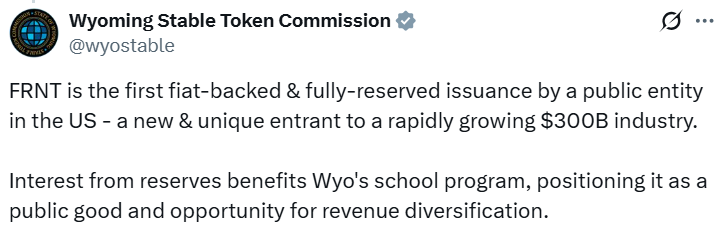
FRNT allows dollar-denominated peer-to-peer transactions with fast settlement times, round-the-clock availability, and fees of roughly $0.01.
Related: Solana’s stablecoin market cap surges by $900M in 24 hours
“The county is like any other business — we take credit cards, but we can’t raise registration fees and property taxes to absorb the processing costs, so we send those costs directly to the customers,” Schell said.
“Last year, my office took in about $3.4 million in credit card transactions, which cost our constituents about $70,000 in fees that our processors collected. We’re anxious to get out of that climate and to move into something else. Electronic payments, especially the stable token, would let us get more efficient.”
FRNT scaling throughout 2026
Wyoming’s Stable Token Commission plans to scale FRNT throughout 2026 by onboarding additional resale partners, deploying the token across other state agencies, and working with public entities interested in launching their own stablecoins.
The commission conducts quarterly assessments of new blockchains for potential FRNT deployment. Anthony Apollo, the commission’s executive director, said it looks forward to “scaling the program throughout 2026.”
“While we are working towards growing the supply of FRNT in circulation, we are also looking forward to utilizing the stable token as a tool to enhance government efficiency,” he added.
Magazine: How crypto laws changed in 2025 — and how they’ll change in 2026