


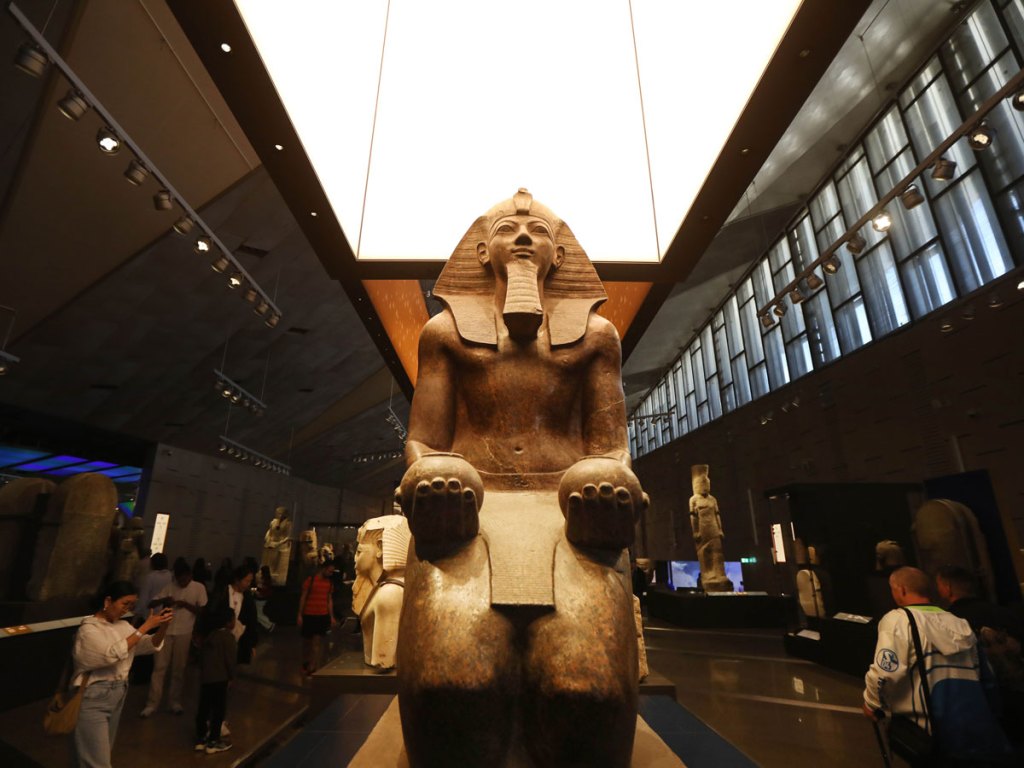
After more than a decade of anticipation, the Grand Egyptian Museum (GEM), the largest museum devoted to a single civilization, has fully opened its exhibitions, including the long-awaited King Tutankhamun halls.
Originally announced in 2002, the idea for the museum dates back to the 1990s, when Egypt began envisioning a new institution in Giza to relieve the strain on the aging Egyptian Museum in downtown Cairo. Construction began in 2005, but the path to completion faced setbacks from political upheavals, economic instability, and the logistical complexities of moving tens of thousands of fragile artifacts from across the country—and from abroad. The museum opened its doors in stages over the years: limited exhibitions, preview tours, and select events, including a visit from the British Royal Philharmonic.
The museum was officially inaugurated on November 1, in a ceremony attended by world leaders, with public access beginning on November 4—the 103rd anniversary of the discovery of Tutankhamun’s tomb. Twice the size of the Louvre, the vast complex is expected to draw between 13,000 and 15,000 visitors daily, according to Egypt’s Minister of Tourism & Antiquities Sherif Fathy.
Home to more than 100,000 artifacts, including several repatriated works never before shown in Egypt, the museum spans 7,000 years of history. Its 12 main galleries unfold chronologically, tracing the evolution of ancient Egyptian civilization from the Prehistoric and Early Dynastic eras through the Old, Middle, and New Kingdoms, the Late Period, and the Greek and Roman Era. The journey culminates with the artifacts of the Tutankhamun galleries, displayed as a complete collection for the first time since the discovery of his tomb in 1922.
For those wondering where to begin, ARTnews asked three experts—Zahi Hawass, Egypt’s former Minister of Antiquities and one of the world’s leading Egyptologists; Curtis Ryan, a documentarian and Egyptologist; and Hassan Elzawy, an archaeologist, Egyptologist, and former cataloguer at the Grand Egyptian Museum—to each select five objects as starting points for one’s journey through GEM.
-
The Statue of Ramses II
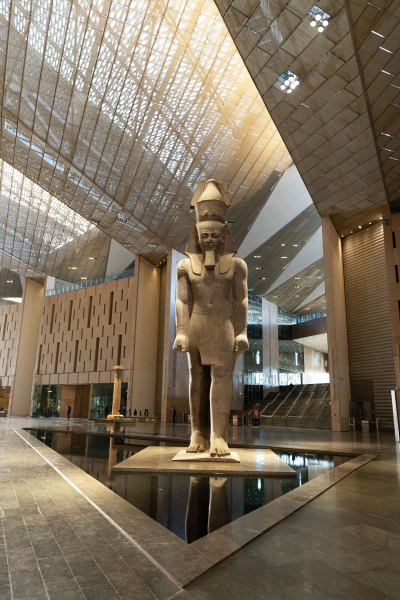
Image Credit: ©Grand Egyptian Museum Standing over 30 feet tall and weighing 82 tons, the pink granite statue of King Ramses II, the third pharaoh of Egypt’s 19th Dynasty, serves as GEM’s dramatic entrance hall centerpiece.
Ramses II led campaigns across the Levant, concluding the world’s earliest known peace treaty. Originally unearthed at Mit Rahina (ancient Memphis) in 1820, the statue was a Cairo landmark for decades before its relocation from Ramses Square to the grounds of the GEM in 2006 in a highly publicized nighttime operation to protect it from the city’s pollution and traffic. In 2018, it made its final journey into the museum’s atrium, becoming the first major installment.
-
The Solar Boat of Khufu
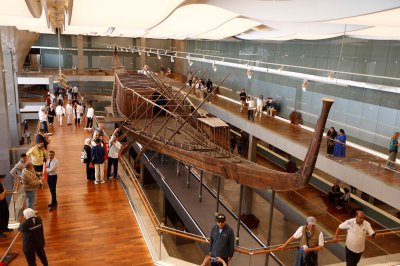
Image Credit: Ahmed Gomaa/Xinhua News Agency via Getty Ima Built for Pharaoh Khufu of the Fourth Dynasty, who commissioned the Great Pyramid of Giza, the Solar Boat is among the oldest vessels from antiquity on record. This full-size Lebanese cedar barque was sealed in a pit beside the Great Pyramid around 2500 BCE. Like other buried Egyptian boats, it was intended to carry the king’s spirit on his journey into the afterlife.
Hidden for over 4,000 years, it was rediscovered in 1954, when Egyptian archaeologists unearthed 1,224 wooden fragments, later painstakingly reassembled over years by master restorer Hag Ahmed Youssef Moustafa. It has been reported that the ship’s construction was so precise, it could theoretically still sail the Nile today.
-
The Collection of Queen Hetepheres I, Including Her Headrest
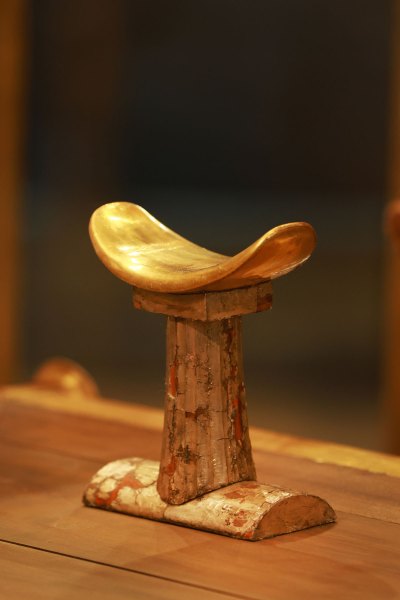
Image Credit: Courtesy Ahmed Maatouk Discovered in 1925 near the Great Pyramid, the tomb of Queen Hetepheres I, mother of Pharaoh Khufu, offers a glimpse into luxurious and royal life of the 4th Dynasty, known for its architectural marvels such as the Great Pyramids and the Sphinx.
Among the treasures uncovered was her headrest, crafted of wood, gold, and silver. In Ancient Egypt, headrests were essential for sleep in both life and death, designed to support the head, promote circulation in the heat, and in the afterlife, support the deceased during resurrection.
The discovered collection also contained an alabaster sarcophagus (found empty), a bed, carrying-chair, and jewelry box. Overshadowed by the global frenzy around Tutankhamun’s tomb, the discovery drew little attention at the time. Nearly a century later, the Hetepheres collection is known as a remarkable record of early dynastic sleep rituals.
-
King Tut’s Dagger
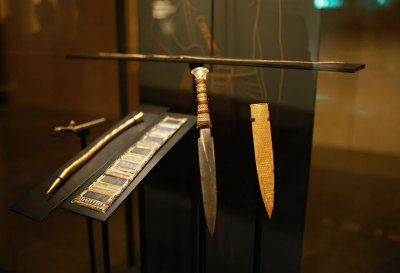
Image Credit: Courtesy Ahmed Maatouk Of the more than 5,000 objects from Tutankhamun’s tomb, the young king’s dagger has long captivated—and puzzled—researchers. The iron dagger, found strapped to the right thigh of King Tut, was made of iron at a time when smelting the metal was unknown.
Dating to the 14th century BCE, its composition—iron with nickel and trace cobalt—has led archeologists to conclude it came from a meteorite, earning it the name “iron from the sky” by Egyptians of the era, who likely recognized its extraordinary significance. The dagger’s craftsmanship and origin continue to intrigue scholars still trying to understand the production skills of the Ancient Egyptians.
-
Tutankhamun’s Throne
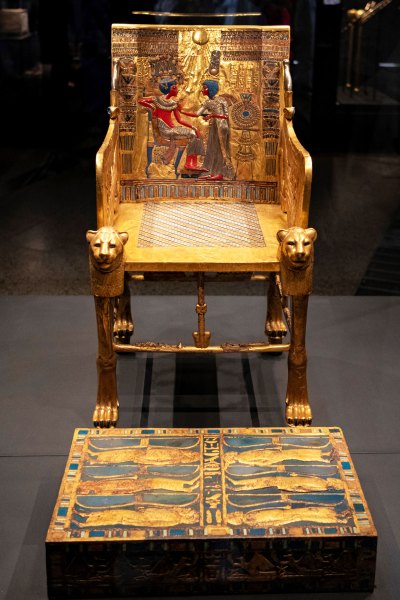
Image Credit: Xin Mengchen/Xinhua News Agency via Getty Ima Gilded with gold and inlaid with glass and semiprecious stones, Tutankhamun’s throne remains one of the most iconic symbols of ancient Egyptian design.
Discovered in 1922 in the Valley of the Kings, the throne shows the immense status and authority of the Egyptian crown. On its back panel, Tutankhamun is shown seated, with his wife, Ankhesenamun, reaching out to rub oil across his shoulder, a sign of the pharaoh’s tender and humanistic side while maintaining his godlike status. Dating to the late 18th Dynasty, the piece has become a defining image of the boy-king, whose brief reign endures as a symbol of how divine power was immortalized during the New Kingdom.
-
The Stele of Revealing
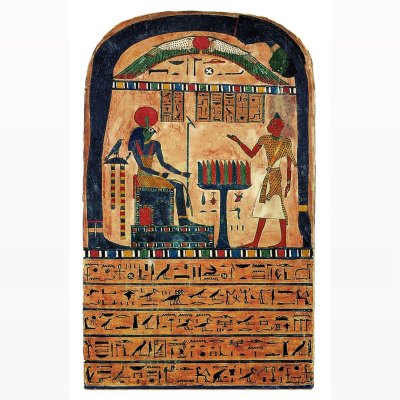
Image Credit: Via Wikimedia Commons Dating back to the Late Period, this painted wooden tablet was made for the Montu priest Ankhefenkhonsu. The stele shows the priest presenting offerings to the solar god Ra-Horakhty, the syncretic form of deities Horus and Ra.
Millennia later, the object gained unlikely fame when the British occultist and magician Aleister Crowley encountered it at the Egyptian Museum in Cairo in 1904, claiming to receive a mystical revelation that would become the foundation of his modern religion Thelema.
-
Greco-Roman Relief Depicting the Abduction of Persephone

Image Credit: Curtis Ryan This limestone relief shows Hades abducting Persephone, who is greeted by Anubis in a fascinating fusion of Greek and Egyptian mythology. The artifact reflects a period of religious syncretism, when Greek settlers in Egypt came to view deities such as Hades and Osiris as counterparts, interpreting the foreign gods through familiar stories and attributes.
This merging of belief systems developed through periods of contact between the two ancient nations, with this plaque offering a glimpse into how shared religious beliefs led to the development of a hybrid iconography.
-
Wig Stand in the Form of a Woman’s Head
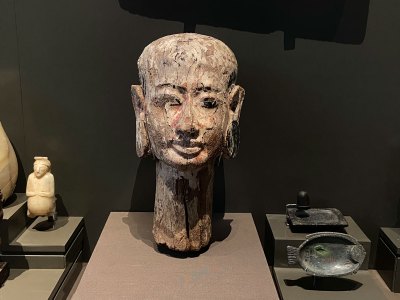
Image Credit: Curtis Ryan This wig stand is carved in the shape of a woman’s head with large earrings. The artifact offers a window into the cosmetic practices of the time, where wigs played a significant role in culture and identity.
Wigs, worn across social classes and genders, were also strong indicators of a person’s class, age, and authority. For example, wigs made of human hair were typically worn by the elite. While much of what is known about hair comes from burial practices, this stand reveals their significance in daily life and personal expression.
-
Gold Death Mask of Hekaemsaf
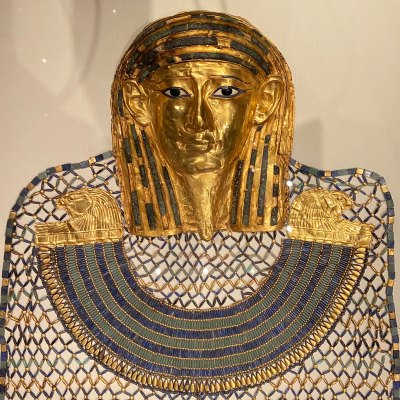
Image Credit: Curtis Ryan In ancient Egypt, masks were both protective and symbolic, helping the soul recognize its body in the afterlife. This gold funerary mask belonged to Hekaemsaf, Overseer of the Royal Boats under Pharaoh Amasis II from the 26th Dynasty, otherwise called the Late Period.
The mask consists of a hammered gold sheet, with eyes crafted from feldspar, obsidian pupils, and eyelids and eyebrows made of lapis lazuli, set to suggest a lifelike appearance while signaling both divine protection as well as the wearer’s rank.
-
Triad Statue of Ramesses II
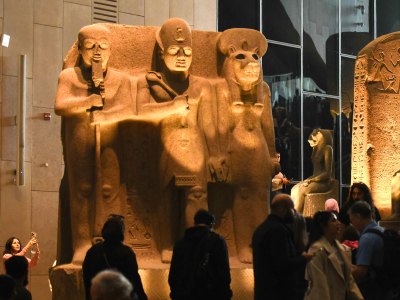
Image Credit: Sayed Hassan/Getty Images This red-granite triad, dating to the 19th Dynasty (ca. 1279–1213 BCE), depicts Ramesses II between Ptah, creator god of Memphis, and Sekhmet, the lioness goddess of war and healing. Originally found in the Great Temple of Ptah at Heracleopolis Magna (modern-day Ihnasya el-Medina), the statue shows the king literally framed by divine power. By positioning Ramesses between Ptah and Sekhmet, the sculpture visually conveys that he is both protected by and in partnership with the gods, reinforcing his authority.
Now displayed on the museum’s grand staircase, it emphasizes the pharaoh’s role in upholding Ma’at—the principle of cosmic order, balance, and harmony.
-
Statuette of Two Women Making Beer
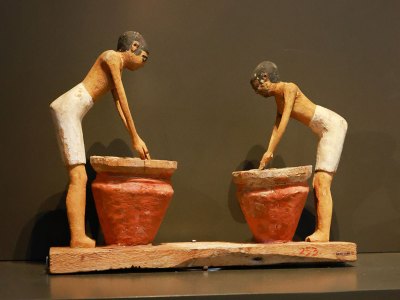
Image Credit: Costa Beavin Pappas for ARTnews This painted wooden statuette from the Old Kingdom depicts two female servants straining mash into large jars in order to brew beer. The model offers a window into Ancient Egyptian society, where beer was a staple across social classes.
Beer was brewed each day due to its short shelf life, establishing it as an important part of daily routines—intended for enjoyment as well as calories and hydration. Workers on state projects, including pyramid builders, were even compensated with rations of beer throughout the day. Discovered in the tomb of Niankhpepikem as part of his grave goods, the statuette suggests beer was so valued that it was included in tombs for enjoyment in the afterlife.
-
Khafre Enthroned

Image Credit: Courtesy Egyptian Museum of Cairo Seated on a throne, Pharaoh Khafre from the Fourth Dynasty gazes forward as the falcon god Horus shelters his head. He wears a nemes headdress, only worn by royalty. Lotus and papyrus motifs—the Sema Tawy symbol of unity— are shown on his throne, symbolizing the unification of Upper and Lower Egypt. Remarkably, the statue was carved from anorthosite gneiss, an especially adamantine green stone found only in a remote part of the Sahara Desert.
This ka statue was created to house Khafre’s ka, or “life force.” In ancient belief, the ka needed a physical home; if the mummy was damaged, the ka statue served as a substitute.
-
Tell El-Farkha Statuettes
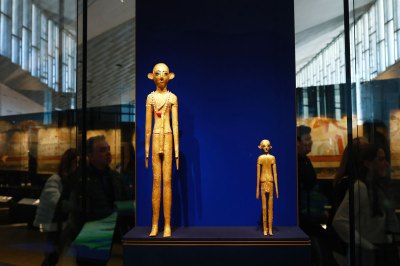
Image Credit: Courtesy Ahmed Maatouk These gold-covered figurines, dating to the Naqada IIIB period (ca. 3350–2920 BCE), are considered the oldest known depictions of Ancient Egyptian rulers at over 5,000 years old. Originally made over a wooden core, they are known for their signature piercing eyes outlined in lapis lazuli, giving them a fierce stare.
The lapis lazuli was highly valued and imported from as far away as what is now Afghanistan. The taller figure stands at nearly 2 feet, the smaller at around 12 inches, suggesting a ruler and heir. The materials reveal the trade networks, wealth, and status of Delta elites.
-
Statue of Menkaure
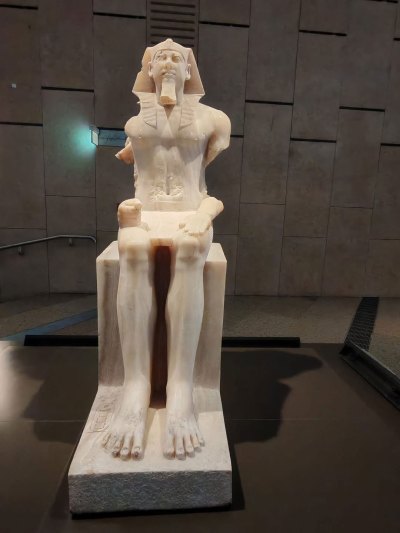
Image Credit: Courtesy Mosaic Club This statue depicts Pharaoh Menkaure, builder of the smallest of the Giza pyramids. Created during the Fourth Dynasty, he is shown with large hands, long legs, large feet, and a strong, muscular body—an idealized form during the era.
The statue was placed in his valley temple, which was never completed, alongside other statues intended for the site.
-
Gold and Silver Dandera Statue of Horus
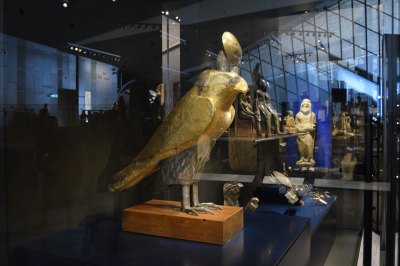
Image Credit: Curtis Ryan This striking statue depicts Horus, a god in the form of a falcon, crowned with a large golden sun disk. Likely hidden by temple priests to protect it from thieves, the piece was part of the Dendera treasure hoard—a remarkable cache of statuettes, jewelry, ritual instruments, and mirrors discovered in the early 20th century within and around the Dendera Temple.
The statue is now displayed alongside other finds from the discovery.