



The art world spent much of 2025 not unveiling masterpieces but unsealing court documents, as if the industry had drifted into a year-long deposition. What began as the usual background hum of disputes swelled into something grander: collectors accusing advisers, advisers suing one another, estates defending colors, sneaker companies parsing securities law, and even a SoHo garden insisting—quite earnestly—that it is a work of art entitled to federal protection. It was a year in which everyone, from billionaires to anonymous artists, seemed determined to prove that the only medium more enduring than bronze is litigation.
Part of the spectacle—if one can call it that—was the dizzying range of conflicts. Some were baroque financial dramas in which auction houses behaved more like investment banks than cultural institutions. Others rose from the sediment of decades-old handshake deals and foggy memories involving motorcycles and Malibu property. Threading through all of them was a single contradiction the art world can no longer ignore: a market built on secrecy that now finds itself hauled, blinking, into the fluorescent glare of legal scrutiny. If 2025 had a mood, it was the realization that discretion is no defense against a motivated plaintiff.
What follows is a thematically organized tour through the year’s dozen most revealing lawsuits—cases that together map the pressure points of a field undergoing a reluctant reckoning. The picture that emerges is of an industry discovering, with mounting discomfort, that mystique is a poor substitute for governance.
-
Market Mechanics: Billionaire Jan Koum’s Suit Pulls Acquavella, Nahmad Contemporary, and Perrotin into Discovery

Image Credit: Photo David Ramos/Getty Images When WhatsApp cofounder Jan Koum accused interior designer Rémi Tessier in October of inflating invoices and pocketing improper commissions, the lawsuit quickly expanded beyond décor. Tessier’s dealings with major galleries—Acquavella, Nahmad Contemporary, and Perrotin—became central to Koum’s claim that the designer used legitimate art purchases to pad bills for unsuspecting clients.
The galleries, none of which are accused of wrongdoing, objected to sweeping discovery requests they say would expose confidential pricing structures and internal negotiations. Their pushback is understandable: few industries rely as heavily on discretion as the gallery world.
Yet the case raises an uncomfortable question: when billionaires litigate, how private can the art market remain? Depending on how the court rules, 2025 may be remembered as the year clients began prying open the black box.
-
Market Mechanics: Art Advisers Barbara Guggenheim and Abigail Asher Sue Each Other

Image Credit: Photo Gregg DeGuire/WireImage For an industry that prides itself on discretion, nothing was more startling this year than watching two A-list advisers—Barbara Guggenheim and Abigail Asher—air decades of grievances in dueling lawsuits. Guggenheim claims Asher diverted clients and funds; Asher counters that Guggenheim torpedoed professional relationships and smeared her reputation.
Advisers typically operate in the genteel gray zone between confidant and broker, and the profession’s currency is trust. When that trust breaks down, the results are spectacularly unseemly.
The case has become an inadvertent tutorial on how advisers actually work: on relationships, not rules. Going forward, expect far fewer handshake agreements—and far more paperwork.
-
Market Mechanics: Jacob ‘Jacqui’ Safra Sues Christie’s for Bad Faith in a $100 M. Consignment

Image Credit: PA Images via Getty Images In January, Swiss financier Jacqui Safra launched an unusually sweeping attack on Christie’s, accusing the house of mishandling a $100 million consignment that included Old Masters, antiques, and a trove of Einstein love letters. He claims the auction house failed to market the works properly, botched attributions, delayed applying proceeds, and wrongly declared him in default on a $63 million advance.
Christie’s insists it followed the contract to the letter. Yet the allegations hit at the heart of the modern auction model, where houses play lender, marketer, expert, and seller simultaneously—a bundle of roles that works beautifully until it doesn’t.
The case may force courts to define where fiduciary duty ends and commercial discretion begins. For consignors—and auction houses accustomed to wide latitude—that line matters.
-
Authenticity and Attribution: Pace Faces Suit Over Louise Nevelson Sculpture Pulled From Sotheby’s
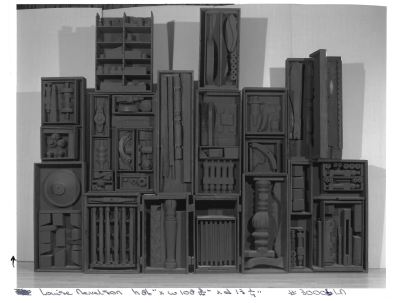
Image Credit: Court documents/Beloff Complaint
When a Nevelson sculpture was abruptly withdrawn from Sotheby’s in 2022 after Pace raised concerns about its authenticity, the estate of collector Hardie Beloff accused the gallery of sabotaging the sale. Most claims were dismissed, but a key one—wrongful interference—survived, keeping the gallery in the legal spotlight.Because Pace has long shaped Nevelson’s market, its doubts carry unusual weight. That influence is now part of the dispute: when does due diligence become overreach? The surviving claim, which has yet to be settled, ensures the art world will continue scrutinizing how much power major galleries wield when they whisper a single, dangerous word: questionable.
-
Authenticity and Attribution: Phillips Sues David Mimran Over Unpaid $14.5 M. Pollock Guarantee

Image Credit: WireImage In July, Phillips alleged that film producer David Mimran failed to honor a third-party guarantee for a Pollock that sold in 2024. According to the complaint, Mimran acknowledged the debt, asked for time, and then declared he could not pay. The auction house is seeking nearly $15 million with interest.
Third-party guarantees now underwrite a significant portion of evening auctions, and they rely on a delicate combination of bravado and liquidity. When either falters, the entire system wobbles.
Mimran told the press he simply intended to “buy it a little late.” Phillips disagrees. The courts will decide whether such lateness is a privilege or a breach.
-
Authenticity and Attribution: Steve McQueen’s Granddaughter Sues for Return of a $68 M. Pollock

Image Credit: Photo Silver Screen Collection/Getty Images In one of the year’s most cinematic disputes, Molly McQueen sued to recover a Jackson Pollock drip painting she says belonged to her grandfather. In the complaint, McQueen claims that Steve McQueen traded the work “in anticipated exchange for a motorcycle and Latigo Canyon property. However, one of the Borcherts crashed the motorcycle and the property never changed title.”
The Borchert family maintains the arrangement was informal, distant, and possibly apocryphal. Memories dating to the 1970s do not always make compelling legal evidence. Still, the case highlights a truth the market prefers to ignore: some of the most valuable works circulating today were acquired in a world far looser, hazier, and less documented than the one we now inhabit.
-
Provenance and Restituion: Czech Claimant Sues Christie’s for Information on Nazi-Looted Schieles
Image Credit: Photo Roy Rochlin/Getty Images Miloš Vávra sued Christie’s in New York seeking the locations of two Schieles connected to the Grünbaum collection, arguing that auction-house nondisclosure agreements prevent him from filing restitution claims before the Holocaust Expropriated Art Recovery Act expires in 2026.
Auction houses consider confidentiality a core obligation; heirs consider it a stone wall. The case pits these principles against each other with unusual clarity. With the HEAR Act’s sunset approaching, Vávra’s suit could accelerate a broader reckoning: secrecy and restitution are, by definition, incompatible.
-
Provenance and Restitution: Collector Sasan Ghandehari Sues Christie’s Over Picasso Once Owned by Convicted Smuggler
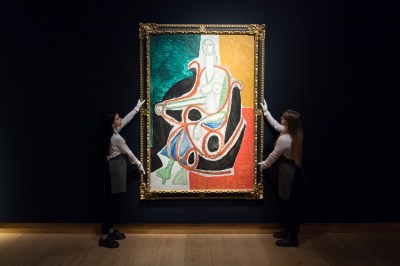
Image Credit: Photo Wiktor Szymanowicz/Future Publishing via Getty Images Ghandehari, whose firm guaranteed a Picasso at Christie’s, claims the auction house failed to disclose that a previous owner—José Mestre Sr.—had been convicted of cocaine trafficking. Christie’s says it met all legal obligations and calls the suit a simple debt dispute.
As anti–money laundering rules tighten, prior ownership carries more risk than ever. Guarantors, who assume massive financial exposure, want transparency; auction houses, who protect client confidentiality, resist it. This case could set a precedent for what auction houses must reveal—not only about the work, but about the people who have owned it.
-
Artists’ Rights and Cultural Property: Yves Klein Estate Wins Trademark Suit Against Stuart Semple
Image Credit: Photo by Cat Morley/SOPA Images/LightRocket via Getty Images A French court ruled that Stuart Semple’s “Easy Klein” infringed the Yves Klein estate’s trademark, ordering him to halt sales and pay damages. Semple framed his paint as a democratic challenge to proprietary color; the court saw it as a deliberate commercial appropriation.
The ruling clarifies an increasingly crowded zone where parody, remix culture, and intellectual property collide. For estates guarding artistic legacies, it is a welcome line in the sand. For artists hoping to test those boundaries, it is a reminder that cheekiness does not always withstand litigation.
-
Artists’ Rights and Cultural Property: Full Color Black Attempts to Cancel the ‘Banksy’ Trademark
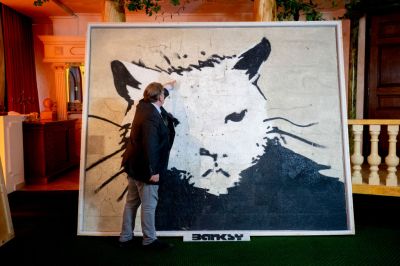
Image Credit: Getty Images Greeting-card company Full Color Black petitioned to cancel Banksy’s trademark, arguing the anonymous artist has not used it legitimately in commerce. In their challenge, Full Color Black has taken to using Banksy’s own words and actions regarding copyright—which in the past he has flounced—to argue its case. Pest Control Office, Banksy’s firm, will try to prove in court that the artist has in fact sold merchandise of his work, and therefore retains trademark. The dispute is still unfolding.
-
Artists’ Rights and Cultural Property: Manhattan Nonprofit Attempts to Protect Elizabeth Street Garden Under VARA
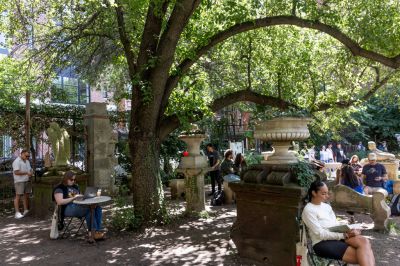
Image Credit: Photo Andrew Lichtenstein/Corbis via Getty Images In February, the director of the Elizabeth Street Garden sued New York City, arguing the beloved community space is a “social sculpture” protected under the Visual Artists Rights Act. The city has plans to build affordable senior housing on the lot; supporters argue the garden’s decades-long evolution gives it artistic standing.
The claim is bold. VARA traditionally protects discrete works, not environments shaped by volunteers, neighbors, and time itself. Still, the suit arrives at a cultural moment when the definition of public art is expanding—and when communities increasingly use art law as a shield against development.
-
Tech and Securities: RTFKT Users Hit Nike with $5 M. NFT Class Action Lawsuit
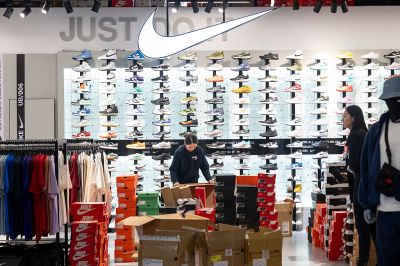
Image Credit: SOPA Images/LightRocket via Gett After Nike shuttered its RTFKT NFT platform, users filed a class action alleging the company sold unregistered securities by promoting NFT sneakers as investments tied to Nike’s brand power. The plaintiffs claim heavy losses; Nike has declined to comment.
The case sits at the messy intersection of art, collectibles, and securities law—a zone regulators are only beginning to map. Whether these NFTs qualify as securities could set an important early standard. NFTs may have cooled, but their legal fallout is only just heating up. This case is unlikely to be the last.