


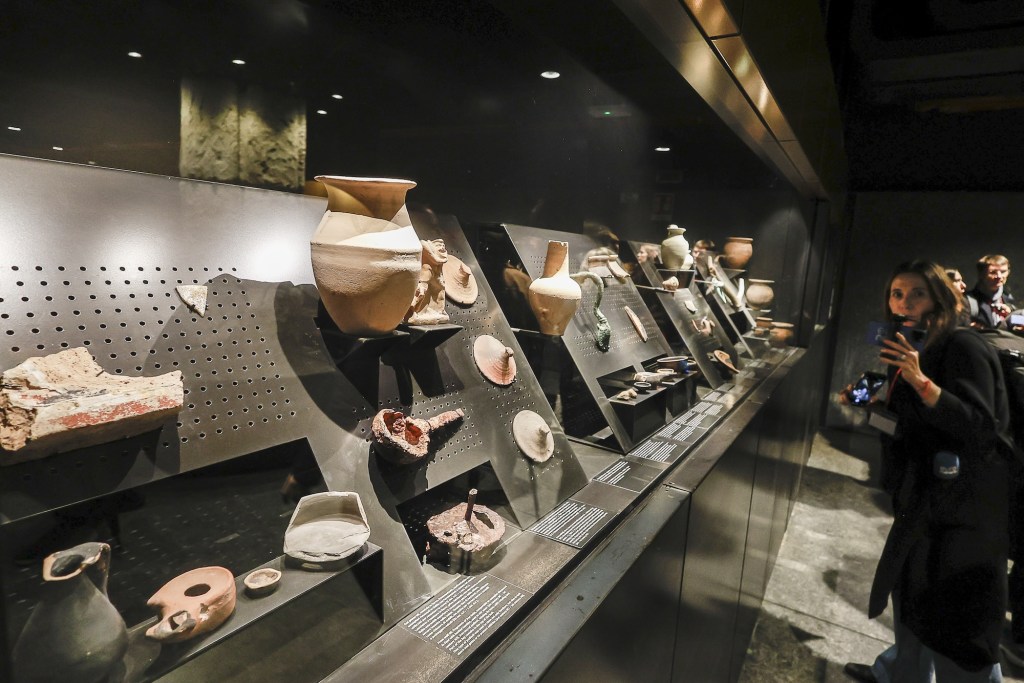
Construction projects in cities that have been inhabited for thousands of years often run into special challenges as work crews come upon ancient artifacts, and suddenly, what was a construction site becomes an archaeological dig. Officials in Rome have been at work for two long decades on a new subway line for just that reason, as workers excavating stations on the new Line C, which will link the city center with distant southern suburbs, have turned up more than 500,000 artifacts.
The city’s solution? Turn the subway stations themselves into little museums, so that ancient artifacts exist side-by-side with modern transit technology.
Along just under two miles of line, Rome now has two new 100-foot-deep stops, Colosseo/Fori Imperiali and Porta Metronia, that serve to showcase the artifacts unearthed during the excavations that created the stations.
The Colosseo/Fori Imperiali station, located between the Colosseum and the Basilica of Maxentius—the largest building in the Forum when it was built—contains a display of artifacts curated and funded by the Colosseum Archaeological Park and developed with the department of architecture and design at Rome’s Sapienza University. Commuters will encounter historical artifacts all the way from the entrance to the train platforms, and they don’t even have to buy a ticket to visit the station’s atrium, where they can see marble remnants and a video showing what the spot would have looked like in ancient times.
On display are artifacts like ceramic vases and plates and, from a first-century home, the remains of a cold plunge pool and a thermal bath. Multimedia displays show the excavation that resulted in the station.
Porta Metronia station, meanwhile, is located in Piazzale Ipponio, next to the Aurelian Walls, erected between 271 and 275 C.E. Excavations there revealed a military compound, sprawling over 260 feet and dating back to the 2nd century B.C.E., including a commander’s house richly decorated with well-preserved frescoes and mosaic floors. The station was redesigned around the compound.
More museum-cum-stations are in the works, for a total of six on Line C, including San Giovanni, Venezia, Chiesa Nuova, and San Pietro.
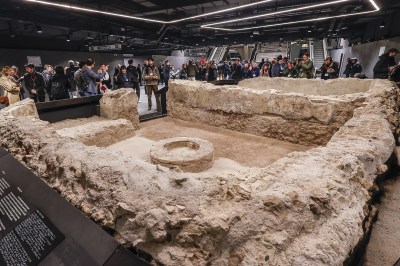
The new Colosseo-Fori Imperiali station on Metro Line C in Rome.
Riccardo De Luca/Anadolu via Getty Images
“Rome is the most difficult city in the world in which to build a subway,” Marco Cervone, construction manager at both new stations, told the New York Times, adding, “It’s not just what’s underneath that’s important, it’s also what’s on top.” Builders sometimes had to dig by hand due to the sensitivity of the site.
Future stations will run underneath more heritage sites, including Trajan’s Column, the Basilica of Maxentius, and Renaissance palaces, churches, and the Vatican.
Italian infrastructure company Webuild, together with Italy’s construction group Vianini Lavori, are conducting the work on the stations.
“The delivery of the Colosseo/Fori Imperiali and Porta Metronia stations represents—for Rome and for Italy—a strategic milestone that combines in an exemplary way progress in infrastructure with the conservation of our heritage,” said Webuild CEO Pietro Salini.

