


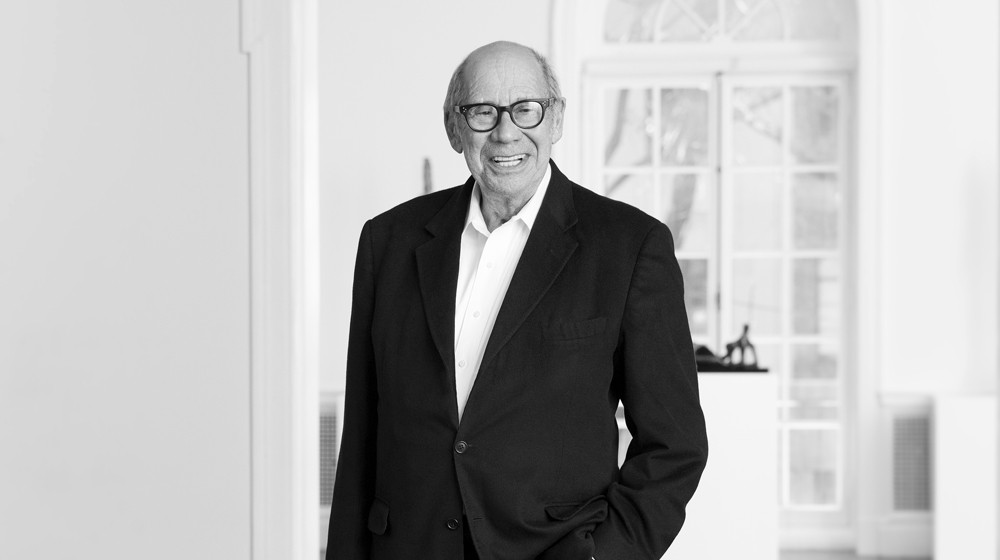
Robert Mnuchin, the Wall Street pioneer who became one of New York’s most respected art dealers and a fixture at blue-chip auctions, died on Friday at his home in Bridgewater, Connecticut. He was 92. His death, first reported by the New York Times, was confirmed by his stepdaughter, Lisa Hedley Wick.
Mnuchin was unusual in having two long and highly successful careers. At Goldman Sachs, he was a central figure in the rise of block trading in the 1960s and ’70s, helping build the firm’s institutional equities business under managing partner Gustave Levy. By 1978, the Wall Street Journal described him as “the acknowledged dean of block traders,” rivaled only by Salomon Brothers’ Michael Bloomberg. His skill on the trading floor—an encyclopedic recall of buyers and sellers, an instinct for pressure and timing—made him a legend inside the firm. He became a partner in 1967, co-headed trading and arbitrage by 1976, and joined the firm’s powerful management committee in 1980. He retired in 1990.
That same set of instincts—competitive, analytic, and deeply interpersonal—animated his second act. After decades on Wall Street, Mnuchin did something that surprised even close friends: he left finance to open a gallery. It was not a move financiers of his stature typically made. As he later told ARTnews, it “took a lot of courage” to step away from the Goldman machine and test whether his success came from his own abilities or the institution behind him. “I wanted to see what I could do on my own,” he recalled. And because no museum would hire someone without a formal art background, “the only alternative was to start my own gallery, which is what I did.”
He and his wife, Adriana, converted part of their East 78th Street townhouse into C&M Arts (partnering with James Corcoran) in 1992, later partnering, with Dominique Levy in L&M Arts. He would establish Mnuchin Gallery, on his own, in 2013. From the start, the gallery had a clear identity: rigorous, museum-quality exhibitions focusing on the pillars of postwar American art—Pollock, Rothko, Kline, de Kooning—as well as major presentations of Alexander Calder, Donald Judd, Jeff Koons, Frank Stella, Philip Guston, Sam Gilliam, Ed Clark, and David Hammons. He staged eight exhibitions devoted to Willem de Kooning alone, calling the artist “Picasso-esque” for the breadth of his distinct periods.
Mnuchin’s passion for exhibitions—and his conviction that art should be lived with—shaped both his gallery and his own collecting. “The reason to buy art is because you love it, you love it, you love it,” he told the New York Times in 2013. He disliked the term “collection,” insisting that he and his wife kept everything they bought in their home, never in storage.
He became equally known for his presence in the auction room. At evening sales, he was a calm but relentless bidder—sometimes shouting out prices or jumping ahead in increments to secure a work. In 2019, wearing a cream-colored jacket and armed with a flip phone, he set a record for a living artist when he placed the winning $91.1 million bid for Jeff Koons’s Rabbit (1986), acting on behalf of an anonymous client widely believed to be hedge fund manager Steven A. Cohen. His bidding style—patient, unshowy, decisive—made him a recognizable figure even for those who didn’t know his long résumé.
Though he was the father of Steven Mnuchin, the former Treasury secretary, Robert Mnuchin largely avoided politics and was described by colleagues as modest, disciplined, and deeply devoted to art. Friends and art-world peers often noted his integrity: Amy Cappellazzo, the former Sotheby’s chairman, once called him “one of the straightest shooters in the business.”
Robert Elliott Mnuchin was born on September 5, 1933, in Manhattan. His father, Leon A. Mnuchin, was a lawyer and longtime director at several retail companies. The family collected works by Franz Kline and Mark Rothko—and, as he liked to note, once owned a forged Matisse. He grew up on Central Park West before the family moved to Scarsdale. He attended Scarsdale High School, graduated from Yale in 1955, and served briefly in the Army before joining Goldman Sachs.
Mnuchin married Elaine Terner in 1957; they had two sons, Steven and Alan. After their divorce, he married Adriana Graber, with whom he had a daughter, Valerie. In addition to his wife, daughter, and sons, he is survived by his stepchildren Lisa Hedley Wick and Bradley Abelow.
Mnuchin worked well into his later years, even as he faced mobility challenges. He skipped Art Basel in Basel for the first time in two decades in 2019, but continued to remain at the gallery’s exhibitions and for major sales. “I love what I do,” he said in the 2021 ARTnews interview. “I’d be lost without it.”