


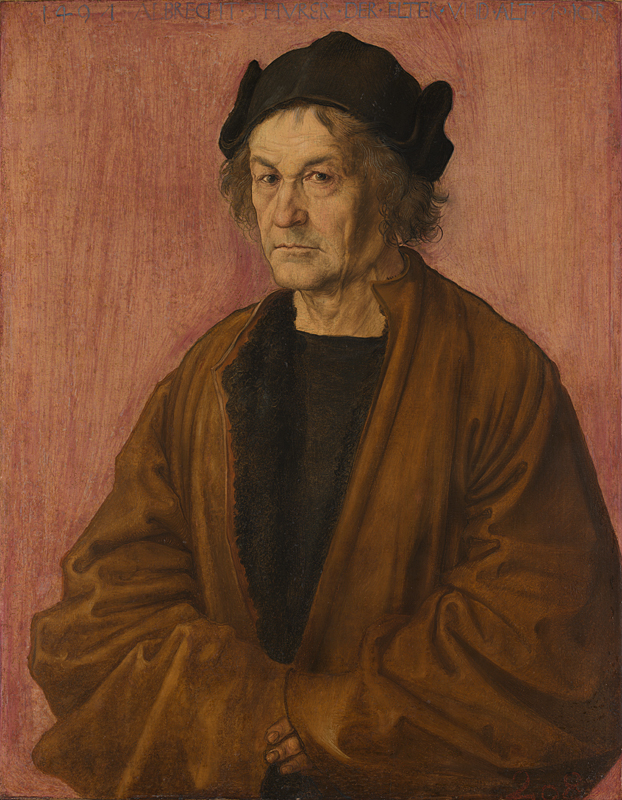
In a new catalogue raisonné, scholar Christof Metzger argues that The Painter’s Father (1497), a painting in the collection of London’s National Gallery, is in fact an authentic work by Albrecht Dürer.
The Painter’s Father, gifted to King Charles I of England in 1636, has long been thought to be a copy made decades after Dürer’s death in 1528, based on a lost original. But in the new publication Albrecht Dürer: The Complete Paintings, Metzger—a Dürer expert and curator of German art at Vienna’s Albertina Museum—contends that the face is “preserved so well that the painting’s formerly outstanding quality is still perceptible.” He told the Art Newspaper that the London work stands apart from at least seven known early copies of the portrait of Dürer’s father for its “experienced brushwork and masterful glazing technique.”
Curators at the National Gallery have long taken a different view. In a 2010 catalog entry, Marjorie E. Wieseman, then the museum’s curator of Dutch paintings, wrote that the painting’s “quality and technique are not consistent with authentic works by Dürer” and that it “lacks Dürer’s sophisticated and highly realistic approach to the modelling of form.”
Susan Foister, the museum’s longtime curator of German paintings, similarly argued in a 2024 catalogue of the gallery’s German holdings that the painting’s cracks are not found in Dürer’s other works and that the sitter’s hair “lacks Dürer’s usual fluency and delicacy.”
The painting is currently not on view at the National Gallery, owing to space constraints and its status as a copy. However, the Art Newspaper reported that the museum may soon put it back on display. There is still no indication, though, that the National Gallery plans to revise its position on the work’s attribution. For now, the museum’s website continues to list it as “probably a later sixteenth-century copy of a lost original by Dürer.”