


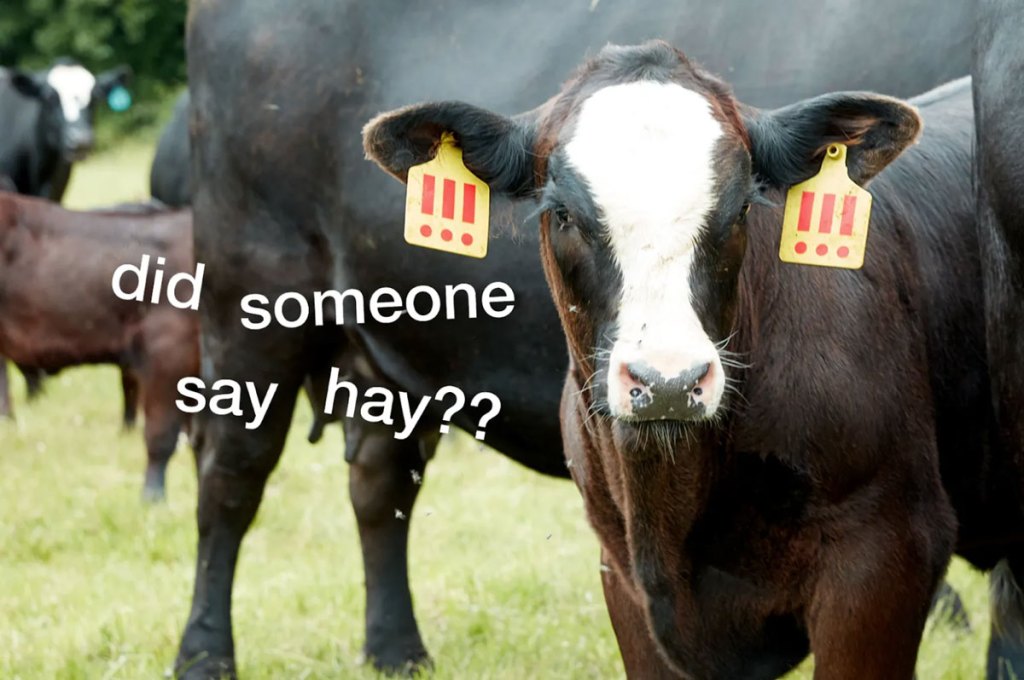
In about two months, the fate of a cow named Angus will be decided. At present, the outlook is grim: Angus is slated to be turned into roughly 1,200 hamburger patties and four leather handbags. But MSCHF—the art collective behind viral artworks ranging from Big Red Boots to a branded ATM publicly displaying users’ account balances—appears to be hoping that might still change in the next 64 days.
Angus, who lives on a farm in upstate New York, is the subject of MSCHF’s ongoing project Our Cow Angus, which began in August 2024 when the group purchased the animal. To fund the project, MSCHF presold “Angus Tokens”—priced at $35 for a three-pack of five-ounce patties and $1,200 for a crossbody bag—tied to the cow’s eventual slaughter. The plan is set to be carried out when Angus turns two, the typical age for cattle slaughter in the United States. (The project’s website also features a diary documenting Angus’s life on the farm, though it has not been updated since July 24.)
There is, however, a catch. Anyone who has purchased an Angus Token—cheekily dubbed an “Angus Steakholder”—can cancel their pre-order through a so-called “Remorse Portal.” If 50 percent of token holders opt out, Angus’s slaughter will be canceled, and all proceeds “will be used to send Angus to a Home For Happy Cows for the rest of his natural life,” according to the site. Token holders wary of losing their investment can also sell their tokens on the secondary market, which MSCHF is actively encouraging as a way for opponents of the slaughter to intervene.
As of the afternoon of January 8, only 31.8 percent of token holders had canceled their orders.
“Much of MSCHF’s work revolves around creating fantastic economic transactions and relationships within the business–product–consumer triad,” Kevin Wiesner, a cofounder of MSCHF, told the Art Newspaper. “It’s central to these speculative, critical commercial arrangements that we do exactly what we say we will.”
The project appears intended to provoke reflection on the meat industry’s treatment of animals. The website notes that, if slaughtered, Angus will be ground entirely into hamburger patties—an approach that runs counter to standard butchery practices. “Best practices would never see a whole cow rendered down into grind,” the site states.
“The myth of individual consumer responsibility was gleefully propagated by polluting industry interests,” the Our Cow Angus website reads. “The justified backlash paradoxically neutered public response even more effectively: blackpilled, we resigned all personal agency, and are even less inclined to take action.” But, the site continues, “If you want Angus to live, in defiance of man and industrial production, then your path is clear-cut and commercial … Conscious Consumerism actually can win this one.”
Critics, however, are unconvinced. They argue that Our Cow Angus turns serious ethical questions into spectacle—MSCHF’s bread and butter. When the collective first announced the project, PETA told Fast Company, “At a time when most people wish to see violence diffused, it’s shameful for MSCHF to make a game out of snuffing out a life.”