


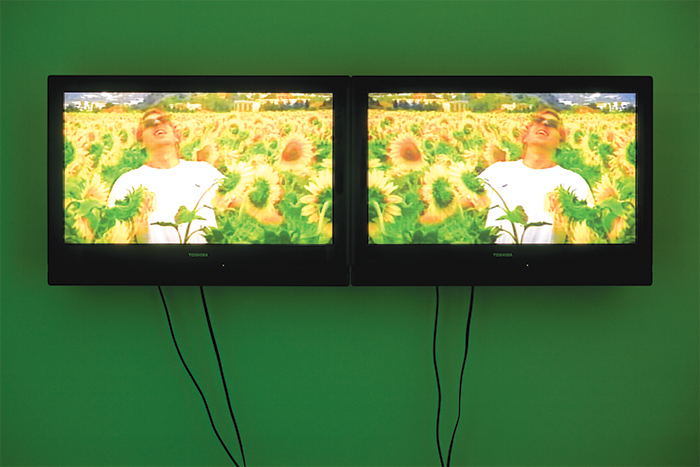
When the fire reached Diana Thater’s home in Altadena last January, there was no time for triage. As she and her husband, the artist T. Kelly Mason, evacuated ahead of the flames, Mason grabbed what he could carry: a server and several hard drives. Thater took the cats. Everything else—decades of raw footage, master tapes, installation manuals, ephemera, paintings—was left behind in a temperature-controlled garage that burned to the ground.
“It’s hard to live to be 62 years old and lose your entire life in one night,” Thater told the New York Times at the time. The loss was not just personal but professional. Much of her work, made since the early 1990s, exists at the intersection of video, sound, and installation, the kind of media whose survival depends on constant technological upkeep. While some of her post-2005 work had been digitized and survived on the drives her husband carried out, large portions of her earlier archive were never transferred. Those materials are gone.
A year later, as Los Angeles marks the anniversary of the fires that devastated Altadena and the Pacific Palisades, Thater’s experience has come to stand for a broader, unresolved problem in contemporary art: how fragile media-based practices remain once they leave the studio, and how little infrastructure exists to support artists when catastrophe strikes.
In the months after the fire, Thater began working with the Canyon Media Art Conservation Center (CMACC), a new nonprofit conservation laboratory opening in 2026 that is devoted exclusively to time-based media art. Led by Cass Fino-Radin, a longtime media art conservator and former staffer at the Museum of Modern Art and digital arts nonprofit Rhizome, CMACC is designed to address what might be described as a preservation crisis driven by technological obsolescence, limited institutional capacity, and the sheer volume of digital material contemporary artists produce.
For Thater, the collaboration is both pragmatic and urgent. While dozens of her works were destroyed in the fire, many others exist in museums and private collections around the world. CMACC is now working with her to locate the best surviving versions of those works—master tapes, artist proofs, or institutionally held copies—so they can be assessed, digitized, and returned, restoring as much of her archive as possible.
“It’s detective work,” Thater told ARTnews in a recent interview. “Who has which version? What condition is it in? Is it the one that should be saved?” The process involves contacting collectors and institutions, evaluating aging tape formats, and, in some cases, attempting last-chance recoveries from fragile analog media. The goal is not to re-create what was lost, but to reconstitute her archive in a form that can endure.
But Thater’s case isn’t an exception but a common experience faced by artists working in film and video. For decades, these artists have often been the ones charged with managing preservation of their own work, especially since collectors or institutions often lacked staff specialized in this kind of conservation. Even when contracts required works to be migrated every few years, those updates frequently went undone. Digital storage, meanwhile, introduced its own risks: hard drives fail, formats become unreadable, and “the cloud” is no substitute for active stewardship, according to Fino-Radin.
CMACC was conceived in response to that reality. Though housed within Canyon, a forthcoming museum and exhibition venue for time-based art on Manhattan’s Lower East Side, CMACC as a conservation lab is focused on serving the entire field—artists, collectors, and institutions—irrespective of their affiliation with Canyon’s collection and program. The goal is to create a cooperative model of regional conservation centers—long used for painting and sculpture—for media art.
Fino-Radin describes the moment as analogous to the early 20th century, when American museums first recognized that traditional conservation models were inadequate for modern art. “We’re at a similar inflection point now,” they said. “Media art has become central to contemporary practice, but the systems designed to care for it haven’t caught up.”
Unlike private conservation studios, which are often inaccessible to artists, CMACC operates as a nonprofit, raising funds to support projects that might otherwise be impossible. Thater’s archive is among its first high-profile cases, but the center’s mandate is broader: to stabilize works, develop standards, and build long-term capacity for a medium that resists permanence by design.
The fires that swept through Los Angeles last year exposed the stakes of that work in stark terms. Thousands of homes were destroyed, including those of artists whose studios doubled as archives, storage facilities, and production sites. For many, the loss was total. Insurance could replace equipment, but not time, authorship, or the accumulated record of a career.
Thater is clear-eyed about what can and cannot be recovered. Some works are simply gone. Others may yet be saved. What matters now, she said, is that the process exists at all. “This isn’t academic,” she said. “This is about whether the work survives.”