


Federal authorities, journalists, and Jeffrey Epstein’s accusers have spent years scrutinizing the financier’s properties and possessions, piecing together an aesthetic world that often seemed to mirror the abuses he committed. Reporting by ARTnews, the New York Times, Artnet, and other publications has detailed Epstein’s fixation on sexually charged imagery, the theatrical displays inside his properties, and the objects that blurred the line between décor and surveillance.
Despite being heavily redacted, the first tranche of documents released under the Epstein Files Transparency Act now add a new layer to that picture. These newly surfaced details expand the record with visual evidence from inside his Manhattan townhouse and with an early, long-buried complaint from an artist who says Epstein manipulated and stole her work.
Below, details on a few new revelations from the Epstein files.
-
Epstein owned a Coming of Age Ceremony mural
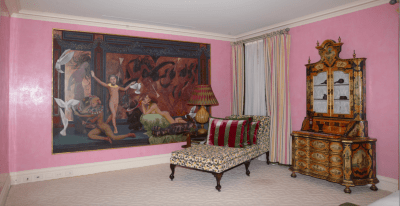
Image Credit: Department of Justice One of the most discussed pictures in the newly released photographs is a floor-to-ceiling mural by the Miami-based Cuban American painter Jorge Alvarez, titled Coming of Age Ceremony (1995). According to the Daily Mail, the painting, which spans nearly seven by ten feet, dominates the better part of a large wall in a bright pink bedroom in Epstein’s townhouse. It depicts a young boy with an erection prancing around in front of a mural that features wild-haired figures playing musical instruments. The picture had quietly moved through the market until resurfacing this fall at Collective Hudson Auction House in Kingston, New York, where it failed to sell.
The FBI photographs released by the Department of Justice reveal an interior saturated with similar imagery. Hallways and bedrooms are lined with nude photographs and paintings of women in exaggerated, often contorted poses. A bronze statue of a young boy in a sideways baseball cap sits near a statue of a girl dressed as a bride and clutching a rope. In one bathroom, investigators documented a photograph of two boys peering down their underwear.
-
An artist complained in 1996 that Epstein stole pictures of her underage sisters

Image Credit: Heather Diehl/Getty Images If the townhouse photographs illuminate the environment Epstein made for himself later in life, a second set of documents released by the DOJ offers a deeper view into how art figured into his offenses decades earlier. Among the newly disclosed materials is a 1996 FBI complaint made by a professional artist—confirmed by her attorney to be Maria Farmer, one of Epstein’s earliest known accusers. According to CNN, the document describes how Epstein stole photographs that Farmer had taken of her underage sisters for her own artwork, then attempted to sell them. It also recounts that he encouraged her to photograph young girls at swimming pools, a request that now appears to have been an effort to pull her into his network. The file notes that Epstein threatened to burn down her home if she revealed what he had done.
The complaint, stamped September 3, 1996, is significant not simply for its content but for what it demonstrates about the timeline. It shows that federal authorities had in hand detailed allegations involving minors, imagery, coercion, and stolen artwork long before any meaningful legal consequences followed. Farmer has said that seeing the document publicly acknowledged after nearly 30 years felt like vindication. Her sister Annie described the emotional impact of reading it, noting how many other girls were harmed after that date.
-
An artist claimed she was “being used” by Epstein in 2006
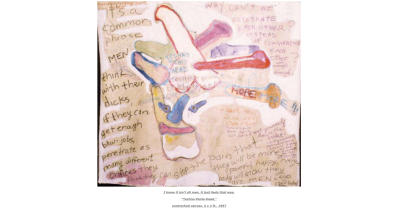
Image Credit: Screenshot via the artist’s website One document filed by the Palm Beach Police Department recounts an alleged encounter between Epstein and the artist Suzannah B. Troy. According to that document, in 2006, Troy visited Epstein’s New York residence; the meeting was allegedly arranged by Ghislaine Maxwell, his associate who is currently serving 20 years after being convicted of child sex trafficking and other charges. Troy, who would have been in her 40s at the time, tried to sell Epstein some of her paintings, but he “did not appear interested.” Still, they continued speaking anyway. “She provided massages for Epstein,” the document claims, “and sometime during their relationship, she felt she was being used by Epstein and terminated the relationship.” (This act and others were done by “consenting adults,” the officer wrote, echoing Troy’s words at the time.)
The document then goes on to note that Troy painted a work called Techno-Penis-Head based on the encounter. A painting with the same title—which appears on Troy’s website, where it is dated to both 1997 and 1999, nearly a decade prior to her alleged relationship with Epstein—features multiple phalluses, along with written phrases such as “Men think with their dicks, if they can get enough blow-jobs, penetrate as many orifices as they think they can.” ARTnews has reached out to Troy for comment.
-
Ghislaine Maxwell thought Epstein’s Bill Clinton painting was “hideous”
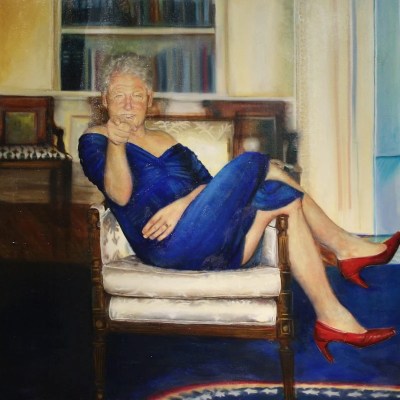
Image Credit: Via New York Academy of Art A certain Bill Clinton painting, one showing the former President wearing a blue dress and red heels, has long been one of the most mysterious pieces in Epstein’s holdings. (The work’s maker, the painter Petrina Ryan-Kleid, has said the dress is Monica Lewinsky’s and called the painting “a silly school artwork.”) Now, we know Ghislaine Maxwell’s thoughts on the work. In a newly released 2025 interview with Maxwell that was conducted by the Department of Justice, Maxwell denied any knowledge of Epstein acquiring the painting, titled Parsing Bill (2012). In fact, she said, she had never seen until it was published in the press. But she does appear to have spent some time parsing Parsing Bill. Without even be asked for her opinion on the work, Maxwell said, “I thought it was hideous.”
-
Epstein had a taste for modern art
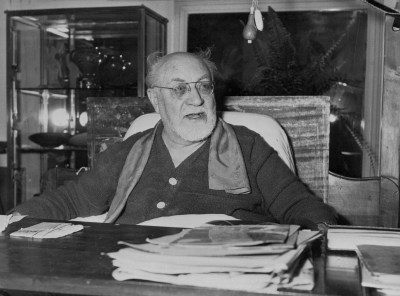
Image Credit: Bettmann Archive via Getty Images In a group of files related to Epstein’s Virgin Islands residence, there’s a Sotheby’s provenance record for a 1935 Henri Matisse painting called Le Reflet. Featuring a woman posed before a mirror, the painting was auctioned at Sotheby’s in 2005, though it’s unclear whether Epstein—or even someone related to him—made any attempt to purchase it. It’s also not clear why Epstein held on to the provenance sheet, since there are no other documents related to the painting.
He does, however, appear to have displayed an interest in modern art. The same PDF of photographs and scanned documents related to the Virgin Islands home features shots of CDs that were scrawled with the names of modern artists such as Matisse, Claude Monet, and Kees van Dongen. One of those CDs even references a specific artwork: Picasso’s Garçon à la Pipe (1905), which sold for $104 million in 2004. Though its buyer has never been confirmed, the piece was rumored at the time to have been purchased by Guido Barilla, the chairman of his eponymous pasta company.
It is not the first time Picasso has figured in Epstein files released this year. In emails released last month, Epstein discussed an attempt to acquire a $100 million Picasso painting from Gagosian gallery for his friend, the collector Leon Black, in 2015. Epstein raised questions about the gallery’s selling procedure, writing, “Who transfers 100 million dollars overseas without a contract?”