


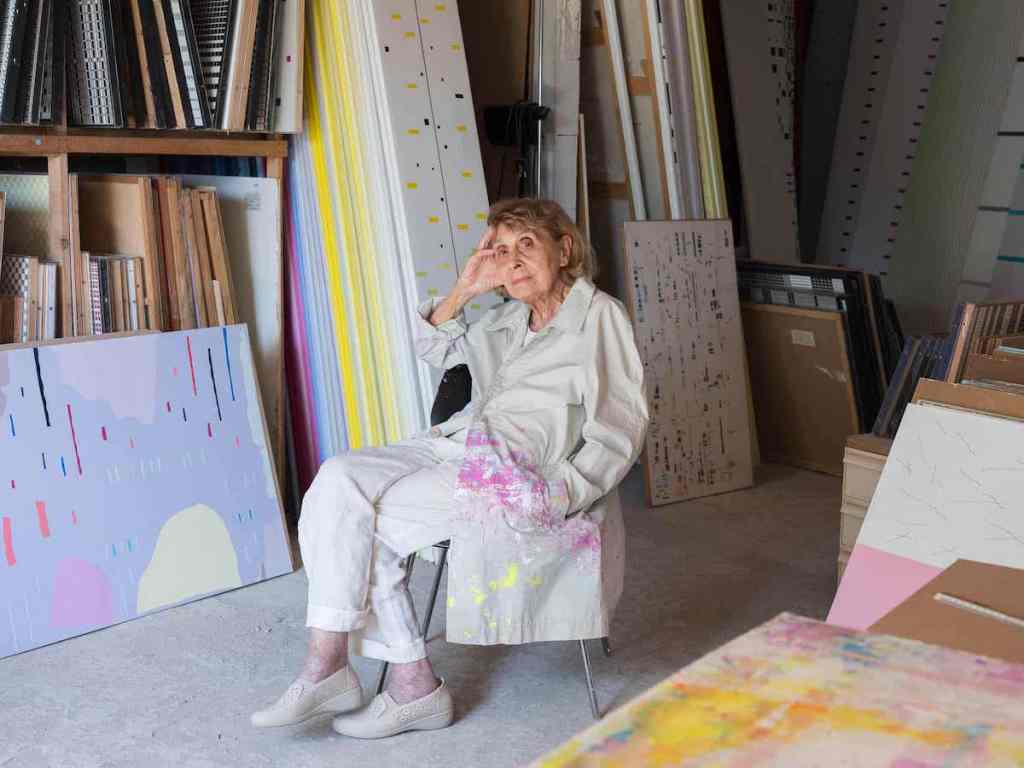
Lucia Di Luciano, an Italian painter associated with the Arte Programmata movement of the 1960s who only recently gained wider recognition, died this past weekend. Her death was announced by her Milan gallery, 10 A.M. Art, which did not specify a cause. Many Italian publications reported that she was 93 years old.
Di Luciano is known mainly for her abstractions of the 1960s, which are often composed of gridded black and white patterns. She made them entirely by hand, but she worked with such precision that they appear today as though they were made using computers, which were not yet widely available to the public during the 1960s. Only when standing up close to these works does one notice the areas where Di Luciano’s paint diverges ever so slightly from her predetermined compositions.
Unlike many artists of her era, Di Luciano did not only work in oil. She embraced house paint and acrylic, both of which were considered “low” or délcassé at the time.
Her paintings of the mid-’60s made her one of the leading figures associated with Arte Programmata, a movement that has often been positioned as an Italian response to the Op art pouring in from the US and England. The movement’s purveyors used the aesthetics of computers to consider how systems of orderliness are formed and broken down. Lindsay Caplan, an art historian who wrote a book on the movement in 2022, has written that the Arte Programmata was inherently political because it was about “individual freedom in relation to systematic constraints.”
Born in 1933 in Syracuse, Italy, Di Luciano attended the Academy of Fine Arts in Rome during the ’50s. While she was a student there, she met the artist Giovanni Pizzo, who later became her husband. Together, they took part in avant-garde groups such as Gruppo 63. They remained together, living in Rome until 2022, when Pizzo died.
Di Luciano described her career during the ’60s as an uphill battle, for she had chosen a profession that was still unkind to women. To supplement her artistic practice, she also opened a clothing store called Mondo Giovane, where she sold Perspex purses and plastic miniskirts that she designed.
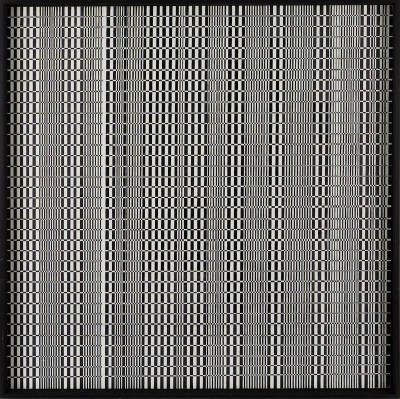
Lucia Di Luciano, Untitled, 1964.
Courtesy the artist and Lovay Fine Arts
Though she painted for nearly eight decades, the international art world did not take note until 2022, when Di Luciano figured in the main exhibition of the Venice Biennale, curated by Cecilia Alemani. She appeared in a section called “Technologies of Enchantment,” which focused on how Italian women active during the postwar era had looked to computers as a means of envisioning other worlds.
After the Biennale, Di Luciano figured in “Electric Dreams: Art and Technology Before the Internet,” a Tate Modern exhibition that opened in 2024. Her art began to appear in fairs such as Frieze Masters and Independent 20th Century, and at galleries such as Herald St., which mounted Di Luciano’s first London show last year. Maxxi, a contemporary art museum in Rome, is currently organizing a retrospective that is set to open in 2027.
While Di Luciano remains best known for her austere abstractions of the 1960s, she wound up introducing color to her gridded paintings during the 1970s. By the end of her career, she had begun working in a very different mode altogether. Recent works shown by Lovay Fine Arts gallery at Independent featured rows of brushy swoops of paint, evincing an embrace of entropy that was not always present in her earlier work.
Whether or not the rest of the world was looking, Di Luciano continued to paint daily. “My thoughts are all
on the surfaces of my paintings,” Di Luciano said in 2022 in an interview with Konfekt, which reported that she was 89 at the time. “To stop working would have brought my mind to a halt and probably my life as well.”