


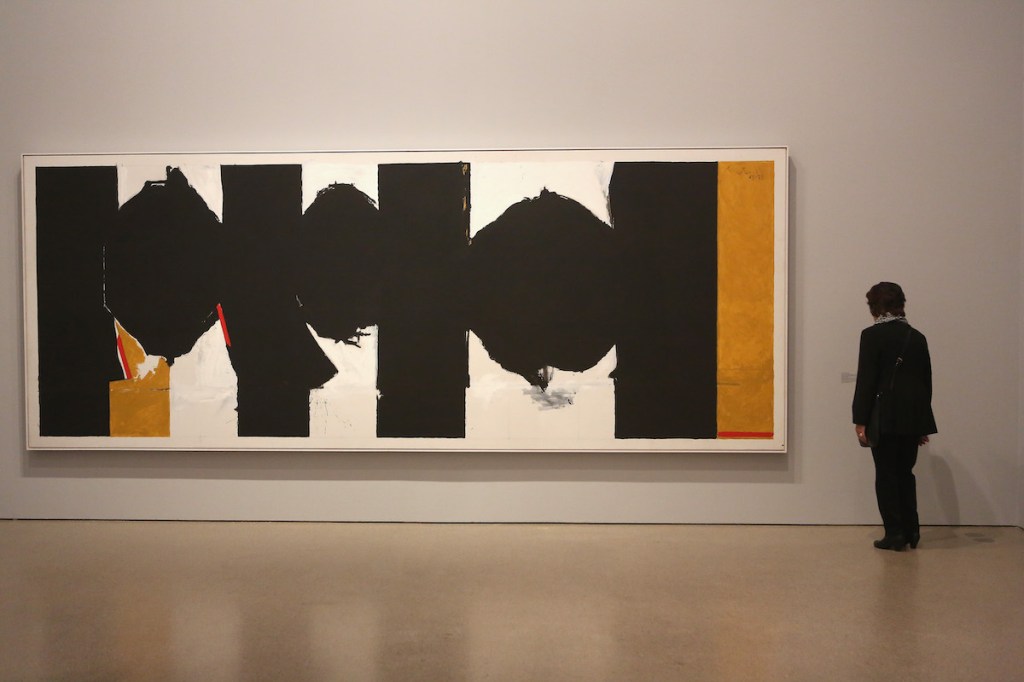
Longstanding questions about an episode surrounding a Robert Motherwell painting in Spain have finally been answered: the Franco regime really did try to censor the Abstract Expressionist’s work, proposing an altered title for one work with a name that explicitly referred to the Spanish Republic.
The drama centered around Elegy to the Spanish Republic No. 35 (1954–58), one of more than one 150 paintings in a series of abstractions that obliquely refer to the Spanish Civil War via black ovals and expanses of white.
Now owned by the Metropolitan Museum of Art, the painting was one of several by Motherwell that appeared in “The New American Painting,” a legendary exhibition organized by the Museum of Modern Art. The exhibition’s tour, which was facilitated by the US government, has been credited with bringing Abstract Expressionism beyond the United States. (Many have claimed the show was American propaganda, with ArtCurious podcast host Jennifer Dasal writing that it was “a way to cement alliances among like-minded Cold Warriors and to promote the much-lauded cultural preeminence of the United States for the first time in history.”)
It has long been rumored that the Franco regime raised concerns about Elegy to the Spanish Republic No. 35 prior to the exhibition’s opening in Spain. In 1996, critic Dore Ashton said that authorities in Madrid, where “The New American Painting” was to travel in 1958, would only show the painting if Motherwell retitled it. He refused, and the painting never went on view, leading many to suspect censorship.
Previously unpublished documents from MoMA’s archives confirm Ashton’s account. According to those documents, which were reviewed by El País for a report published this week, local authorities did indeed want Motherwell to call the work either Elegy or Painting, without any reference to the Spanish Republic.
“In case you consider this title unacceptable, the painting would have to be removed from the exhibition and the catalogue, since we are not authorized to change titles of paintings without the consent of the author,” wrote René d’Harnoncourt, MoMA’s director at the time, in a letter to Luis González Robles, the curator of the Madrid version of “The New American Painting.”
Once Porter McCray, the leader of MoMA’s international programming, told Motherwell that it would be impossible to exhibit the painting with its original title in Spain, the artist said he was no longer interested in showing his art in the capital city. “Better none of my paintings on display in Madrid,” he wrote McCray. Motherwell then wrote Alfred H. Barr, MoMA’s founding director, to apologize for drawing the museum into a controversy.
El País’s report did not definitively answer one continued question about Elegy to the Spanish Republic No. 35: whether the painting appeared in a Spanish newsreel filmed prior to the exhibition, as some have claimed across the years. If it did, the painting may have slipped past censors.
Still, the MoMA documents appear to confirm that it was not only Motherwell who faced pushback from the Franco regime. The El País report also quotes a note from Antoni Tapiès, a Catalan artist whose rough-hewn paintings drew international acclaim during the postwar era.
Tapiès decided not to participate in shows organized with the blessing of the Spanish government, telling McCray, “It is scandalous to see how Spanish exhibitions are organized here and there with the sole aim of showing the world that Spain is a free country, where painters can live from their work and where there is a formidable body of painting thanks to a favorable environment. For me, the reality is exactly the opposite.”