


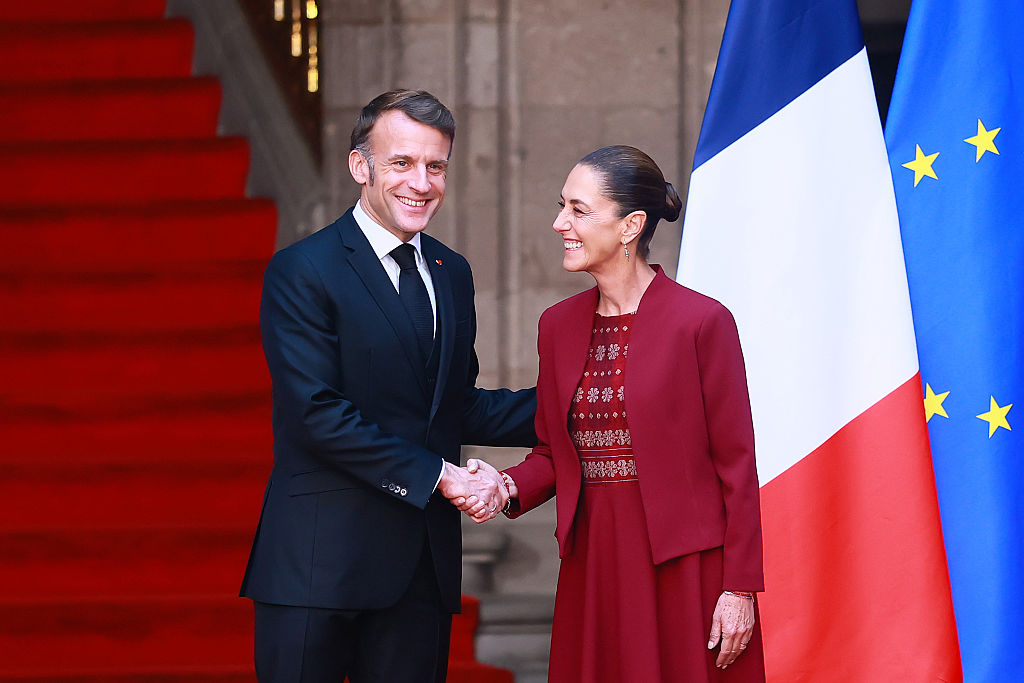
In May 2025, Mexican President Claudia Sheinbaum met with French President Emmanuel Macron in Mexico City. It was Macron’s first official visit to Mexico, and was an important step in Mexico’s recent attempts to bolster trade relations with Europe.
While much of the meeting focused on economic relations between the countries, Sheinbaum also announced that France and Mexico agreed to temporarily exchange a pair of handwritten codices. The Codex Azcatitlán, housed in Paris’s Bibliothèque Nationale de France, will travel to Mexico City, while the Biblioteca Nacional de Antropología e Historia will loan its Codex Boturini to Paris. Due to conservation concerns, neither are frequently on view in their respective libraries, and they rarely travel, according to The Art Newspaper.
Both pre-Hispanic illustrated manuscripts tell the story of the Aztecs’ migration to Tenochtitlan (present-day Mexico City). The Italian historian for whom the 16th century Codex Boturini is named was forced to leave the manuscript behind when he left what was then known as “New Spain”; it has remained in Mexico since 1825.
Mexico has long attempted to repatriate various Mesoamerican codices held in European collections. So far, the Vatican has declined to loan or return the Codex Borgia or the Codex Vaticanus, and France has declined to return the Codex Borbonicus. Repatriation is complicated, and often depends on when they were acquired, according to Rita Sumano, an expert on Mexican heritage/
“Codices’ repatriation relies on goodwill as they were acquired before the 1972 heritage law protecting them, which adheres to the 1970 UNESCO convention,” Sumano told the Art Newspaper.
The 17th century Codex Azcatitlán, for example, also once belonged to Lorenzo Boturini, and was eventually acquired by French collector Eugène Goupil. His widow donated it to France’s national library in 1898, two years after his death. Emilia Mendoza, a restitution activist with the group Frente de Defensa de la Cultura Ancestral, hopes that this recent manuscript swap will move the needle when it comes to repatriating manuscripts like this one. “The loan is a good signal, but we want something permanent,” she told TAN.