


29
Aging is often a process of subtraction. As mobility decreases and cognitive health shifts, the physical world begins to shrink. For many older adults in assisted living, reality becomes a series of four walls, a television, and a window that looks out onto the same patch of grass.
This isn’t just a matter of boredom; it is a clinical crisis. When the brain stops receiving new, complex sensory input, cognitive decline accelerates.
This “sensorial poverty” is the friction that Mynd Immersive seeks to solve. Their spark was a simple, empathetic question: If a person can no longer walk to the ocean, can we bring the ocean to the bedside?
The problem: the trap of “passive care”
The traditional model of elderly care is often passive. We give older adults puzzles to solve or shows to watch. But these activities lack agency. They don’t engage the “spatial” brain — the part of us that feels like we are inhabiting a world.
Furthermore, “Digital Therapeutics” (DTx) for seniors have often been ignored because of the “tech gap.” There was an assumption that the elderly wouldn’t or couldn’t use virtual reality (VR).
The problem, however, wasn’t the age of the user; it was the design of the interface. Most VR was designed for the fast-twitch muscles of teenagers, not the calm, contemplative needs of an 80-year-old.
The breakthrough: the empathetic interface
Mynd Immersive’s breakthrough is a shift from “gaming” to “therapeutic presence.” They didn’t just build a VR platform; they built a delivery system for memory and wonder.
- Lightweight engagement: the hardware is modified to be used while seated or reclining, with a simplified “gaze-based” navigation that doesn’t require complex controllers.
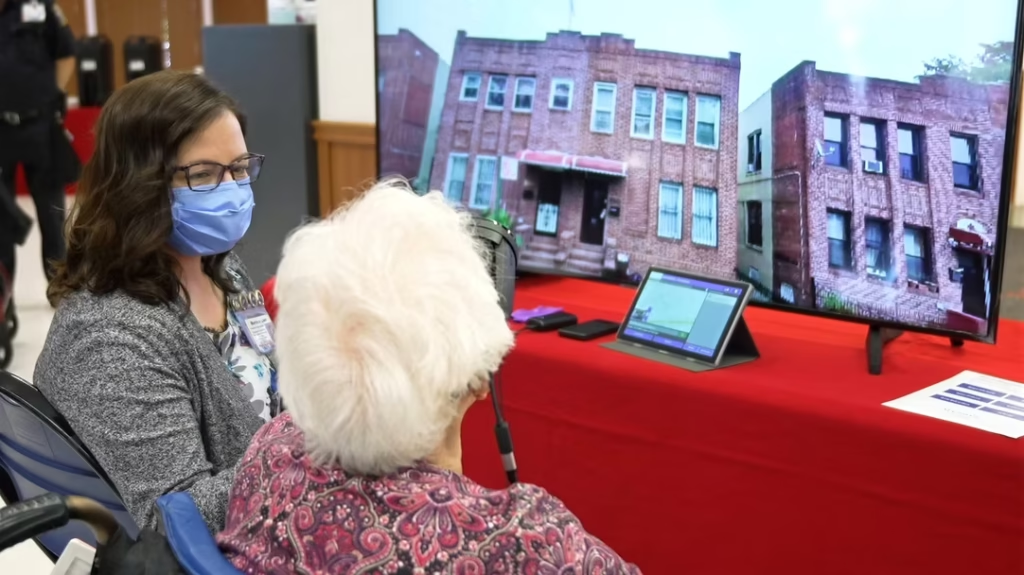
- The “Map of Life”: their “Mynd Explorer” platform allows seniors to visit their childhood homes or the streets where they were married. This isn’t just a trip; it’s a form of reminiscence therapy.
- Cognitive redirection: it effectively silences the signal of physical pain by occupying the mind with complex, pleasing stimuli.
The impact: the neurobiology of wonder
Researchers have begun to notice what they call a “Halo Effect” — a lingering clarity that persists long after the headset is removed.
In the wake of a fifteen-minute Mynd Immersive VR journey, the walls of the care facility seem to recede; residents often find themselves more positive, more inclined to conversation, more present at the dinner table, and less burdened by “Sundowning,” that peculiar evening agitation that often shadows dementia.
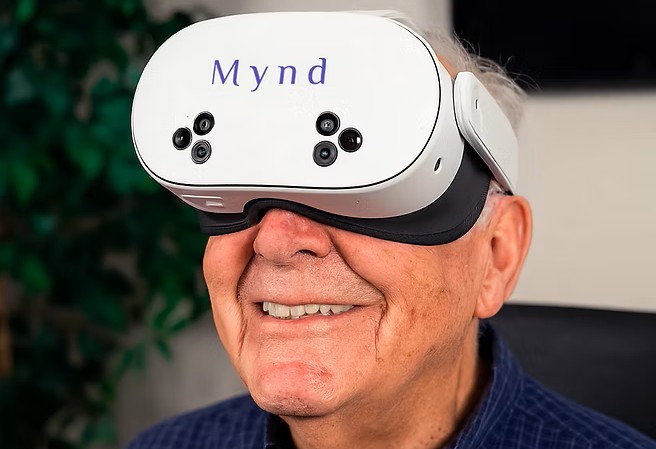
This isn’t just a change in mood; it is a response to spatial novelty. By offering the brain a new landscape to navigate, the simulation stirs the neurochemistry of discovery, reminding the mind of its inherent plasticity.
It suggests that while the body may have found its limits, the impulse to explore remains intact. In this sense, the technology offers a form of “digital mobility” — a way to ensure that a person’s world remains as expansive as their identity, regardless of the physical constraints they inhabit.
What’s next: the virtual human right
As digital therapeutics become more common, we may eventually view access to virtual travel and social simulation as a fundamental part of elder care — as important as physical therapy or medication.
However, we must ask: does the simulation become a substitute for real-world interaction? Or is it the bridge that keeps the mind sharp enough to value the real world even more?