


51
It began not with a grand vision for blockchain, but with a simple, persistent question: what if a product could tell its own story?
Not just where it came from, or who owned it last, but the full, messy arc of its existence — every repair, every journey, every material salvaged.
This wasn’t about marketing; it was about meaning.
The problem: a world of anonymous objects
For decades, the life of a product has been largely opaque. We buy, we use, we discard.
The journey from raw material to finished good is often a black box, and once it leaves the factory, its history becomes fragmented, if it’s recorded at all. This lack of transparency created a host of problems.
Luxury brands battled counterfeits, their heritage undermined by cheap imitations. Consumers, increasingly aware of environmental impact, struggled to make informed choices, unable to verify claims of sustainability or ethical sourcing. Repair services were hampered by a lack of original specifications or a clear history of previous work.
And at the end of a product’s life, recycling became a guessing game, as the precise composition of materials remained unknown, leading to inefficient processes and mountains of waste.
The system was designed for a linear economy — take, make, dispose. But the world was quietly shifting, demanding a circularity that the old ways simply couldn’t support.
There was a friction, a growing unease, in buying something with no verifiable past and no clear future beyond the landfill.
The breakthrough: a digital echo for every item
The idea was deceptively simple: give every physical product a digital twin, a unique and immutable record of its life.
This concept, now maturing into what we call the Digital Product Passport (DPP), didn’t spring from a single invention but from the convergence of several technologies.
First, the NFC (Near Field Communication) chip. Small, inexpensive, and easily embedded, these chips allow a smartphone to instantly read a unique identifier from a physical object. This identifier acts as the bridge, the physical anchor to the digital world.
Second, the Non-Fungible Token (NFT). While often associated with digital art and speculation, the underlying technology of an NFT is what makes a DPP truly powerful. An NFT is essentially a unique digital certificate of ownership and authenticity, stored on a blockchain. This means the data linked to a product’s identity is secure, transparent, and virtually tamper-proof. It’s not just a serial number in a company database; it’s a verifiable, public record.
The breakthrough wasn’t just in linking a chip to a digital token. It was in realizing that this connection could host a dynamic, evolving story. When you tap your phone on a product with a DPP, you don’t just see a static webpage. You access a living ledger.
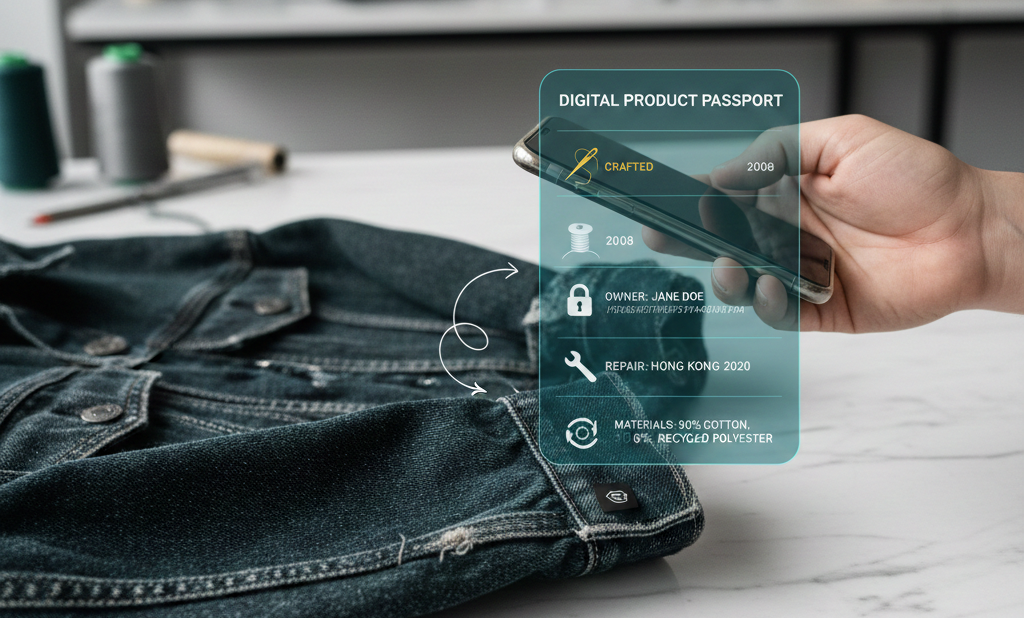
Imagine a luxury handbag. Its DPP could record:
- Origin: where the leather was sourced, who crafted it, and when.
- Authenticity: a cryptographic proof that it’s a genuine item from the brand.
- Ownership history: every time it’s sold, the ownership of the associated NFT is transferred, creating an unbroken chain of custody.
- Repairs and maintenance: details of any repairs, with dates, locations, and parts used, adding to its verifiable condition.
- Material composition: a precise breakdown of all components, crucial for end-of-life recycling.
The beauty of this system lies in its decentralization and immutability. Once information is added to the blockchain via the NFT, it’s there forever.
No single entity can unilaterally alter or erase the product’s history. This fosters a new level of trust and transparency that was previously impossible.
The impact: sustainability, trust, and a new definition of value
The implications of Digital Product Passports are quietly profound, reaching far beyond the initial promise of authenticity for luxury goods. They are fundamentally reshaping how we interact with products, driven in no small part by new regulatory landscapes, particularly in Europe.
The European Union, for instance, is pushing for widespread adoption of DPPs as a cornerstone of its circular economy action plan. This isn’t just a suggestion; it’s becoming a requirement for certain product categories, with electronics, batteries, and textiles often cited as initial targets.
For brands, the impact is multifaceted:
- Enhanced trust and authenticity: the fight against counterfeits becomes far more effective. Consumers can verify genuine products with a simple tap.
- Rethinking after-sales services: with a complete history of repairs and components, brands can offer more efficient, personalized, and sustainable repair services, extending product lifespans and building customer loyalty.
- Supply chain visibility: from farm to factory to consumer, brands gain an unprecedented view into their supply chains, allowing them to identify and address environmental or ethical issues with greater precision.
- New business models: the verifiable history of a product opens doors for robust secondary markets, certified pre-owned programs, and even product-as-a-service models where the brand retains ownership and leases items, managing their full lifecycle.
For consumers, the benefits are equally compelling:
- Informed choices: shoppers gain access to verifiable information about a product’s sustainability credentials, ethical sourcing, and environmental impact, enabling more conscious purchasing decisions.
- Empowered ownership: knowing the full history of an item — who owned it, what repairs it received — adds a new dimension to personal ownership, fostering a deeper connection and potentially increasing resale value.
- Simplified recycling: when it’s time to dispose of a product, the DPP provides recyclers with the exact material composition, leading to more efficient sorting, recovery of valuable resources, and less waste.
It’s no longer just about the initial purchase price or the brand name; it’s about the verifiable story embedded within the object, the transparency of its journey, and its potential for a prolonged, sustainable life.
The early adopters: putting the passport to the test
The shift toward Digital Product Passports is already being built into the seams and steel of some of the world’s most recognizable brands.
Wrangler, through a collaboration with MNTGE, has pioneered the use of NFC-integrated denim, allowing holders to scan vintage western shirts not just for authenticity, but to unlock exclusive digital wearables and brand stories.
In the sports world, VeChain and the UFC have introduced blockchain-infused fighter gloves. These pieces of equipment, embedded with NFC chips, allowed fans and collectors to verify that a pair of gloves was actually worn in the Octagon, turning a piece of sports memorabilia into a verifiable digital asset.
The luxury sector is where the “passport” concept truly finds its stride as a service of heritage. Italian watchmaker Panerai has partnered with Arianee to issue digital passports with every timepiece, linking the watch’s historical journey and warranty to an immutable NFT.
Similarly, high-jewelry designer Lorenz Bäumer uses NFT passports for his “Roses Bäumer” collection to provide absolute traceability of gemstones and gold, while granting owners access to rare, real-life experiences like private tours of the Colonne Vendôme.
Even in the world of cycling, Colnago has integrated MyLime blockchain technology to link bicycle frames to digital passports, effectively creating a “theft-proof” record of ownership that follows the bike through every mile and every new owner.
What’s next: from transparency to transformation
The journey for Digital Product Passports is still in its early stages, but the trajectory is clear: from simple transparency tools, they are evolving into foundational elements of a truly circular economy.
One direction involves the standardization of data. For DPPs to achieve their full potential, there needs to be common ground in how data is collected, formatted, and presented across industries and brands.
This coordination is a complex undertaking, involving industry consortia, regulatory bodies, and technology providers. The goal is to ensure that a DPP for a battery can communicate seamlessly with a DPP for a car, and that both can be read by recycling facilities across borders.
We can also expect to see a deeper integration with AI and machine learning. As vast amounts of product lifecycle data accumulate within DPPs, AI could be employed to identify patterns, predict maintenance needs, optimize recycling processes, and even suggest design improvements for future products based on real-world performance and end-of-life data.
Further down the line, the concept of “programmable” products might emerge. An NFT-backed DPP could, for example, be programmed with conditional logic. Perhaps a product offers a discount on its next repair if it’s returned to a certified service center, or unlocks access to exclusive digital content based on its age or usage history.
The vision isn’t about eliminating physical objects, but about enriching them. It’s about giving them a voice, a memory, a story that empowers brands, informs consumers, and ultimately helps us move towards a more sustainable relationship with the things we create and consume.