



Current market dynamics suggest that Bitcoin market bottom signals are becoming increasingly visible during this period of structural realignment. More precisely, several high-conviction data points suggest that the digital asset market is currently experiencing a scenario of maximum pain.
While retail investors often focus on price action alone, professional analysts look deeper into the interplay between institutional behavior, whale movements, and sentiment-driven volatility.
Learn more: Reasons Why Most of Cryptocurrencies Have Failed
Bears Finally Dominate
Institutional players have fundamentally altered their stance on Bitcoin over the past several weeks.
Coinbase Premium Gap: Institutions De-Risk
Evidence for this shift appears most clearly in the Coinbase Premium Gap, which has reached its most negative state since the start of 2026. As Coinbase Pro serves as the primary liquidity hub for North American institutions and high-net-worth individuals, this persistent discount compared to Binance highlights a significant imbalance in professional demand.
As a result, the data confirms that aggressive selling from the institutional side has overwhelmed local buying interest.
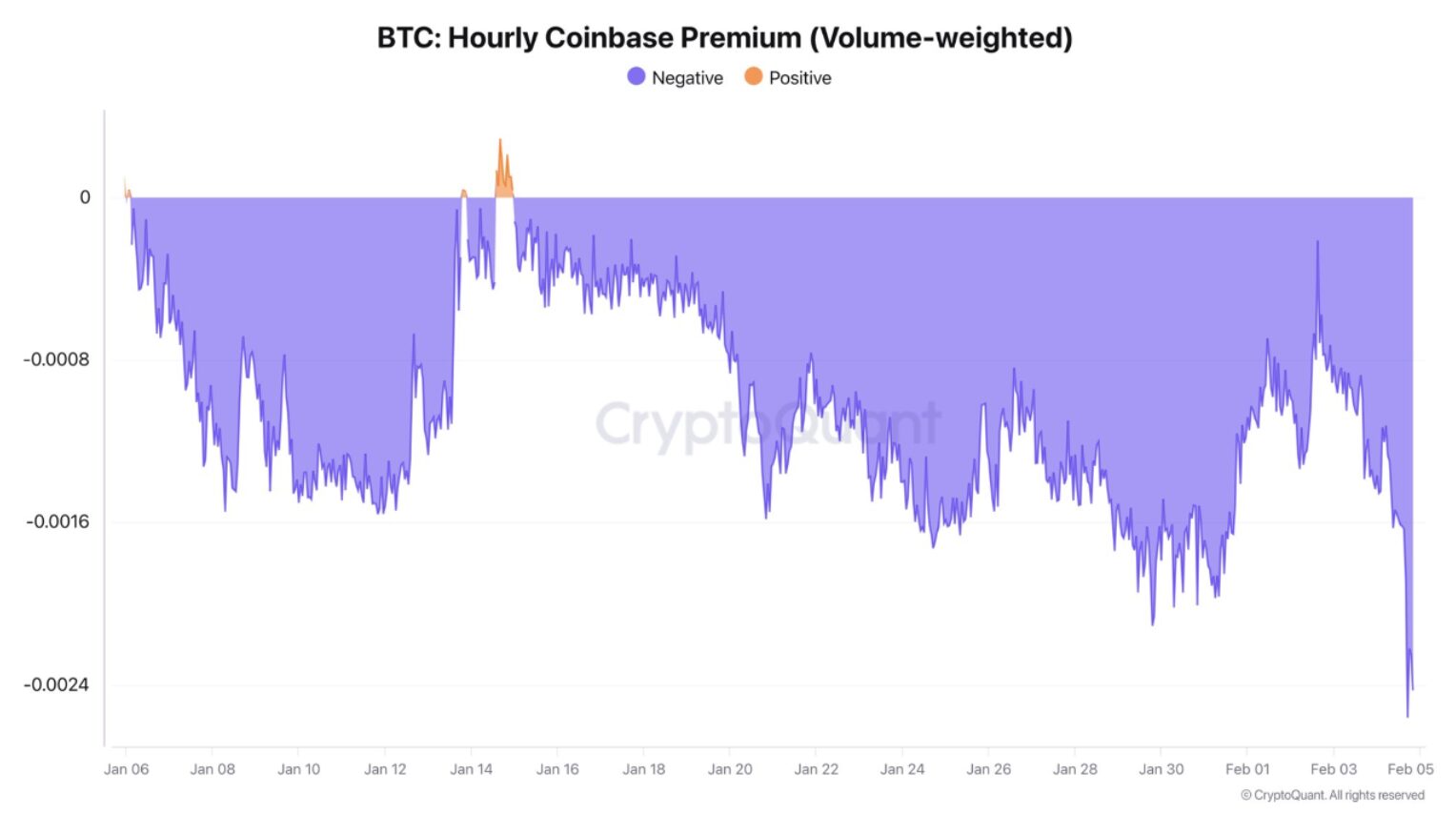
The Coinbase Premium indicator has been dropping. – Source: CryptoQuant
In other words, professional managers currently de-risk their portfolios in response to a global macro environment defined by extreme uncertainty. Precedent indicates such intense selling from “smart money” creates a heavy anchor on price, yet it also functions as a necessary clearing event that purges speculative excess.
Synchronized Selling Pressure From Whales
Beyond the institutional activity on Coinbase, a broader trend of synchronized distribution has emerged across multiple wallet cohorts. Recent on-chain data from analyst Carmelo Alemán reveals that holders of 10 to 100 BTC, 100 to 1,000 BTC, and even “Humpback” whales with over 10,000 BTC have concurrently reduced their balances.
To clarify, this unified selling behavior signals a transition from a long-term accumulation phase into a structural distribution phase.
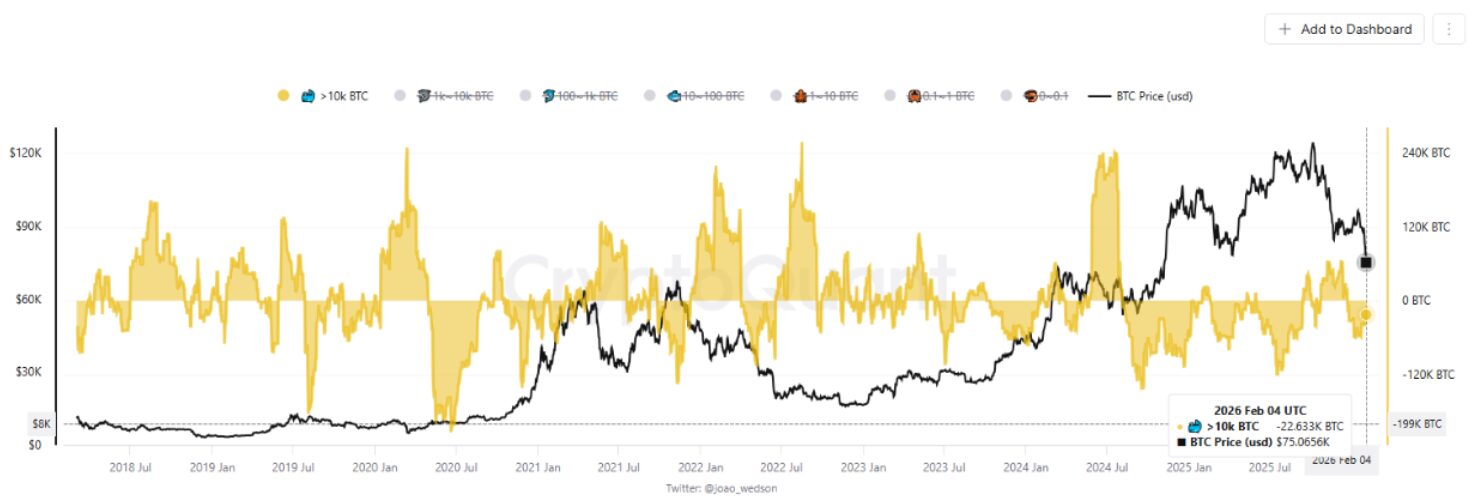
Whales holding 10K BTC are still in the distribution phase. – Source: CryptoQuant
Past data suggests the market views this alignment as a precursor to intense bearish moves, as these entities possess the liquidity required to dictate market direction. Whenever these diverse groups of heavyweights sell at once, the spot market typically struggles to absorb the sudden influx of supply.
Persistent ETF Outflows
Adding to this pressure, Bitcoin ETF products have experienced a notable reversal in capital flows. Vincent Liu from Kronos Research characterizes the current environment as a “perfect storm” driven by forced liquidations from over-leveraged longs and massive institutional outflows.
In the past 3 weeks, Bitcoin ETFs have witnessed net outflows of respectively $1.33B, $1.49B and over around $700M. Data proves that the risk-off macro backdrop has forced even the most sophisticated players to reduce exposure, accelerating the downward momentum.
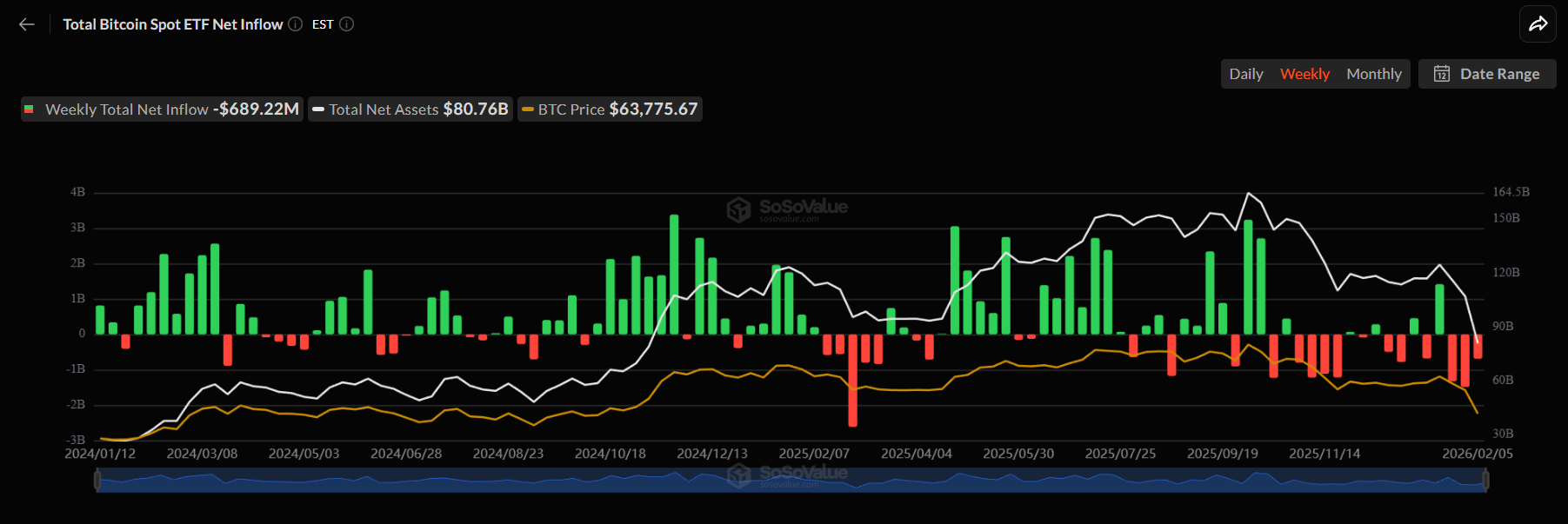
Bitcoin ETFs have seen outflows over the past 3 weeks. – Source: SoSoValue
Sluggish Derivatives Market
The derivatives data reinforces the bearish outlook. Notably, the Cumulative Volume Delta (CVD) for Bitcoin futures remains stuck in negative territory, proving that market sellers drive the price lower with aggressive market orders.
Instead of seeing passive limit orders provide a solid floor, we observe a scenario where long liquidations and short position openings amplify every downward move. Because buying liquidity has thinned out, the price remains highly sensitive to sharp dislocations, recently forcing a retest of the $60,000 – $66,000 support zone.
Never-Before-Seen Volatility Since FTX Crisis
Perhaps the most alarming development involves the Volmex Bitcoin Volatility Index (BVIV). Recently, this volatility gauge spiked to nearly 100%, a level of expected price turbulence not seen since the infamous collapse of the FTX exchange in 2022. By nearly doubling in a matter of days, the BVIV reflects a state of pure panic among participants.
In addition, a violent leverage unwind has devastated the market, resulting in $2.67 billion in total liquidations over the past day. Long positions accounted for a staggering $2.31 billion of that total, representing a massive flush of over-leveraged retail and institutional bets. During just one four-hour window, $817 million in positions vanished, highlighting the speed and violence of the current capitulation.
Looking Into Bitcoin Market Bottom Signals
While these technical breakdowns paint a bleak picture, a deeper look at holder psychology suggests that the final stage of the bearish cycle is possibly underway.
aNUPL Hints at Despair Phase
Analysis of the adjusted Net Unrealized Profit/Loss (aNUPL) by analyst MoneroDV_ on CryptoQuant shows that Bitcoin has re-entered a zone of average unrealized losses for the first time since the 2023 recovery. Currently, this indicator places the market firmly in the “Despair” phase of the cycle.
In the past, Bitcoin has seldom lingered in the negative aNUPL zone. Past occurrences, specifically in 2018, 2020, and the bear market of late 2022, have consistently functioned as prime accumulation windows for disciplined investors. With the typical holder currently facing unrealized losses, the psychological strain is intensifying, often driving a sense of urgent capitulation.
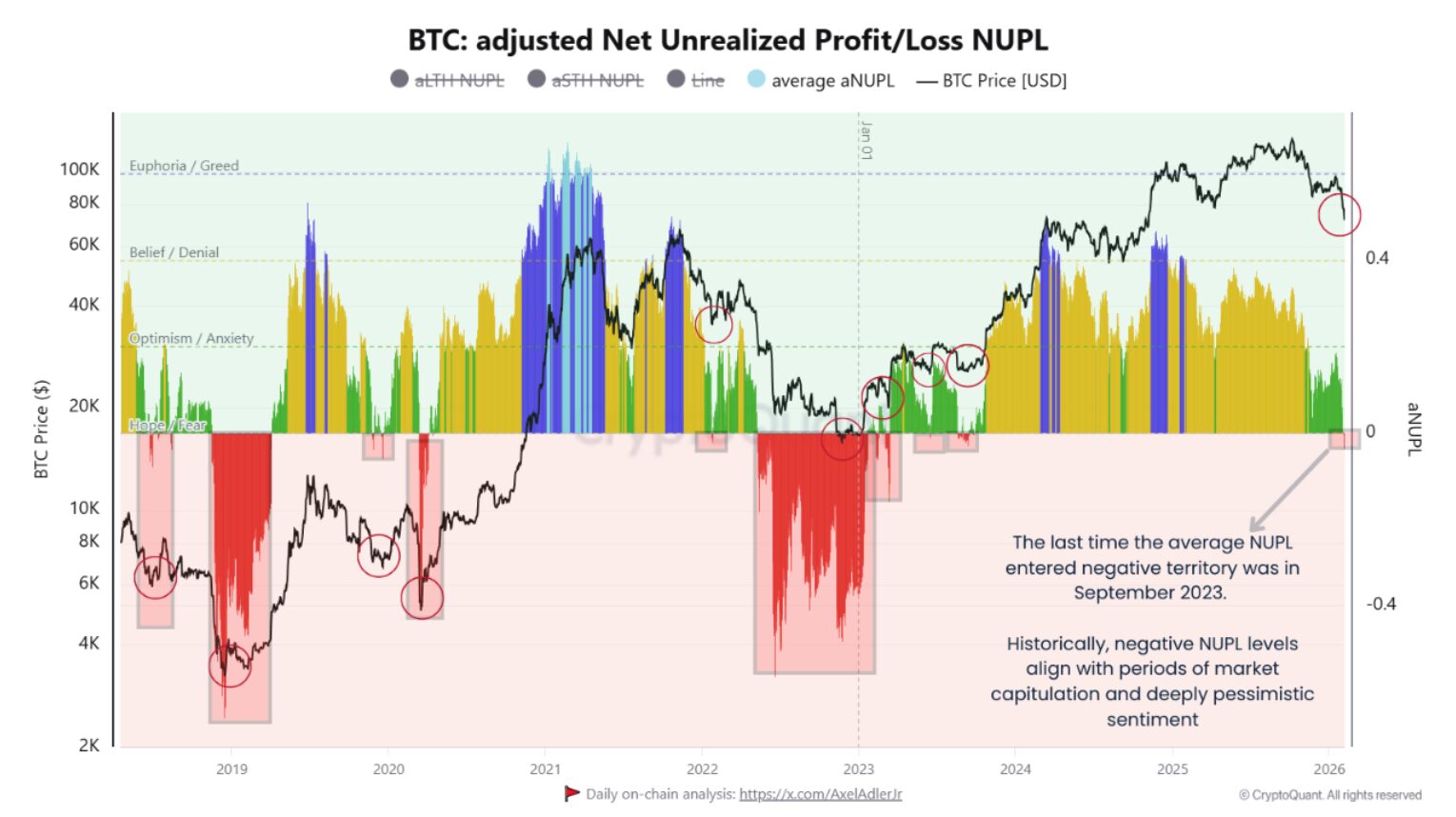
aNUPL finally enters the negative zone after 2023. – Source: CryptoQuant
Fear & Greed Index at Extremely Low Level
Supporting this view, the Crypto Fear & Greed Index has plummeted to a reading of 5, its lowest point since the index launched in mid-2023. Such a low score indicates that “extreme fear” has completely paralyzed the average participant. Looking back, the current sentiment marks the maximum point of financial opportunity for contrarian investors.
Interestingly, the swift disintegration of the euphoria seen in 2024 points toward a sharp “sentiment reset.” Rather than a slow, agonizing bleed, this rapid transition often leads to a shorter, more violent capitulation phase that effectively bottoms out the market.

