


South Korea’s financial watchdog opened an investigation into Bithumb after the exchange mistakenly credited hundreds of thousands of Bitcoin that it did not actually hold to user accounts.
The Financial Supervisory Service (FSS) launched a probe into Bithumb for alleged platform violations around the erroneous crediting of billions of dollars in non-existent Bitcoin (BTC) to user accounts, Yonhap News reported Tuesday.
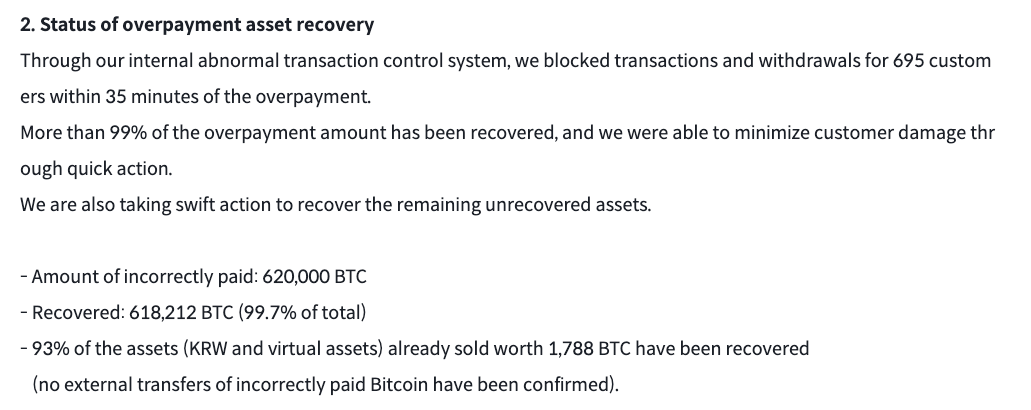
Bithumb acknowledged the incident on Saturday, saying the platform “incorrectly paid” 620,000 BTC ($42.8 billion) to users during a promotional event.
While the exchange recovered most of the miscredited BTC, about 125 BTC ($8.6 million) remains unsettled, raising questions about operational risks at centralized exchanges (CEXs) and fueling community concerns over “paper Bitcoin.”
Authorities point to multiple alleged violations by Bithumb
Although Bithumb said the incident did not result in any loss or damage to customer assets, South Korea’s financial authorities have flagged its potential implications for the broader market.
“We are taking this case very seriously,” an FSS official reportedly said, adding: “The FSS will take stern legal actions against acts that harm the market order.”
The regulator highlighted Bithumb’s alleged violations, including mismatches between crypto held in its wallets and amounts credited to user accounts.
The FSS also cited deficiencies in Bithumb’s internal controls, noting that the error stemmed from a single point of failure — one staff member was reportedly responsible for the incorrect BTC crediting.
“Paper Bitcoin” concerns intensify
“The 620,000 BTC were not ‘real’ Bitcoin,” CryptoQuant analyst Maartunn told Cointelegraph, adding that the credited BTC existed purely in a virtual form and were visible only within Bithumb’s internal systems.
The exchange’s promotional event, which was intended to reward users with 2,000 South Korean won ($1.40), resulted in 2,000 BTC per user due to an employee mistakenly entering “BTC” as the currency unit instead of “won,” he said.
“To put in into perspective, Bithumb currently holds around 41,798 BTC in reserves, far less than the virtual 620,000 BTC that shortly existed on its books,” Maartunn said, adding that some users did benefit from the incident:
“Around that time, 3,875 BTC, or around $268 million, were withdrawn from the exchange. This may partly reflect users who managed to withdraw the mistakenly credited BTC, but it could also indicate a broader loss of confidence among other users.”
The figures reported by Bithumb are therefore lower than what the onchain data suggests, Maartunn said.
Cointelegraph approached the FSS and Bithumb for comment regarding the reported investigation, but had not received a response by publication.
Related: Bernstein calls Bitcoin sell-off ‘weakest bear case’ on record, keeps $150K 2026 target
Bithumb’s news adds to growing community concerns over “paper Bitcoin,” or Bitcoin that does not exist on the blockchain but is traded on CEXs or stock exchanges in the form of products like derivatives and exchange-traded funds.
Some even suggested that paper Bitcoin trading has contributed to the ongoing market turmoil, with Bitcoin losing around 43% of its value since October 2025.
Magazine: Bitcoin difficulty plunges, Buterin sells off Ethereum: Hodler’s Digest, Feb. 1 – 7