


Binance and Crypto.com are two leading cryptocurrency exchanges, each with millions of users worldwide. Binance is generally known for having massive trading volume, advanced trading features and charting tools, and really low fees, while Crypto.com is best for its user-friendly mobile app, easy fiat on-ramp, and crypto Visa cards with cashback.
In this guide, we’ll compare Binance vs Crypto.com side by side based on supported coins, trading features, fees, ease of use, security measures, regulatory compliance, and more.
Binance vs Crypto.com: Quick Comparison
| Feature | Binance | Crypto.com |
| Founded | 2017 (by Changpeng Zhao) | 2016 (by Kris Marszalek) |
| Headquarters | No single global HQ | Singapore |
| Global User Base | 250 Million+ | 100 Million+ |
| Daily Trading Volume | $20 Billion+ (Spot) | $1 Billion+ (Spot) |
| Spot Trading Fees | 0.1% (Standard) | 0.25-0.5% (Exchange) / Variable Spread (App) |
| Futures Trading Fees | 0.02% Maker / 0.05% Taker | 0.02% Maker / 0.04% Taker |
| Supported Coins | 500+ (Global) | 350+ (App) / 250+ (Exchange) |
| Native Token | BNB (Binance Coin) | CRO (Cronos) |
| Fiat Currencies | 50+ (USD, EUR, GBP, AUD, etc.) | 20+ (USD, EUR, GBP, CAD, etc.) |
| Deposit Methods | Bank Transfer, Card, P2P, Crypto | Bank Transfer, Card, Crypto |
| Debit Card | Binance Card (Limited regions) | Visa Card (Metal, Tiered Rewards) |
| Security Fund | SAFU Fund ($1 Billion+) | $750M Insurance Policy |
| US Availability | Binance.US (Very Limited) | Widely Available (App & Exchange) |
| Customer Support | 24/7 Live Chat, Twitter | 24/7 In-App Chat |
| KYC Requirement | Mandatory for all users | Mandatory for all users |
| Passive Income | Earn, Launchpool, Staking | Earn, Supercharger, Staking |

Exchange Background and Market Position
Binance is currently the largest cryptocurrency exchange in the world by trading volume and has held that spot for years. Generally, it dominates the market because it moved fast to offer every feature imaginable, from spot trading to futures and even mining pools. This massive adoption of its services can be estimated by its user base, which passed the 250 million mark in the year 2025. The main reason people love Binance is because of its high liquidity.
Crypto.com launched slightly earlier, in 2016, with the goal of ensuring “cryptocurrency in every wallet.” Frankly, they have generated their fame through branding and marketing, purchasing the naming rights to the “Crypto.com” in LA. Their user base has also grown impressively to over 100 million people, and those are largely driven by their easy mobile app and debit card program. Although they maintain a good trading volume, it is quite lower compared to Binance, with sums sometimes going as low as $1-$2 billion versus Binance’s $10-$20 billion per day.
Trading Volume and Liquidity Comparison
Binance absolutely dominates the market when it comes to trading volume and liquidity. You see, because so many people trade on Binance, you can usually fill large orders instantly without any price slippage. It handles billions of dollars in trades every single day. Currently, it ranks #1 crypto exchange in terms of trading volume and liquidity, according to CMC data.
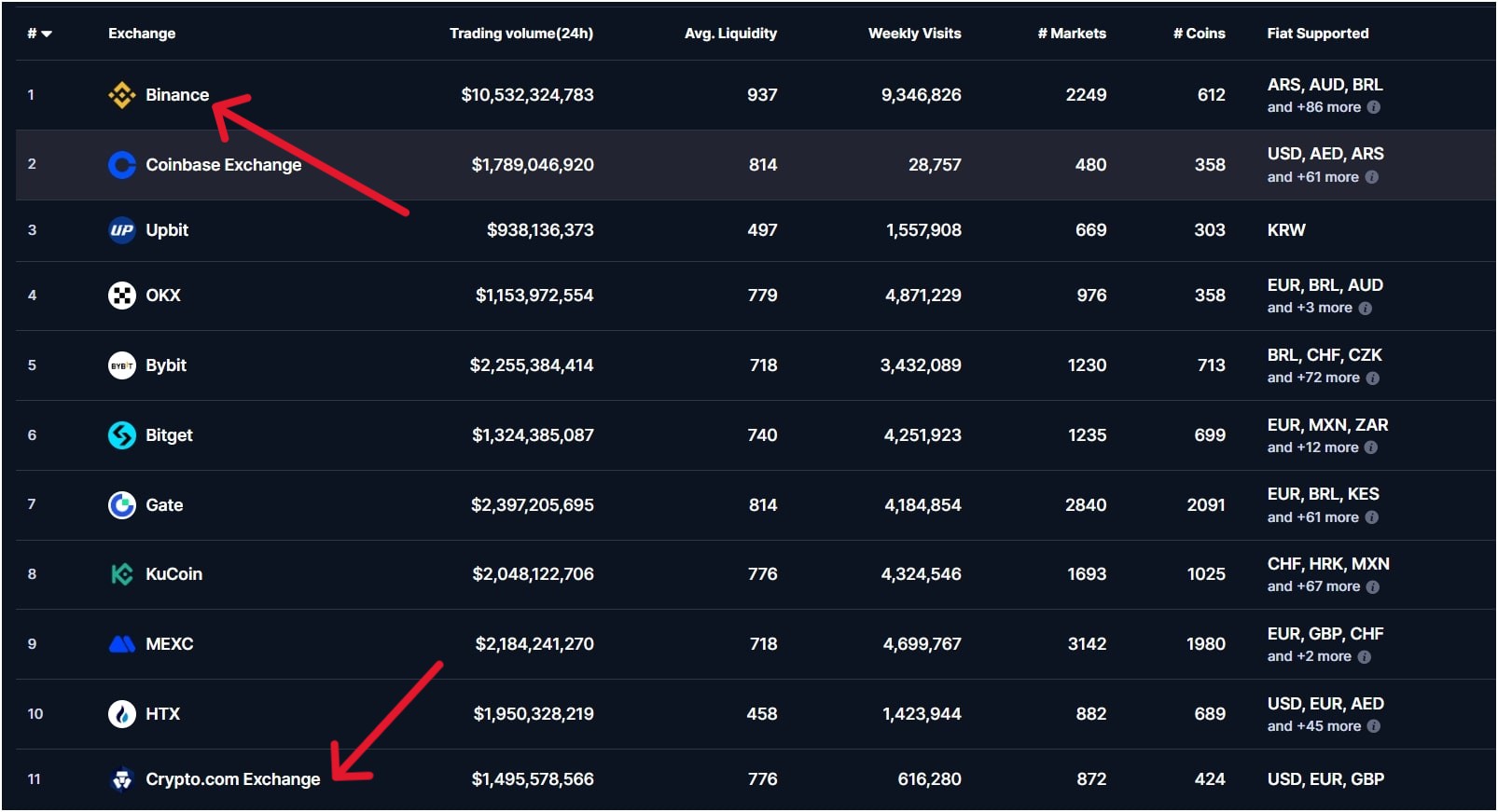
Crypto.com also has a respectable amount of volume, but obviously, it is significantly lower than Binance. While you won’t have trouble buying popular coins like Bitcoin or Ethereum, you might find slightly less liquidity on smaller altcoins compared to Binance. But again, for most regular users, the liquidity on Crypto.com is totally fine, but professional traders will almost always prefer the order book depth found on Binance.
| Metric | Binance | Crypto.com |
| Total Registered Users | ~250 Million | ~100 Million |
| 24h Spot Volume | ~$ 10-20 Billion | ~$1-2 Billion |
| 24h Derivatives Volume | ~$50 Billion | ~$4 Billion |
| Liquidity Score | Very High (Top Tier) | High (Good for Retail) |
Trading Platforms and Features
The top unique features of Binance are:
- Spot and Futures Trading: Binance supports both spot and futures trading for over 500 crypto assets. It offers perpetual futures contracts with up to 125x leverage and also offers margin trading with 10x leverage.
- Binance Launchpad: You can get exclusive access to new token launches before they hit the general market. Also, pretty often, these tokens pump in value right after launching, and hence, making this a favorite feature for investors.
- Binance Earn: You can find dozens of ways to grow your crypto here, from simple savings accounts to complex dual-investment products. It is like a high-yield savings account, but for almost any coin you hold.
- Binance Pay: You can send crypto to friends or pay merchants instantly with zero fees. You just need to scan a QR code, and the money moves directly from your funding wallet.
- Trading Bots: You can set up automated bots to buy low and sell high without doing the work yourself. Binance lets you use grid bots and rebalancing bots right inside the app for free.
- P2P Marketplace: Here, you can easily buy crypto directly from other people using hundreds of local payment methods. So, let’s say, if you are in India, you can use your local options like UPI, PhonePe, Google Pay, etc. It is really useful if your bank blocks direct transfers to crypto exchanges.
- Web3 Wallet: You can switch easily between the centralized exchange and a decentralized wallet. Well, to be exact, it lets you explore DeFi apps without leaving the Binance ecosystem. You can also read our in-depth Binance review for more info.
The top unique features of Crypto.com are:
(Well, Crypto.com is definitely an “app-first” company, meaning their mobile experience is the main product).
- Metal Visa Cards: You can get a sleek metal debit card that pays you cashback in crypto, and depending on how much CRO you stake, you also get perks like free Spotify, Netflix, and airport lounge access.
- Missions & Rewards: You can earn “Diamonds” for completing simple tasks like reading articles or making small trades. Eventually, you can trade these diamonds for mystery boxes that contain actual crypto rewards.
- Strike Options: You can actually trade simple “Yes or No” contracts based on whether a price will hit a target. You see, it simplifies complex trading into a very easy-to-understand format for beginners.
- Crypto.com Pay: It allows you to buy gift cards for popular stores using your crypto and get cashback instantly. So, it is a great way to actually spend your Bitcoin or Ethereum in the real world.
- Supercharger: You can deposit your CRO tokens into a liquidity pool to earn new, popular tokens as a reward. Well, it is kind of like mining, but you don’t need any expensive hardware to do it. Also, you can read our Crypto.com review for more details about its trading features.
Supported Cryptocurrencies and Markets
Binance lists over 500 different cryptocurrencies on its global platform. Hence, it gives you access to a huge variety of altcoins. Well, you will find almost every major token here, plus a lot of smaller and newer projects that are often listed on Binance before other major exchanges. They offer a massive number of trading pairs, including pairs with USDT, FDUSD, USDC, TUSD, and BNB. So, for example, you can trade BTC/USDT, BTC/FDUSD, or even ETH/BTC directly.
Crypto.com supports around 350+ cryptocurrencies in its main app, and yes, it is comparable to Binance now. They do a great job of listing the popular coins and the “flavor of the month” tokens that people are talking about quickly. Now, in their separate Exchange app, you might find fewer trading pairs, mostly focused on USDT, USD, and CRO pairs. So, you can trade BTC/USD directly in the app, or BTC/USDT on the exchange.
Trading Fees and Cost Structure
Binance is best for having competitive trading fees. You standardly pay just 0.1% per trade for spot trading.
Now, Crypto.com has a more complicated fee structure because the main App and the Exchange are different. Generally, on the Crypto.com App, you actually don’t pay a visible fee, but you pay a “spread.” To be exact, this means that the price you buy at is slightly higher than the real market price, which can sometimes cost you anywhere from 0.5% to 2%, depending on volatility. But on their separate Exchange platform, fees are competitive, starting at 0.25% maker and 0.5% taker.
Hence, Crypto.com charges very high fees compared to Binance, up to 5 times, to be exact.
Here is the full comparison between Binance vs Crypto.com based on how users pay trading fees across different fee types:
| Fee Type | Binance | Crypto.com |
| Standard Spot Maker Fee | 0.10% | 0.25% |
| Standard Spot Taker Fee | 0.10% | 0.5% |
| Standard Futures Maker Fee | 0.02% | 0.02% |
| Standard Futures Taker Fee | 0.05% | 0.03% |
| Fee Discount | 25% off if paid in BNB | Paid in CRO (up to 12% off) |
| Fiat Deposit Fee | varies (often free for bank transfer) | Free (for most bank transfers) |
| Fiat Withdrawal Fee | varies by currency/method | varies by currency/method |
| App Trading Cost | Same as web (0.1%) | Spread (can be 0.5% – 2.0%+) |
Fee Discounts: BNB vs CRO Explained
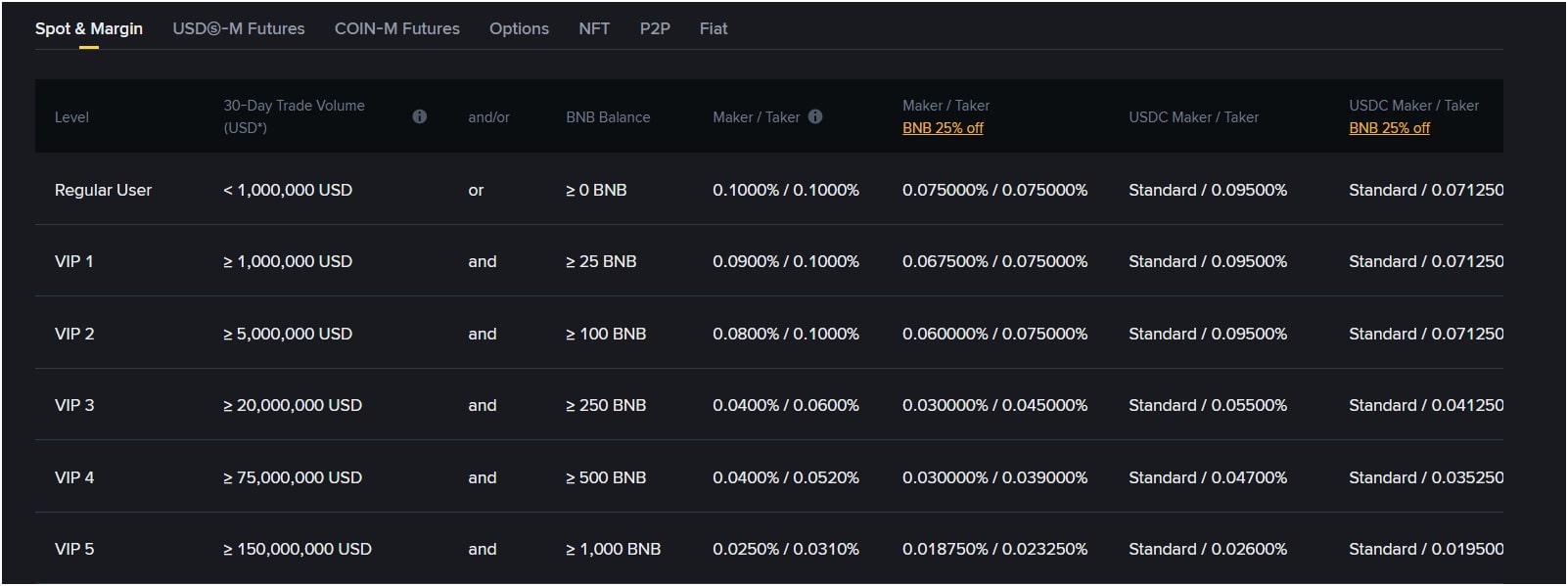
You can lower your trading fees on Binance by using their native token, BNB. Well, if you choose to pay fees with BNB, you can instantly get a 25% discount, and that brings your fee down to 0.075%. That is a pretty sweet deal if you trade often. Plus, holding more BNB can bump you up to VIP levels where fees get even lower.
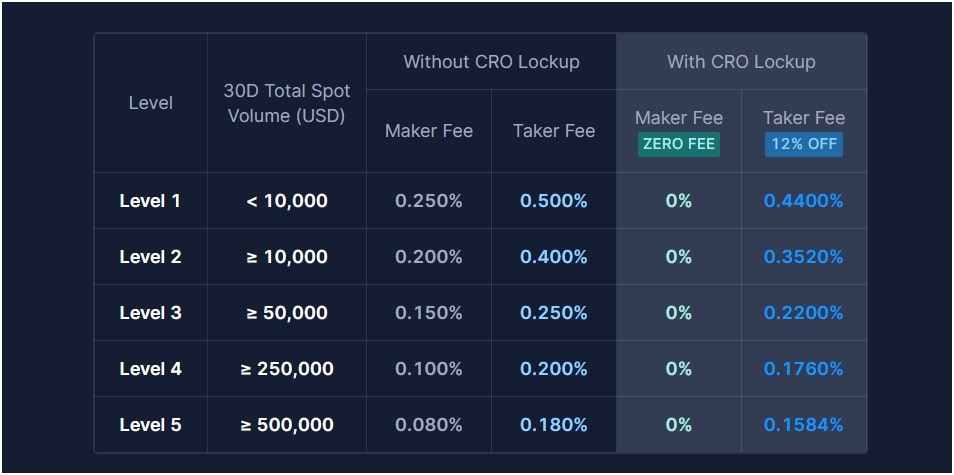
Crypto.com also uses its own token, CRO, to give you benefits, but it works differently. You need to lock up (stake) a significant amount of CRO to get fee discounts on their Exchange (1,000 – 50,000 CRO to start with). You see, while holding CRO does give you trading discounts and higher interest rates in their Earn program, you don’t get a simple “toggle” discount like Binance offers for spot trading.
Security and Asset Protection Measures
Binance and Crypto.com both use strong security practices, and both exchanges store most customer funds offline in cold storage, use industry-standard encryption, and require two-factor authentication (2FA).
They run regular security audits and even have dedicated security teams constantly monitoring for threats. You know, practically, no system is perfect, but your crypto is held under similar safety standards on both platforms.
Binance Security Framework
Binance uses multiple security protocols to safeguard your digital assets. Now, first, they basically use cold storage for a large portion of funds. Well, reportedly over 95% of assets are kept offline. That means those funds can’t be stolen by remote hackers. Also, any withdrawals require multiple confirmations and can be whitelisted to only go to specific wallet addresses.
Binance also has its Secure Asset Fund for Users (SAFU). It is a $1 billion (and growing) fund set aside to cover user losses in some extreme situations. You see, after the 2019 hack (where about $40M was stolen), Binance actually covered all user losses from the SAFU fund.
Now, many of the other popular security features include mandatory 2FA, login and withdrawal alerts, device management, and an anti-phishing code you can set. Plus, they hire external auditors and even have a bounty program for bug hunters.
Crypto.com Security Framework
Crypto.com also locks most funds in cold storage crypto wallets (around 90% offline), similar to Binance, and it uses multi-signature tech and holds assets with secure custodians as well. Here are its other security features:
- $750M Insurance: They have a direct insurance policy of $750 million to cover physical damage or theft, and this one is a traditional insurance policy that adds a layer of trust.
- Account Protection Program (APP): They offer to restore funds up to $250,000 if your account is compromised. Here, you generally have to meet certain conditions, like having MFA enabled.
- SOC2 Compliance: Crypto.com was one of the first crypto exchanges to get SOC2 Type 1 and Type 2 compliance. Basically, this means an outside auditor proved they actually manage data securely.
- Hardware Security Modules (HSM): They use strict physical hardware to generate and store keys, and this is military-grade tech that prevents digital theft of private keys.
- Multi-Factor Authentication (MFA): They force you to use MFA for critical actions like adding a new withdrawal address, and you literally cannot move money without proving it is you multiple times.
Mobile App Experience and Ease of Use
Basically, between Binance and Crypto.com, Crypto.com’s app is generally considered more beginner-friendly, while Binance’s app is more advanced (and complex as well). You see, if you’re new to crypto, Crypto.com offers a clean and much simpler interface. The home screen is easy to navigate: you’ll see all your balances, a big buy/sell button, and even quick links to things like your card and staking. The design is modern and uncluttered.
Binance’s mobile app can be switched between Lite and Pro modes. The Lite mode simplifies things (showing a basic buy/sell interface only), whereas the Pro mode reveals all of Binance’s functions: advanced charts, futures, copy trading, margin, etc. Hence, in Pro mode, everything is at your fingertips, but it can look busy for beginners who don’t have much knowledge.
Visa Cards and Payment Ecosystem
Crypto.com really wins when it comes to crypto debit cards. Their metal Visa cards are iconic and offer amazing perks like free Spotify, Netflix, and airport lounge access depending on your tier. You can easily earn cashback in CRO on every purchase, and this can go up to 5% or even 8% for the highest levels. Yes, you do have to stake CRO to get the good cards, but the rewards are tangible.
Also, Binance offers a Visa card, but it is less flashy. You can earn cashback in BNB, and the percentage depends on how much BNB you hold in your wallet. The rewards range up to 8%, but most users typically get around 1-2% depending on the country. Also, it works well and lets you spend your crypto, but it doesn’t come with the lifestyle perks like free subscriptions that Crypto.com offers. Also, the Binance card has faced some availability issues in certain regions recently.
Staking, Earn, and Passive Income Options
Binance has an “Earn” feature that helps you choose the coins to stake and earn passive income from them. The options in the Earn feature include flexible savings (which allow withdrawal at any time) and fixed savings (which require locking coins for specified terms).
Generally, Binance supports dozens of assets, from stablecoins to altcoins, and the rates depend on market demand. Binance also offers special products like BNB Vault (auto-staking of certain assets) and Launchpool (stake tokens to earn new project tokens).
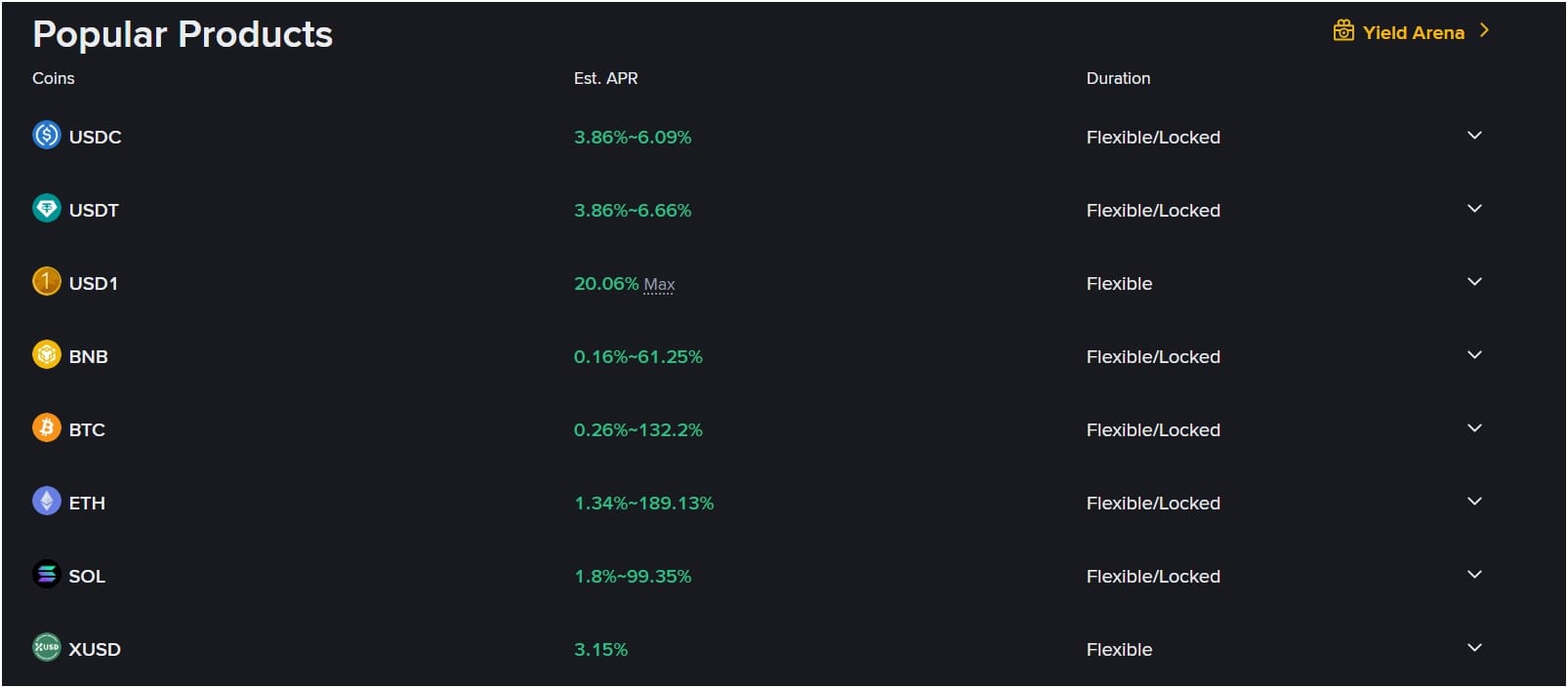
Crypto.com has a program simply called “Earn.” It allows the user to lock their crypto or stablecoins for either a flexible or fixed term. The interest rates differ; stablecoins or CRO provide a higher interest rate compared to the main cryptos, such as Bitcoin or ETH. However, on the Crypto.com exchange platform, staking of CRO is mandatory if the user is to enjoy the best rates. There are other programmes on the platform as well, such as the “Supercharger,” for additional gains through “liquidity mining.”
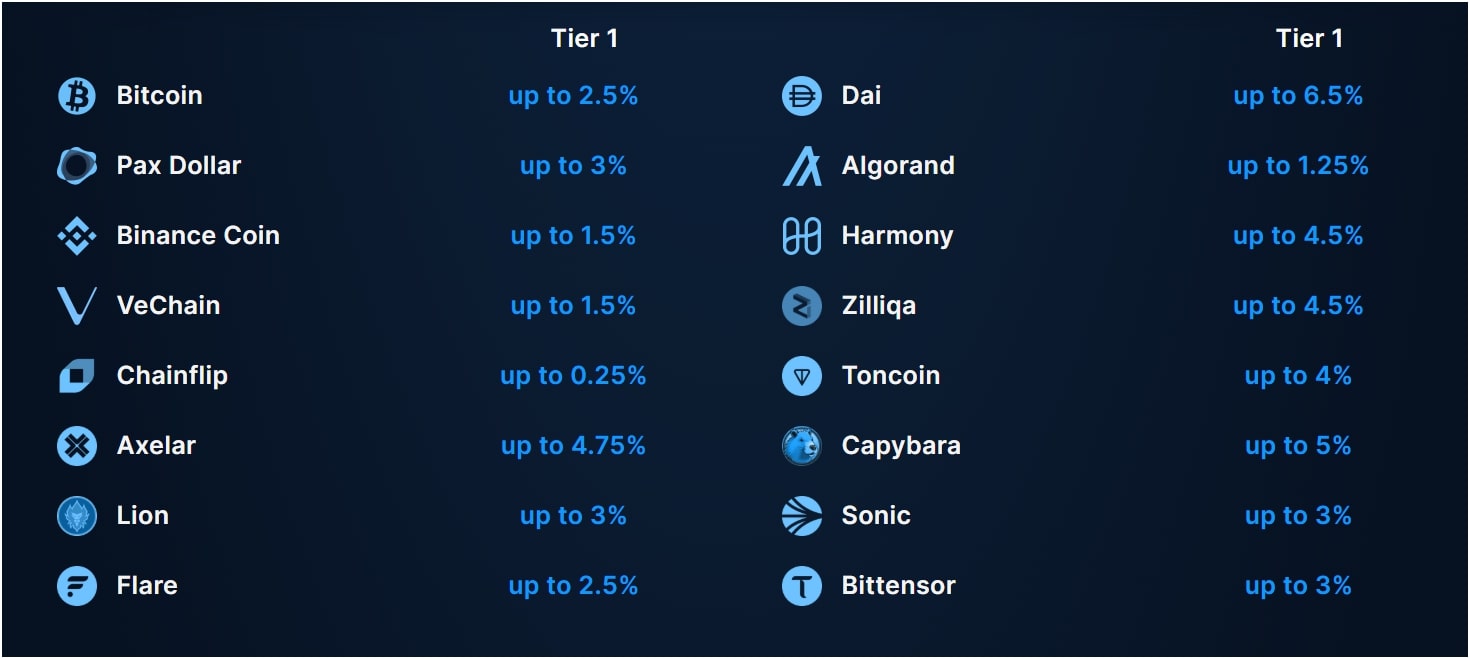
Regulatory Compliance and Global Availability
Crypto.com has gone all in on licenses: it has EU, US, UK, Singapore, and many other approvals. Binance has been more loose; for years, it didn’t even have a main headquarters, though it’s now setting up regulated entities (like in Abu Dhabi and Brazil).
In the last few years, Binance have worked hard to get licensed in various countries, but they still face restrictions in places like the US (where they have a separate, smaller exchange called Binance.US) and parts of Europe. Crypto.com is available in most U.S. states (except some, like New York) with a single account.
Binance was also banned or restricted in some countries in the past, like the UK, Canada, and Australia, causing them to pull out of certain markets entirely. But again, Binance has secured licenses in some key regions to prove it is playing by the rules. To be exact, they are now fully regulated in France (AMF registration), Italy (OAM registration), and Dubai (VARA license). Plus, they also hold licenses in Spain, Sweden, and Japan.
Now, Crypto.com holds some of the most respected licenses in the world, and those names include the Major Payment Institution (MPI) license in Singapore and registration with the FCA in the UK. They are also registered as a Digital Asset Service Provider (DASP) in France and even have regulatory approval in South Korea, Dubai, and Australia.
Quick Tip: Well, if you need a fully regulated crypto trading platform (especially in the US, Europe, or Singapore), Crypto.com is generally the safer choice, but if you are outside those regions and want broad product access, Binance actually provides it (but you should make sure it’s legally allowed where you are).
Ecosystem and Long-Term Vision
Binance is actually trying to be the infrastructure for the entire blockchain world. You know, they have the BNB Chain (BSC), which is a huge network for decentralized apps. They bought CoinMarketCap, they have a massive NFT marketplace, and they are heavily involved in Web3 development. You can say that their vision is basically to be the Google of crypto.
Actually, Crypto.com is focused more on mass adoption and payments. They want to be the bridge between traditional finance and crypto. Well, their vision is “cryptocurrency in every wallet,” and they want to achieve this through their card program and payment gateway. They are building their own chain, Cronos, which is growing, but their main long-term vision is consumer finance.
Recent Developments Worth Noting
You see, in the last year or so, both platforms have had news. Binance has seen some leadership shifts (co-founder Yi He became co-CEO) and has regulatory progress as well (approvals in Brazil and Abu Dhabi). It also cracked down on misuse: banning accounts that use unauthorized trading tools and warning about listing scams. Also, Binance continues to add new coins to its exchange and tries out new products (like a new wallet or payments service).
Crypto.com also hit milestones, as it has gained a suite of US financial licenses (making it stronger in the US), launched more banking partnerships in Singapore, and expanded its custody services. Now, on the product side, it relaunched its NFT marketplace and improved its Earn program after rates had dipped. Today, Crypto.com also sponsors big global events and teams (like car races and soccer).
Which Exchange Is Better for You?
Binance is better for you because of its low fees, high trading volume, advanced trading tools, more altcoins and new meme coins, and a P2P portal for easy fiat-to-crypto conversion.
- Lowest Fees: You simply won’t find cheaper spot trading fees than 0.1%, especially if you hold a little BNB to get the extra discount.
- Massive Liquidity: You can trade huge amounts without slippage because the volume is so high, and this also ensures you always get the price you expect.
- Advanced Tools: You get access to professional charts, trading bots, copy trading, futures trading, and order types that allow you to execute complex strategies easily.
- More Coins: You have access to a wider library of new altcoins that might not be listed anywhere else yet. Mainly, you can trade new meme coins on Binance Alpha on-chain using the Binance main funds.
- P2P Options: You can move money in and out using local payment methods through their Peer-to-Peer market. Well, their P2P platform is available in almost every country with a massive local user base.
Crypto.com is better for you because of its user-friendly mobile app, metal Visa card, higher regulatory compliance, easy fiat on-ramp, and support for multiple local fiat currencies.
- Beginner Friendly: You will find the Crypto.com mobile app incredibly intuitive and easy to navigate, making your first crypto purchase totally stress-free.
- Metal Visa Card: You can carry a premium metal card that gives you real-world perks like free Netflix and cashback on groceries.
- Safety & Compliance: You can feel safer knowing they prioritize regulatory licenses and have top-tier insurance policies for your cryptocurrency assets.
- Fiat On-Ramp: You can easily deposit money from your bank account in many different currencies without jumping through hoops.
- Local Currency Support: You can view your portfolio and make transactions in your local currency more easily than on many global crypto exchanges like Binance.
Conclusion: Binance or Crypto.com – Which Crypto Exchange Fits You Best?
To sum up our Crypto.com vs Binance review, both are top-tier trading platforms, and you honestly can’t go wrong with either for basic buying and selling. Binance is the powerhouse for traders who care about liquidity, low fees, and having every feature imaginable. Crypto.com is a more polished, user-friendly option that bridges the gap between your bank account and your crypto wallet.
Eventually, it comes down to your location and your style. So, if you value advanced trading tools, deep liquidity, low fees, and variety, Binance is probably the better fit. But again, if you value a simpler mobile app, spending your crypto via a card, and possibly staking for bonuses, Crypto.com could be the one that fits you best.
But again, in the end, you can actually choose to use both: trade actively on Binance, and use Crypto.com for its card and passive earnings.
Frequently Asked Questions
- Is Binance cheaper than Crypto.com for trading?
Yes, Binance is generally much cheaper for spot trading because they charge a flat 0.1% fee on trades. Crypto.com often uses a spread in their main app, which can result in you paying significantly more than 0.1% per transaction, around 0.5-2% to be exact.
- Which exchange is actually safer for my money?
Both exchanges are considered very safe, but they use different safety nets for your funds. Binance relies on its self-funded SAFU pot to cover losses, while Crypto.com uses traditional insurance policies and has more regulatory licenses in Western countries like the USA.
- Can I use the main Binance platform in the US?
No, you absolutely cannot use the global Binance.com platform if you live in the United States. Well, you are forced to use Binance.US, which has way fewer coins, lower liquidity, and fewer features compared to the main site.
- Which app is better for a total beginner?
Crypto.com is definitely the better choice if you have never bought cryptocurrency before today. The interface is basically designed to look like a standard banking app, removing all the scary charts and complex numbers that make Binance confusing.
- Do both exchanges require me to upload my ID?
Yes, both Binance and Crypto.com have strict Know Your Customer (KYC) policies that you must follow. You cannot trade, deposit, or withdraw on either platform until you verify your identity with a government-issued ID.

