


The outline of the largest Roman villa ever known in Wales has come to light three feet underground, and the experts behind the find are calling it a possible equivalent to Pompeii.
“My eyes nearly popped out of my skull,” project lead Alex Langlands, co-director of Swansea University’s Centre for Heritage Research and Training, told the BBC of the moment that ground-penetrating radar revealed the “huge structure” beneath a historical deer park. It measures over 6,000 square feet. The villa’s remains may be especially well preserved because they lie under a historical site that has not been built upon.
Langlands may have been “playful” in invoking Pompeii, the rich archaeological site in Italy buried under ash in C.E. 79 by the eruption of Mount Vesuvius, but told the BBC that the parallel is “in part justified because of the levels of preservation here.” The site is in Margam Country Park, an 850-acre site including a 12th-century Cistercian monastery, a 19th-century castle, and an 18th-century orangery.
“This is an amazing discovery,” saiud Langlands in a press release. “We always thought that we’d find something dating to the Romano-British period, but we never dreamed it would be so clearly articulated and with so much potential in terms of what it can tell us about the elusive first millennium AD here in South Wales.”
The building, which Langlands described as “really impressive and prestigious,” includes a corridor villa with two wings and a veranda, measuring about 140 feet long, with as many as six rooms in the front and eight at the rear. “Almost certainly you’ve got a major local dignitary making themselves at home here,” he said, describing it as “the centre of a big agricultural estate.”
“There’s a really exciting prospect that we’ve got really good survival of archaeological evidence and the potential therefore to tell a huge amount about what life was like back in the first, second, third, fourth and maybe even into the fifth century,” Langlands said, adding that the site may offer “unparalleled information about Wales’ national story.”
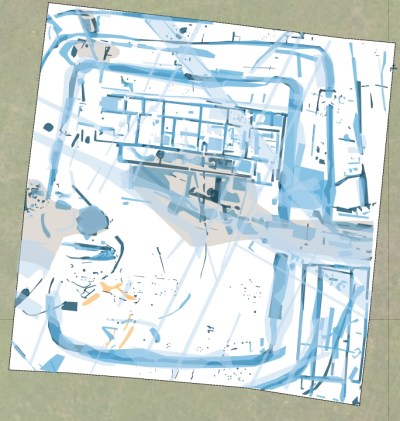
An artist’s interpretation of a ground penetrating radar survey of the villa site.
Terradat
“This part of Wales isn’t some sort of borderland, the edge of empire,” Langlands went on. “In fact there were buildings here just as sophisticated and as high status as those we get in the agricultural heartlands of southern England.” This find may “rewrite the way we think about south Wales in the Romano-British period,” he said.
The majority of Roman villas that have come to light in Wales were military camps and forts. Impressive residences such as this one are less common, notes the BBC.
The research team includes experts from Swansea University’s Centre for Heritage Research and Training along with Neath Port Talbot council and Margam Abbey Church.
The exact location of the villa is being kept under wraps for now to avoid it being targeted by looters. More information will be shared at Margam Abbey on January 17.