


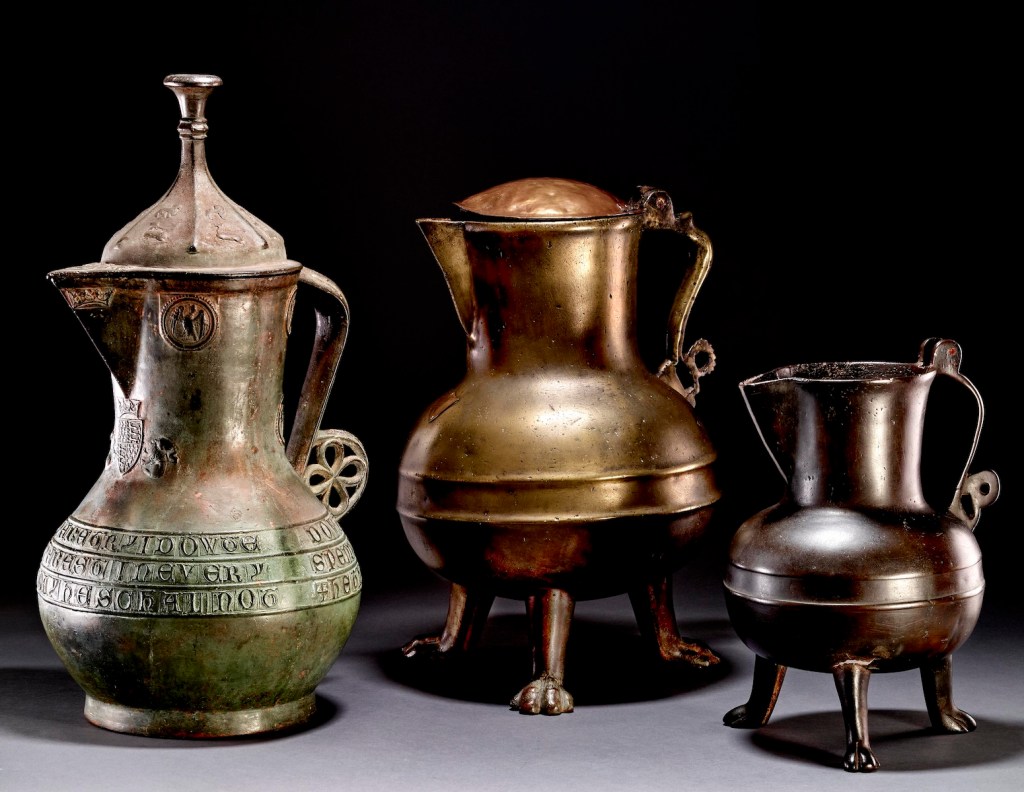
A 14th-century English-made ewer may soon head to Ghana on long-term loan from the British Museum, according to the Art Newspaper. Known as the Asante Ewer, the lidded bronze jug is a rare example of medieval English bronze casting. At some point in its history, the object found its way to Kumasi, capital of the Ashanti (Asante) Kingdom, now Ghana.
It is not known when, why, or by whom the vessel was transported to Africa from England, although it is thought to have been presented to an Ashanti king in the 14th or 15th century. An 1884 photograph clearly shows it (along with the middle jug in the photo above) in the courtyard of a royal palace in Kumasi. Placed under a sacred tree, it may have served a ritual purpose.
The ewer itself is the largest extant bronze vessel made in medieval England and was probably intended to hold wine. It could hold a bit over four gallons, and when filled it likely took two people to carry it. It has the Royal Arms of England on its neck and an English inscription in Lombardic script around its belly. An image of a stag on the ewer’s neck suggest it was originally made for Richard II.
In 1896, during the Fourth Anglo-Asante War, the ewer was looted from the royal palace by British forces—it was subsequently sold to the British Museum. Following preliminary discussions, it is expected that Ghana will soon make a formal request for a loan of the vessel. If the loan is approved, the jug will go on view at the Manhyia Palace Museum in Kumasi. The loan will be long-term, and Ghana is not expected to ask for repatriation of the artifact.