


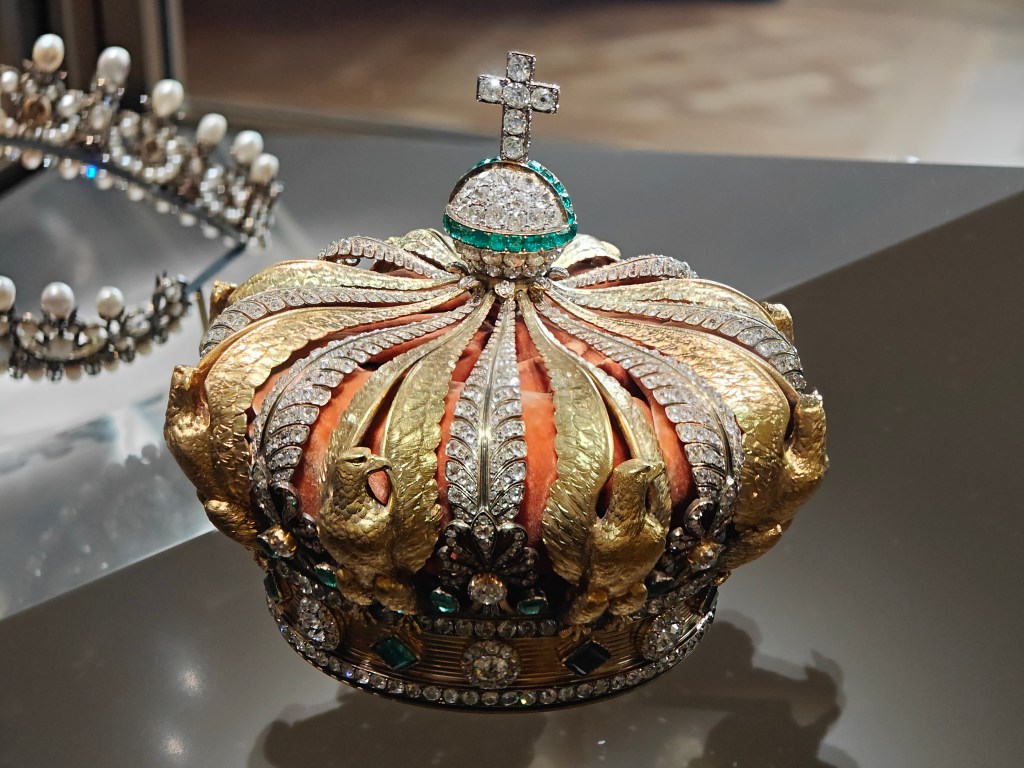
When thieves broke into Paris’s Louvre on October 19 last year, they ran off with an estimated $102 million in jewels. In their scramble to escape, however, they left behind what may have been top of their loot list: the crown of Empress Eugénie. Dropped and badly damaged during the heist, the diamond- and emerald-encrusted crown is now slated for a painstaking restoration before it returns to public view in the museum’s Galerie d’Apollon.
Judicial police initially seized the crown as evidence, transferring it to the Louvre’s department of decorative arts the next day. Olivier Gabet, the department’s director, and deputy director Anne Dion immediately conducted a condition report. Their findings revealed extensive damage.
The crown, lightweight and flexible by design, had been severely deformed. Investigators determined that the thieves used an angle grinder to cut through the glass display case, but the opening proved too narrow for the object. One of the crown’s arched hoops broke off inside the gallery, and a subsequent violent impact appeared to have further crushed the structure. Four of the eight diamond-and-emerald palmettes that decorate the crown had detached, and one of the alternating gold eagles was missing.
Despite the damage, conservators identified several encouraging signs. All 65 emeralds remained intact, and only 10 of the crown’s 1,354 diamonds, small stones set along the base, were missing. The central globe of diamonds and emeralds was unharmed. According to museum officials, the crown can be reshaped and fully restored.
The crown was commissioned by Emperor Napoleon III in 1855 for the “Universal Exhibition,” alongside a companion crown for himself. The emperor’s official jeweler, Alexandre Gabriel Lemonnier, collaborated with sculptor François Gilbert on the eagle-shaped arches and worked with jeweler Pierre Maheu on the execution. Although Empress Eugénie was never crowned, her diadem is one of only three surviving crowns of French rulers still held in France. It entered the Louvre’s collection in 1988.
The museum has now opened a public bidding process to appoint an accredited conservator, in accordance with France’s Heritage Code, the Museums Act, and the Public Procurement Code. An advisory committee chaired by Louvre director Laurence des Cars will oversee the restoration
The theft continues to have a lasting impact. Last month, Schiaparelli’s couture show in Paris featured reimagined versions of the stolen jewels, underscoring their cultural resonance. Police have traced the jewels’ movements as far as a suburban parking garage and arrested four suspects, but the missing treasures themselves have yet to be recovered.