


Art Basel’s first edition in Doha arrives with expectations: new collectors, cautious galleries hoping to land institutional interest, and a city briefly reorganized around a fair schedule. What distinguishes the week is not just the fair, but how clearly Doha’s museums are using the moment to make a case for depth.
Rather than flooding the calendar with kitsch or pandering to Western taste, the strongest exhibitions focus on history, structure, and sustained attention. If you see only a handful of shows, start with two anchors: “Empire of Light: Visions and Voices of Afghanistan” at the Museum of Islamic Art, and a pair of I. M. Pei exhibitions that frame the city itself as an object worth studying.
At the Museum of Islamic Art, Empire of Light: Visions and Voices of Afghanistan does something increasingly rare in international exhibition-making: it treats its subject neither as tragedy nor abstraction. Instead, it builds a long, grounded view of Afghanistan as a place where ideas, materials, and beliefs have circulated for centuries. The exhibition spans more than five thousand years, moving from pre-Islamic objects through Islamic dynasties, imperial transitions, and into the modern period. Manuscripts, metalwork, ceramics, textiles, architectural fragments, and scale models appear not as isolated masterpieces but as evidence of continuity. You are reminded again and again that Afghanistan’s artistic history did not pause for geopolitics, even when politics reshaped it violently.
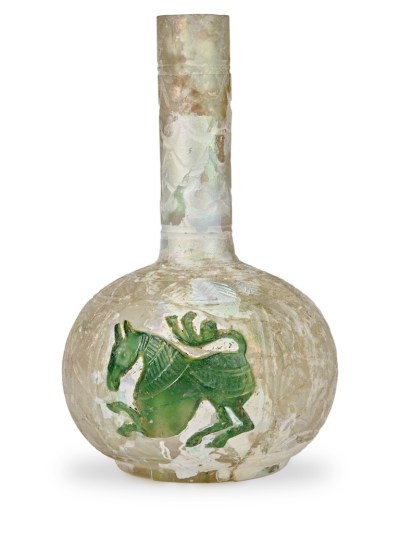
Bottle, Iran or Central Asia Samanid period, 9th–10th century CE, Colourless glass with green glass overlaid patches and wheel-cut decoration, Museum of Islamic Art, Doha.
Chrysovalantis Lamprianidis
What makes the exhibition effective is its restraint. The galleries do not push a thesis so much as hold space. A fragment of carved wood or a delicately cut glass vessel is allowed to register as both beautiful and burdened. Contemporary works appear without being asked to explain everything that came before them. The result is neither sentimental nor detached. It is sober, human, and persuasive.
Seen during Art Basel week, “Empire of Light” puts the fair in perspective. It reminds visitors that cultural exchange long predates the art market, and has never depended on branding.
A short walk away, the Museum of Islamic Art hosts a second exhibition focused on the building itself: “I. M. Pei and the Making of the Museum of Islamic Art.” Rather than celebrating Pei as a genius in isolation, the show walks viewers through the architect’s process as he grappled with a basic question: what does Islamic architecture mean when it is not tied to a single region or period?
Drawings, models, and archival material trace how Pei moved from abstraction toward form, eventually arriving at the geometric clarity that defines the museum. The building emerges as a vessel deliberately shaped to hold a long, complicated past.
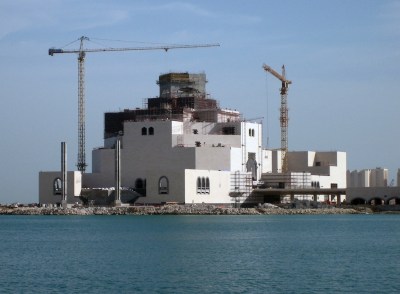
The Museum of Islamic Art by architect I. M. Pei under construction in Doha, Qatar, 2007 Photo © Fabian Servagnat
That perspective deepens at ALRIWAQ Art + Architecture, where “I. M. Pei: Life Is Architecture” widens the lens. This retrospective places Pei’s Doha project within a global career that included Washington, Paris, Hong Kong, and beyond. The show is strongest when it emphasizes Pei’s patience—his willingness to let buildings emerge slowly from research, travel, and doubt. Together, the two Pei exhibitions frame Doha not as a blank canvas for culture, but as a city shaped through deliberate, often philosophical decisions about history and form.
Across town, the Arab Museum of Modern Art (Mathaf) offers a different tempo. Its anniversary presentation, “Resolutions,” draws from the permanent collection to trace how modern and contemporary artists from the Arab world have navigated politics, displacement, and cultural inheritance. The presentation doesn’t reduce modern Arab art to a lesson plan; instead, it places works from different moments in conversation and trusts the viewer to draw the lines. The works on view are a reminder that modernism in the region did not unfold in isolation, and that many of the questions animating today’s debates—about identity, power, and representation—have been circulating for decades.
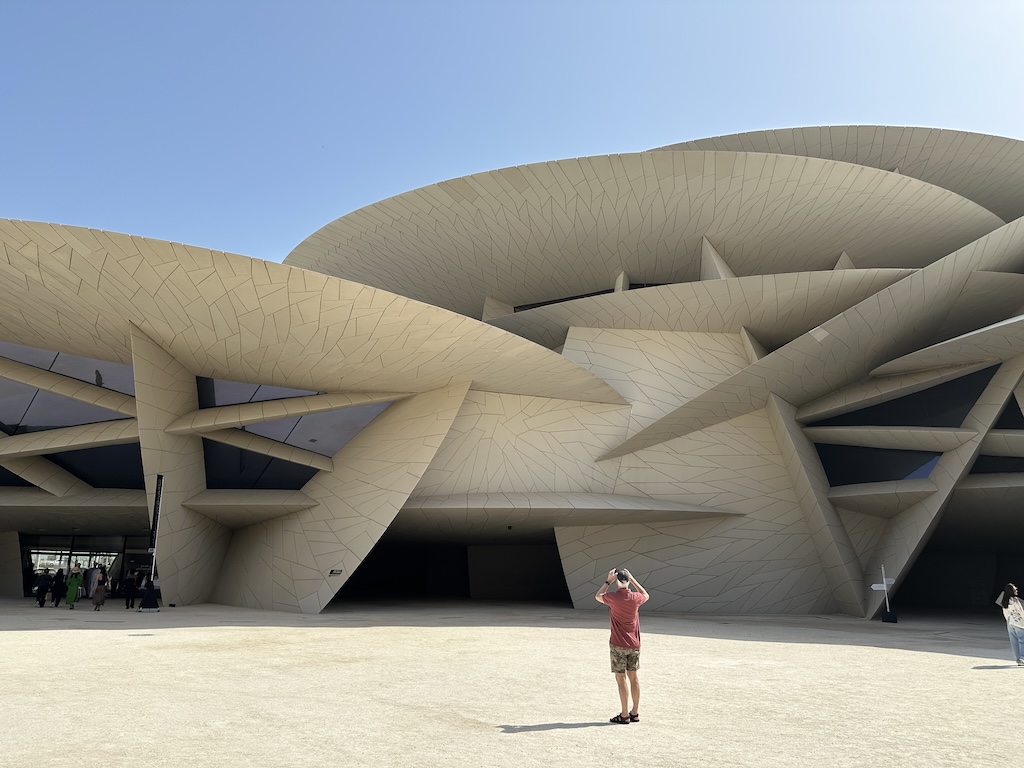
At the National Museum of Qatar, the exhibitions on view during the week lean inward. “A Nation’s Legacy, a People’s Memory: 50 Years Told,” marking the museum’s own history, focuses on how national narratives are assembled, revised, and sometimes contested. Set against Jean Nouvel’s dramatic architecture, these presentations feel intimate rather than monumental, foregrounding everyday life, memory, and continuity over spectacle.
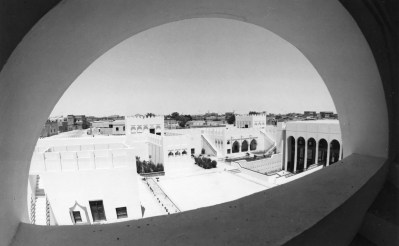
From “A Nation’s Legacy, A People’s Memory: Fifty Years Told” at the National Museum of Qatar
©Mohammed Bu Hindi Al Bu Hindi
For visitors moving between the fair and the museums, the National Museum offers something grounding: a reminder that culture here is not imported for the week, but lived year-round.
If “Empire of Light” traces long historical arcs, the Fire Station operates closer to the present tense. The former civil defense building has become one of Doha’s most flexible exhibition spaces, and during Art Basel week it hosts three solo shows, each approaching contemporary experience from a different angle. The exhibitions—by Chung Seoyoung, Haroon Mirza, and Ho Tzu Nyen—occupy distinct registers, from quiet material interventions to immersive sound and video environments.
The strongest of the three may be “Ho Tzu Nyen: Hotel Aporia,” a multichannel video installation that pulls viewers into a looping, unstable narrative. Ho’s work draws on cinema, archival material, and algorithmic processes to explore how histories are constructed and distorted. Watching the installation unfold feels less like following a story than entering a system that continually rewrites itself. It is demanding but deeply absorbing, especially for viewers interested in how images shape political memory.
Art Basel Qatar’s first edition will inevitably be judged by sales figures and attendance. Doha’s museums, however, seem unconcerned with that timeline. The exhibitions on view during the week make a longer argument: that culture here is built through accumulation, research, and patience.