


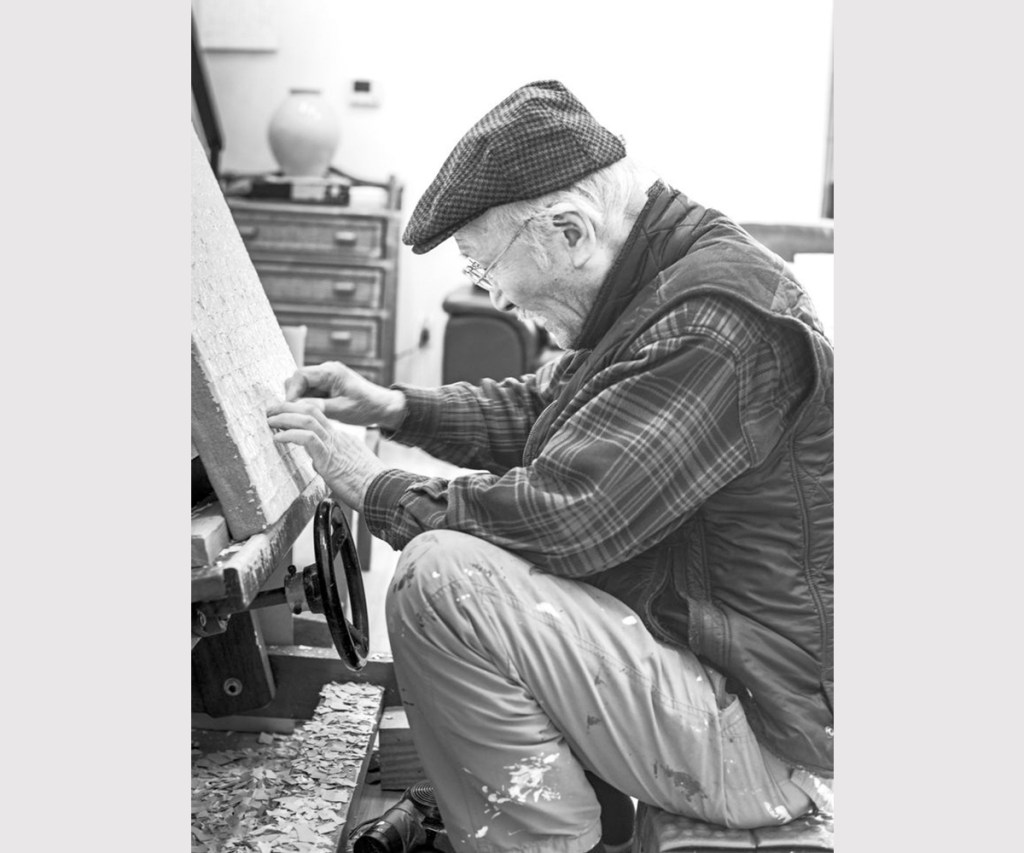
Chung Sang-hwa, a central figure in Korean modern art, died on January 28 after a prolonged illness. He was 93. The news was reported by the Korea Times.
Chung is best known for his affiliation with Dansaekhwa (or “monochrome painting”), a mode of abstract art that emerged in the mid-1970s in Korea and which found new interest in the West in the 21st century.
With roots in Korea’s earlier, more expressive Informel painting of the late 1950s and 1960s, Dansaekhwa was distinguished by labor-intensive processes, repetitive gestures, and low-key palette. In addition to Chung, practitioners associated with Dansaekhwa include Park Seo-Bo, Lee Ufan, and Yun Hyong-Keun, among others.
In keeping with Dansaekhwa concerns, Chung’s mature works were produced by repeatedly applying paint, folding the canvas, and peeling the paint off to achieve a multilayered surface marked by broken grids. Restricting himself to a single piece at a time and eschewing assistance, Chung often took up to six months or a year to complete a painting.
“Performing the same action over and over again to the point of absurdity, that’s what defines my work,” the painter said during his 2023 solo exhibition at Gallery Hyundai in Seoul.
Born in 1932 in Korea during Japanese colonial rule, Chung enrolled in the College of Fine Arts at Seoul National University in 1953. In his early abstractions, made in the turbulent era following the end of the Korean War (1950–53), he adopted the gestural visual language of the Informel movement.
After a 1969 move to Kobe, Japan, however, Chung began to interest himself in painting as a record of time and process. By the late 1970s he was creating his signature monochrome gridded canvases.
In 1977, following the death of his wife, Chung moved to Paris for 15 years. 1n 1992, he returned to Korea, where he continued working until his last illness.
Major retrospectives of Chung’s work were held at the Musée d’art moderne et contemporain de Saint-Étienne Métropole in France in 2011, and at the National Museum of Modern and Contemporary Art, Korea, in 2021.

