


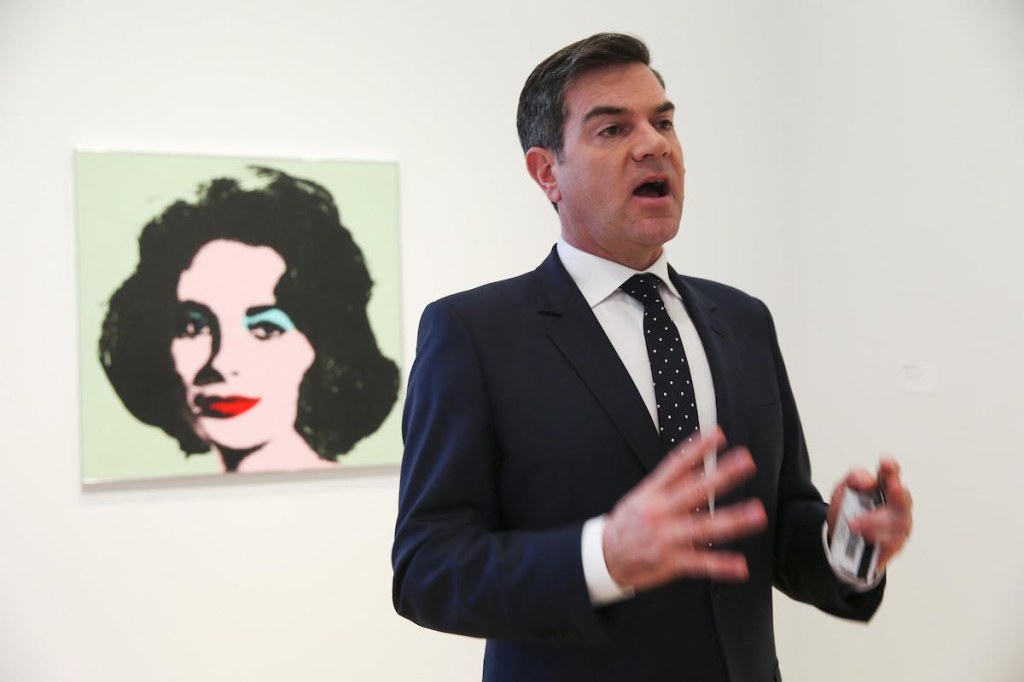
For the first time since his return to his job last May following a voluntary leave, James Rondeau, the director of the Art Institute of Chicago, spoke frankly about a bizarre incident on an airplane that gained attention far beyond the art world.
During that incident, last April, Rondeau was on a plane from Chicago to Munich when he began taking his clothes off, according to the CBS News report. That report said that Rondeau had “drank alcohol and took prescription medication,” and that police were called to the plane.
Rondeau went on voluntary leave for a month and a half. Then, in May, the board issued a statement saying that it was “confident in James Rondeau’s leadership and ability to continue as the president and director.” Rondeau, who is now celebrating his 10th year as the museum’s leader, said he regretted the incident at the time.
Now, in a new profile co-published by the Chicago Star Tribune and WBEZ, Rondeau spoke even more frankly about the incident. He told both Chicago-based outlets that the incident was a “very low moment both personally and professionally,” and said he was grateful that the board was so willing to have him back.
“As cliché as it is, every challenge is an opportunity, and that presented a number of opportunities for me to move forward with a healthy work-life balance and an attentive understanding to wellness,” Rondeau said. “I believe it’s firmly in the rearview mirror, but it’s important to acknowledge.”
Also in that interview, Rondeau hinted at plans for the museum—one of the most widely visited in the US, and one of the largest—to expand. The Art Institute previously said it had the intention to grow in 2024, when it received a $75 million donation for new galleries Aaron I. Fleischman and Lin Lougheed, but it has not provided much information since then about how it will pursue that expansion.
Rondeau said that the museum can only show 15 percent of its modern and contemporary art collection—even though the Art Institute already has a monumentally scaled wing for that area of its holdings that is separate from that building. Moreover, he stated that Surrealist art, a strength of the museum’s collection, is “barely represented” within the galleries, where there already is a good deal of space for work related to that movement.
“We have very concrete aspirations,” Rondeau said. “We do not have an approved building project.”
Moreover, he said, “When you visit this museum, you’re at one of the great museums of the world. And if we spent a decade letting our peers refine their facilities and visitor experience and improve access to their collections and we didn’t do that, we would fall behind.”

