


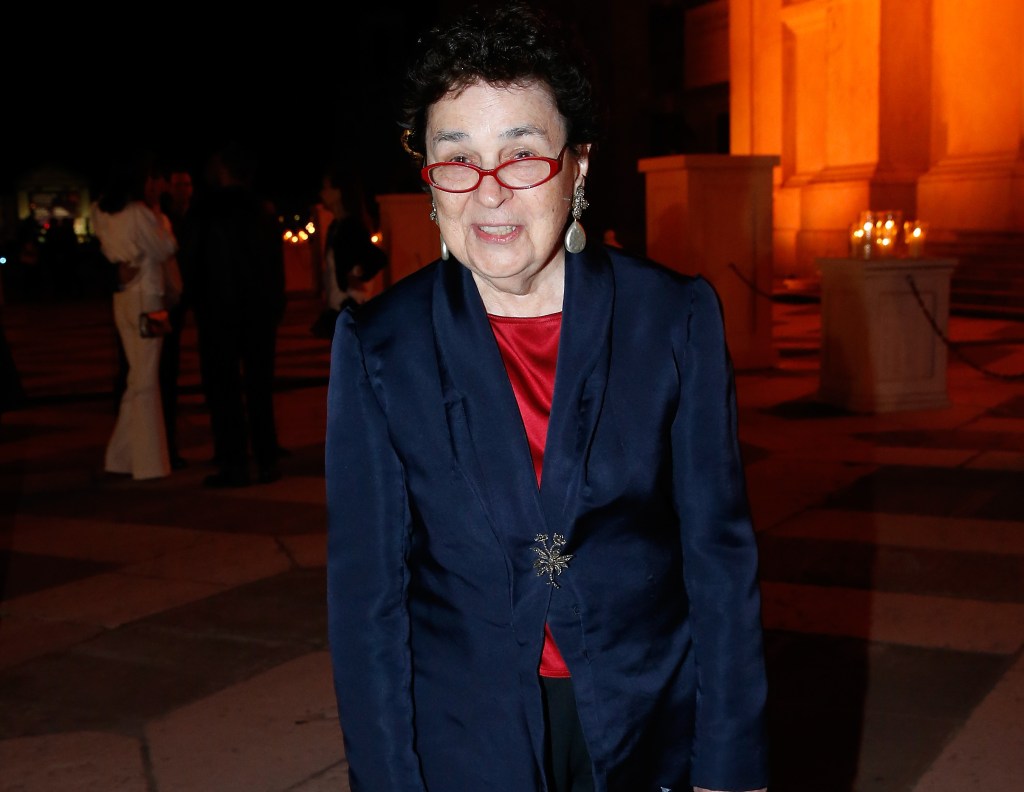
The art dealer Marian Goodman, who was revered for her enduring commitment to the artists that she represented, and for her disinclination to follow either aesthetic or business trends, died on Thursday in a hospital in Los Angeles. She was 97. The New York Times, which first reported news of her death on Sunday, did not report a cause.
In 1977, at the age of 49, Goodman opened her eponymous gallery in Midtown Manhattan with a show of the late Belgian artist and poet Marcel Broodthaers, whose conceptually rigorous work was indicative of her venturesome taste. Over the proceeding five decades, she exhibited, and helped establish, many of the leading artists of her time, especially Europeans who had not yet received their full due in the United States.
Once Goodman decided to take on an artist, she was all-in. “One must be willing to keep showing an artist for fifteen or twenty years,” she told the art critic Peter Schjeldahl in the New Yorker in 2004. (She gave interviews sparingly, preferring to have the press focus on her artists.) Mainstays of her roster included painter Gerhard Richter and installation artist Lothar Baumgarten, both from Germany, the Italian Arte Povera masters Giovanni Anselmo and Giuseppe Penone, British director Steve McQueen, Ethiopian American painter Julie Mehretu, South African draughtsman-filmmaker William Kentridge, and many other celebrated names.
“If you’d only bought work from Marian Goodman over the last 40 years, you would have one of the best museums in the world today,” Tom Eccles, the director of the Center for Curatorial Studies at Bard College, said in a WSJ Magazine profile of her in 2014.
Marian Geller was born in 1928 in New York, where she lived almost her entire life. Her father, Maurice Geller, was an accountant and fervent art fan who amassed 40 paintings by the American modernist Milton Avery. The future gallerist attended Emerson College in Boston, where she mulled a career in journalism, and at the start of her 20s, married William Goodman, a civil engineer. They divorced in 1968.
There is no set track to becoming an art dealer, but Goodman’s approach was particularly unusual. In 1962, she put together a set of prints as a fundraiser for the New York school of her two children, Michael and Amy, who survive her. “I thought, Maybe I could do this for a living,” she said in the New Yorker.
The next year, Goodman started graduate art-history classes at Columbia University, and in 1965 she launched a company called Multiples to publish and sell affordable editions by artists. (She had first brought the idea to the Museum of Modern Art, which rejected it.) The concept was “close to the socialist idea that art should be accessible,” she told Blake Gopnik in the New York Times in 2021. Her capital came from business partners and the sale of an Avery painting that her father had given her, and the firm went on to release material by major artists like Larry Rivers, Claes Oldenburg, and Roy Lichtenstein.
Regular trips that Goodman made to Europe were pivotal in honing her art interests, and she finally took the step of creating her own gallery after being unable to find a New York dealer for Broodthaers. She chose 57th Street for her operation, then a hub of the city’s art world, but as her peers flocked to SoHo and then Chelsea in the coming years, she stayed. “I saw dealers running after artists, then throwing them out and going on to the next,” she said of the SoHo scene in the New Yorker. “I was afraid it was contagious.”
In 1985, the gallery moved into its current home, on the fourth floor of a building on 57th. Because of its modestly sized elevators, larger artworks have to be brought in through a window, gingerly, via a crane. The somewhat unorthodox location, and the sterling reputation behind it, has made each exhibition there a kind of special event.
As the art market roared in the 1990s and 2000s, some ambitious dealers began dotting the globe with branches. Goodman did not. She opened a Paris space in 1995 (her current, intimate venue there dates to 1999), and in 2014 inaugurated a sprawling one in London, which shuttered amid the coronavirus pandemic in 2020. (“Brexit has changed London’s role,” she told ARTnews at the time.)
Goodman’s singular approach suited her artists; like her, they tended to be steeped in art history and serious-minded (true even of the hijinks-prone Maurizio Cattelan, whom she long showed). They were all hands-on in their practices, and they were all in it for the long haul. Many of the gallery’s artists were, or came to be, in high demand from deep-pocketed collectors, but their dealer was famous steering their work into permanent collections.
Even as she kept a certain distance (physically and psychically) from the ever-expanding art industry, Goodman won the admiration of her competitors. David Zwirner told WSJ that, when he was starting his gallery in the 1990s, she was “a model that I aspired to.” Jeffrey Deitch told the New York Times in 2021, “She defined the model of the contemporary gallery as having the same standards of a great museum.” (When Schjeldahl had asked her to guess how art-world denizens viewed her, her answer was: “Responsible. A passionate advocate for my artists. Batting average pretty good. More wise than unwise.”)
As Goodman entered her 90s, she put a leadership team into place, planning for the gallery’s future, and in 2019 hired Philipp Kaiser, once the director of the Museum Ludwig in Cologne; he is currently the gallery’s president. With the passing years, Goodman was seen less often, and there were signs of change. In 2023, the gallery said that it would decamp from Midtown for Tribeca, where many other blue-chip enterprises had been moving. That same year, it opened in Los Angeles, another hothouse of commercial activity.
Richter, who had more than a solo dozen shows with Goodman between 1985 and 2020, departed in late 2022 for Zwirner. “Marian is a presence,” he had told the New Yorker some two decades earlier. “She is wise. She has courage.”

