



A ruble-backed stablecoin linked to sanctioned Russian financial networks processed more than $100 billion in onchain transactions in less than a year, according to a new report from blockchain analytics firm Elliptic.
In a report published Thursday, Elliptic said the A7A5 stablecoin was designed to operate within a broader framework intended to reduce exposure to Western financial sanctions. The structure allowed Russian-linked businesses to move value through crypto markets while limiting the risk of asset freezes.
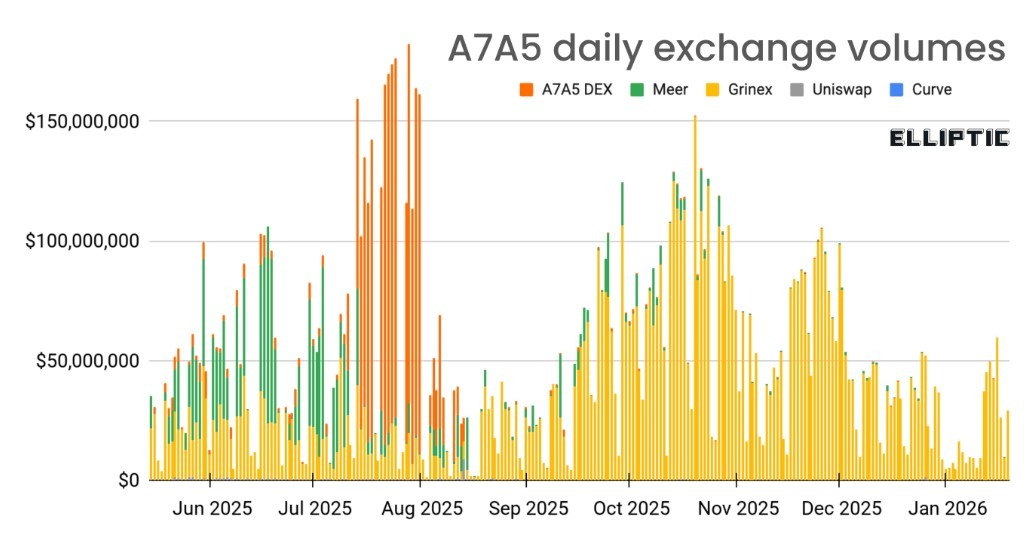
Elliptic found that A7A5’s activity surged following its launch in early 2025, before slowing down in the second half of the year as sanctions and compliance actions taken by exchanges and token issuers started to restrict its usability.
Elliptic said the scale and structure of the flows highlight how non-US dollar stablecoins can be designed to support sanctioned trade and how enforcement pressure can still disrupt such systems.
A7A5’s $100 billion figure and its role as a USDT bridge
Elliptic said the $100 billion figure represents the cumulative value of all A7A5 transfers recorded on public blockchains, including Ethereum and Tron.
“This is the aggregate value of all A7A5 transfers,” Tom Robinson, the founder and chief scientist at Elliptic, told Cointelegraph.
“We are not taking a subjective view on whether each transaction constitutes distinct economic activity, although the fact that transaction fees have been paid for all A7A5 transfers suggests they all confer a benefit to the transactor.”
Elliptic’s analysis shows that A7A5 has primarily functioned as a bridging asset between rubles and Tether’s USDt (USDT), which remains the largest dollar-pegged stablecoin globally.
The company said the structure allowed users to move value into USDT markets without maintaining prolonged exposure to wallets vulnerable to freezes by Western authorities.
The report noted that the stablecoin’s trading activity had been concentrated on a limited number of venues, including Kyrgyzstan-based exchanges and project-linked infrastructure. This reinforces the token’s role as a purpose-built settlement tool rather than a broadly adopted retail stablecoin.
Related: Global sanctions linked to record flows into illicit crypto addresses
Sanctions pressure and exchange controls curb growth
Elliptic said the stablecoin’s expansion slowed around mid-2025, with no major issuances since July and transaction volumes falling from peaks of $1.5 billion to about $500 million.
Robinson told Cointelegraph that US sanctions imposed in August 2025 had the most immediate and material impact on the stablecoin’s functionality.
“The US sanctions in August 2025 appear to have had the largest impact,” Robinson said. “Immediately after the US designations, USDT liquidity provision to A7A5’s DEX dropped substantially, removing one of the stablecoin’s key benefits — easy on-chain access to USDT.”
Additional constraints followed as exchanges took action. In November 2025, decentralized exchange (DEX) Uniswap added A7A5 to its token blocklist, preventing trading via its web interface.
Elliptic also cited reports from users whose USDT deposits were frozen by exchanges after being traced back to A7A5-linked wallets.
On Oct. 23, the European Union formally sanctioned A7A5, describing it as a tool used to bypass financial restrictions tied to Russia’s war economy.
Robinson said A7A5’s trajectory illustrates both the potential and the limits of non-dollar stablecoins built for sanctions-era finance.
“While the US dollar dominates the global economy, there are structural limits to how far a stablecoin such as this can grow,” he told Cointelegraph. “However, if that changes, all bets are off.”
Magazine: How crypto laws changed in 2025 — and how they’ll change in 2026