



Ethereum (ETH) broke its 2021 all-time high in August, brushing $4,945 and a $600 billion market cap, while exchange balances hit record lows.
Corporate treasuries and spot ETFs now control nearly 11% of the circulating supply. By every structural metric, ETH should feel like it’s having a moment.
It doesn’t. No Bored Apes are selling for seven figures. No TikTok explainers are going viral. The 2025 ETH rally is real, measurable, and entirely clinical. This is a quiet reallocation by institutions treating Ethereum less like a speculative trade and more like yield-bearing infrastructure.
The cultural void raises a sharper question: is ETH transitioning from layer-1 casino to institutional plumbing, and what does price discovery look like when the buyers don’t care about hype?
ETH is leaving exchanges
The supply story is unambiguous. Only 10.5% of all ETH now sits on centralized exchanges as of Dec. 21, one of the lowest shares since the network launched and down 43% since July, per Coinglass data.
Additionally, more than 35.6 million ETH is locked in staking as of Dec. 20.
This isn’t speculative hoarding, but rather an operational infrastructure. Nansen’s holder composition shows the largest addresses are staking contracts, institutional custodians, and ETF wrappers, not whale wallets.
Exchange float is draining, but not into day-trading accounts. It’s moving into pipes: layer-2 bridges, restaking protocols, treasury vaults.
Corporate balance sheets tell the same story. Treasury data from Dec. 19 estimates that corporate holders plus spot Ethereum ETFs now control 10.72% of the circulating supply. This is divided in 5.63% in corporate hands and 5.09% in ETFs, according to Strategic ETH Reserve data.
BitMine has accumulated over 4 million ETH, equivalent to 3.36% of the total supply, and has explicit plans to reach 5%.
These aren’t venture bets, but strategic positions tied to Ethereum’s role in stablecoin settlement and tokenized asset rails.
ETF flows confirm the institutional tilt. Year-to-date, ETPs tracking ETH have drawn about $12.7 billion in net inflows, with US spot Ethereum ETFs representing $12.4 billion.
The infrastructure is built. The allocators are here.
ETH as infrastructure, not just beta
The 2025 research cycle has started treating ETH as yield-bearing infrastructure rather than a levered bet on tokens.
Citi’s September note setting a $4,300 year-end target is explicit: the driver is demand for Ethereum-based stablecoins and tokenization, not speculative trading. The bank highlights staking yield as a differentiator for corporate portfolios, sketching a bull case to $6,400 if stablecoin adoption evolves on the optimistic trajectory.
Binance Research argued that if stablecoin settlement and layer-2 scaling continue on current trends, ETH’s valuation logic shifts from “deflationary asset” to “ecological infrastructure asset.”
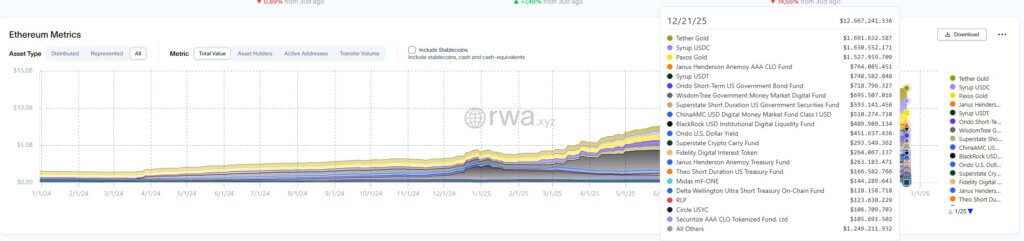
Data from rwa.xyz shows that Ethereum controls $12.5 billion of the tokenized real-world assets (RWA) market, equivalent to 66.6%.
Ethereum’s growth in RWA tokenization since 2024 has been stellar, rising from $1.5 billion, representing a 735% increase from its current size.
Stablecoin usage also skyrocketed. According to data from Artemis, Ethereum recorded $1.6 trillion in monthly stablecoin transaction volume as of Dec. 21 and $172.1 billion in stablecoin supply. Supply growth is 141% compared to the $71.3 billion seen in January 2024.
The thesis emerging from these reports is consistent: ETH is increasingly treated like a yield-bearing, rails-of-the-system asset in professional portfolios.
It’s about needing Ethereum to function as plumbing for tokenized dollars, securities, and derivatives that institutions are already building.
Cultural vacuum
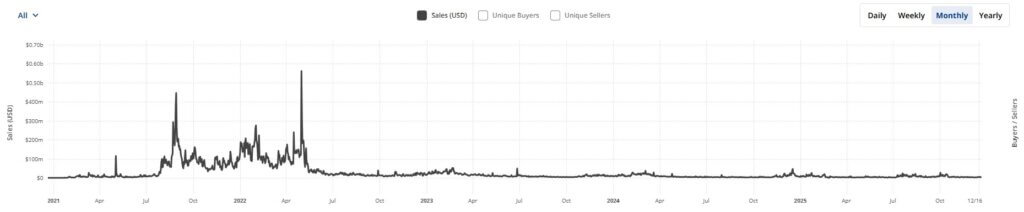
NFTs are the clearest cultural contrast. Data from CryptoSlam shows NFT art sales plunging from nearly $16.5 billion in 2021 to just $2.2 billion in 2025, a drop of roughly 87%.
LG shut down its Art Lab NFT marketplace, Tennis Australia’s Artball collection saw floor prices collapse by around 90%, and CryptoPunks were transferred to a non-profit, with coverage bluntly observing that the “money-making days” are over.
Google Trends data shows that crypto-related searches in the US remain well below prior-cycle peaks, rising to 100 only when prices grind higher between July and August.
The participation mix confirms the shift.
Retail mania has rotated heavily into US single-stock trading rather than altcoins. Ethereum ETP flows swing between huge inflow weeks and very large outflow weeks, more like a tug-of-war between structured products than a one-way retail stampede.
What this means for price discovery
The mismatch between accumulation and attention creates a medium-term puzzle.
Traditional price discovery depends on a mix of fundamental flows and narrative momentum. Ethereum in 2025 has the former without the latter.
ETFs and treasuries provide slow, steady demand. Staking locks up supply, and tokenization brings real-world assets to Ethereum.
But the cultural engine that drove 2021, consisting of retail users treating every transaction like a statement, has stalled.
This matters because Ethereum’s valuation has always been partly reflexive.
The network becomes more valuable as more applications build on it, partly because developers expect it to grow in value.
That virtuous cycle depends on momentum, not just infrastructure. When corporate buyers treat ETH as a tool to settle tokenized bonds rather than a bet on the future of finance, they stabilize the asset but flatten its narrative arc.
The wire shows ETH buying. The data shows supply draining from exchanges. What’s missing is the cultural proof that any of this matters to anyone outside the trade.
Ethereum may be transitioning from a speculative layer-1 to financial plumbing, and if that’s the case, the 2021 feeling might not return.
The question is whether the next phase of steady, institutional, infrastructure-driven flows can sustain the valuations that retail mania once underwrote.