




Bitcoin has performed poorly over the last three midterm election years. In 2014, Bitcoin dumped 59%. In 2018, Bitcoin suffered the most, 75%. 2022 has seen a lot of blood too, with a 64% drop. But why is that relevant?
Because 2026 is the next midterm election year. We are two weeks away from 2026! So, will 2026 follow the previous midterm election years? Let’s find out what this means for crypto.
S&P 500 Performance
Before we check Bitcoin, let’s check the macro market. Why? The midterm election is a political event, and if it is indeed bearish, the macro market may be affected too. Here is the annual performance of S&P500 since 1930.
Let’s filter according to midterm election years. There have been 11 bullish years, 11 bearish years, and 2 neutral years. This means there is NO evidence of a macro bearishness specifically in midterm election years. It could be bullish or bearish depending on the overall market.
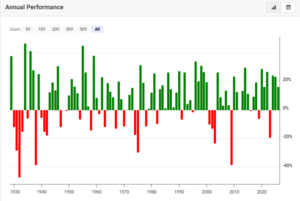
Even since the origin of Bitcoin, from 2010, there have been two bullish years and two bearish years. The midterm election is a cyclical event. It happens every 4 years. However, the market has NO such cycles. Bitcoin has a 4-year cycle, because of halving.
The halving happened in 2012, 2016, 2020, and 2024. Halving is a bullish event, and it is quite natural that there are bearish years in between these bullish events. And remember, without bearish years, there will not be bullish years. The point is there is no relation between the midterm election and S&P500 performance. That’s the thing to remember.
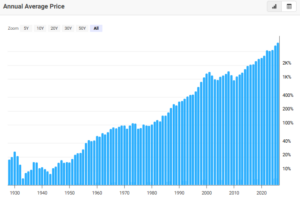
Why Bitcoin Was Bearish In Midterm Election Years
It’s happened all 3 times we’ve had midterm elections during Bitcoin’s existence. Down each time. Let’s see why. Let’s consider each year.
1) 2014
Bitcoin dumped from $1000 to $111 in 2014. Why? Mt Gox, the biggest crypto exchange at that time, collapsed, and filed for bankruptcy. Mt Gox had the same market dominance that Binance commands right now. The exchange balance has been in a steady uptrend since 2014, and in a slow downtrend since 2022.
This uptrend is because of the high inflation state of Bitcoin at the time. After 2020, Bitcoin inflation (Bitcoin rewards) is low, and the exchange balance has been going down.
2) 2018
2018 was the worst possible year for Bitcoin. Is it because of the midterm elections? Not at all. In 2017, the ICO bubble reached an unsustainable state. This caused massive market corrections.
2017 had seen unprecedented gains in crypto. This invited sustained political intervention into Bitcoin. Following that, web2 giants like Facebook, Twitter, Google, etc. banned ICO ads on their platforms.
This also means that the 2018 midterm election had nothing to do with the Bitcoin price action.
3) 2022
In 2022, two major bearish events happened. The first was Terra Luna and UST collapse.
Terra and Do Kwon had a strategy to buy Bitcoin and use it to back its stablecoin UST. When UST lost its peg initially, Terra dumped Bitcoin on the market to save UST and LUNA. Those efforts failed and kickstarted the 2022 bear market.
But that was not it. Soon, FTX collapsed, mimicking the Mt Gox collapse. This also fueled distrust in crypto, adding to the NFT and Metaverse bubble. But how can such coincidence happen? Ian Fleming says
“One time is happenstance. Two times is coincidence. Three times is enemy action.” So three times in a row can not be a coincidence, right? Well, it could be. We need enough historical data to draw conclusions, and there is not enough data to predict that 2026 could be bearish as well.
Will 2026 Be Bearish?
Here comes the direct question – is it possible that 2026 is a bearish year. There is a possibility. It has nothing to do with the midterm election, though. Bitbo has a halving chart that explains how 2026 could be bearish. The mid-year of halving has been bearish.
Check 2014. 2012 to 2014 had been extremely bullish, and 2014 was a cool off year. In 2015, Bitcoin started its recovery and entered the bull market. 2018 tells a similar story. Explosive growth from 2016 to 2018. Cool off in 2018, and recovery started in 2019.
2022 follows the same trend. Bitcoin pumped from 2020 to 2022. Dumped in 2022, and recovery started in 2023. If the history repeats, 2026 could be bearish, and 2027 could see further bullishness in preparation for the 2028 halving.
However, the growth between 2024 and 2026 has been slow. If Bitcoin has not pumped high, there is no logic in massive corrections. Let’s go back to the Bitcoin circulation chart.
Since 2010, Bitcoin inflation has been steady and aggressive. The inflation slowed down in 2020, and the first demand driven pump happened. This was supported by the post-covid global market recovery.
In 2024, institutional demand fueled the pump. This was supported by the dropping exchange balance. When the supply goes down along with the demand, the volatility comes down. By 2028 halving, Bitcoin will be a fully adopted institutional asset. Strategy and BlackRock has been buying BTC, and they will be more than happy to buy more when Bitcoin is cheap.
It implies the retracement that could happen in 2026 could be a sideways market, at best. The good news is that we don’t have to wait long to figure it out. The worst happens in January and February of such years. If 2026 starts in a bearish tone, it’s possible the year will be bearish.
Onchain-wise, Bitcoin remains strong and healthy. The next big crisis could be from quantum computing. Quantum computing can crack how private keys are created. This is something we will be watching. This rumor could trigger a bear market, but not anytime soon.


Disclaimer
The information provided by Altcoin Buzz is not financial advice. It is intended solely for educational, entertainment, and informational purposes. Any opinions or strategies shared are those of the writer/reviewers, and their risk tolerance may differ from yours. We are not liable for any losses you may incur from investments related to the information given. Bitcoin and other cryptocurrencies are high-risk assets; therefore, conduct thorough due diligence. Copyright Altcoin Buzz Pte Ltd.

