


The winds of change blasted through New York in 2025. Dealers fretted about the state of the market as galleries closed. Curators privately worried about what could and could not be shown as an oppressive President returned to power in Washington, D.C. Deep-pocketed collectors died, raising questions who would take up their mantle, and longtime institutional directors vacated their posts. Everyone in the art world kept talking about uncertainty.
There were many reasons to feel depressed over the state of arts and culture this year. Four artists from the roster of one mega-gallery received concurrent museum retrospectives during a single season. The Whitney Museum shamefully put its beloved Independent Study Program on hold amid a controversy over a performance about the war in Gaza. Sotheby’s took over a famed Marcel Breuer–designed building uptown, suggesting that anything and everything—even places where avant-garde art used to be shown—can be turned into a bastion of capitalism. Most galleries and institutions eschewed experimentation for pleasant, unprovocative, and largely unmemorable programming.
But there were also glimpses of hope in an otherwise bleak climate, which, in a year like this one, is about as much as one could ask for. Two museums—the Frick Collection and the Studio Museum in Harlem—reopened after closures prolonged by the pandemic, with a third, the New Museum, soon to follow in 2026. Teeny-tiny galleries popped up in unexpected corners of the city, some with adventurous programming mounted on a shoestring budget. Blue-chip artists stepped in when others wouldn’t: Dan Colen launched a biennial upstate, Lucy Bull revived her art space, and Sanya Kantarovsky started a residency program.
Perhaps it is no surprise, then, that the best art I saw in New York in 2025—the art I’ll remember long after the year is finished—was often about perseverance in the face of adversity. That bodes well for society more broadly. Consider this quote by the painter Ben Shahn, the subject of a New York retrospective from this year: “It is not the survival of art alone that is at issue, but the survival of the free individual and a civilized society.”
More on that Shahn show and nine other exquisite exhibitions below.
-
Terran Last Gun at Chapter NY
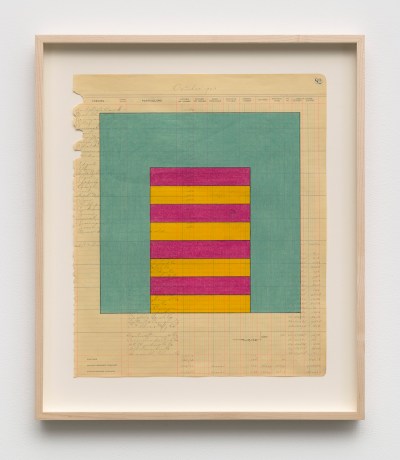
Image Credit: Charles Benton/Courtesy the artist and Chapter NY Terran Last Gun’s drawings are sometimes composed of blocks of color set against yellowed sheets of paper and little more. Yet these are not just any papers, for Last Gun, a citizen of the Piikani Nation, has utilized century-old ledger sheets, some of them given to him by his father. That places Last Gun within the 19th-century Plains Indian tradition of ledger art, which saw artists draw battle scenes on top of used sheets from accounting books and the like. This act of appropriation—taking the materials of one’s colonizers, then using them to tell a new story—is given new life by Last Gun, whose abstractions refer to portals pervasive in Blackfoot lore. His doorways and windows open onto planes of yellow and pink, holding out the possibility of rehabilitation following so much violence.
-
Isaiah Davis at King’s Leap
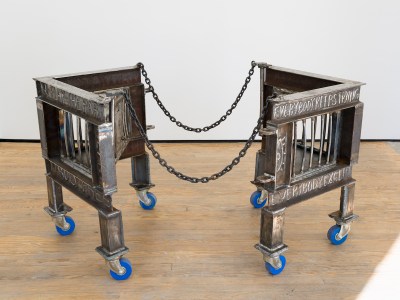
Image Credit: Courtesy the artist and King’s Leap Slave (2025), the beguiling sculpture that greets viewers at Isaiah Davis’s current exhibition, gets my vote as the most surprising work of this year. Most times, this wheeled sculpture looks either like a cage or a cradle, but when pulled open, it reveals two chains yoking its steel halves together. Welded with phrases such as “EVERYBODY KEEPS TRYING 2 BREAK MY HEART,” the sculpture is itself a heartbreaker—a potent statement about the necessity of withholding information in the face of pressure and the impossibility of ever becoming fully free as a result. Like so many young artists right now, Davis imbues tossed-off objects with new meaning. Few others do so in a way quite as mysterious or oblique.
-
Lotus L. Kang at 52 Walker
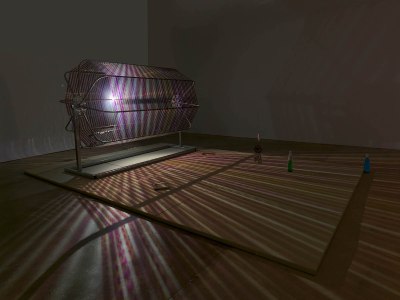
Image Credit: ©2025 Lotus L. Kang/Courtesy the artist and David Zwirner, New York Under the directorship of Ebony L. Walker, 52 Walker continued its formidable run this year with a range of shows that virtually no other New York gallery would dare stage. A case in point: Lotus L. Kang’s astonishing follow-up to her Whitney Biennial presentation from last year. This lush exhibition featured at its center an installation composed of two greenhouses strewn with 49 objects—cast metal versions of anchovies, knots of kelp, film strips, and more. Those greenhouses spoke well to Kang’s interest in sites of transformation and objects imbued with unknowable meaning. Downstairs was another unforgettable installation, Azaleas II (2025), in which strips of celluloid containing images of flowers circled a slowly spinning armature illuminated by a light. As this machine churned, the darkened space was bathed in haunting violet hues.
-
Juliana Seraphim at 55 Walker
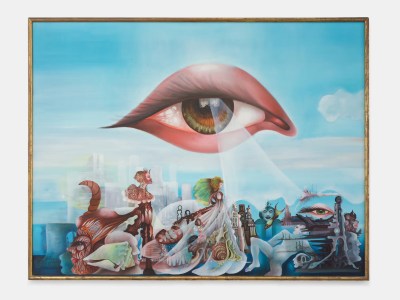
Image Credit: Courtesy 55 Walker, New York This was a great year in New York for both uppercase-S Surrealists (MoMA’s excellent Wifredo Lam retrospective) and lowercase-s surrealists inspired by the movement (“Sixties Surreal” at the Whitney; Harold Stevenson at Andrew Kreps Gallery, Tommaso Calabro, and the Art Omi sculpture park upstate). But no surrealist art moved me quite like the paintings of Juliana Seraphim, a Palestinian artist who fled with her family to Lebanon following the Nakba in 1948. Seraphim’s canvases feature women in lacy dresses, birds with voluminous plumages, and shisha-smoking princesses—and that’s to say nothing of one painting from 1978 in which a gigantic eye stares down at a city below populated by fish, shells, and towers. Organized by Kreps, Bortolami, and Kaufmann Repetto, the show left me gobsmacked, as did the lack of information available about Seraphim when I went home to research her. Give her a retrospective, stat.
-
Ayoung Kim at MoMA PS1
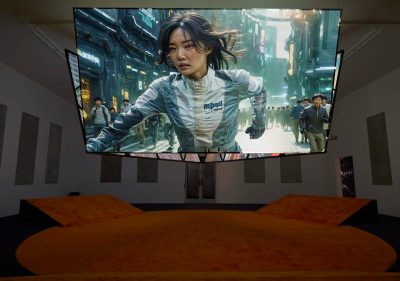
Image Credit: Roz Akin/Courtesy MoMA PS1 Every year, New York gets the breakout star it deserves. This year, that star was Ayoung Kim, who had already gained a following in her home country of South Korea before making her splashy US debut this fall with a show at MoMA PS1 and a Performa commission. The PS1 show centers around her hypnotic “Delivery Dancer” series, a trilogy of videos in which female delivery workers fight each other in extended sequences that fluidly move between modern-day Seoul and futuristic worlds of Kim’s own making. Utilizing gaming engines and AI, and drawing on everything from anime subgenres to precarity theory, Kim revels in science-fictional spectacle. PS1 has given the greatest of her three “Delivery Dancer” video installations a massive room of its own, with ramps to recline upon while viewing. Relax, and enjoy the show. (Read our profile.)
-
Madalena Santos Reinbolt at American Folk Art Museum
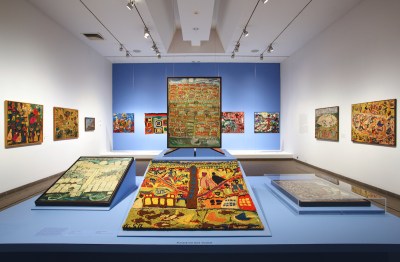
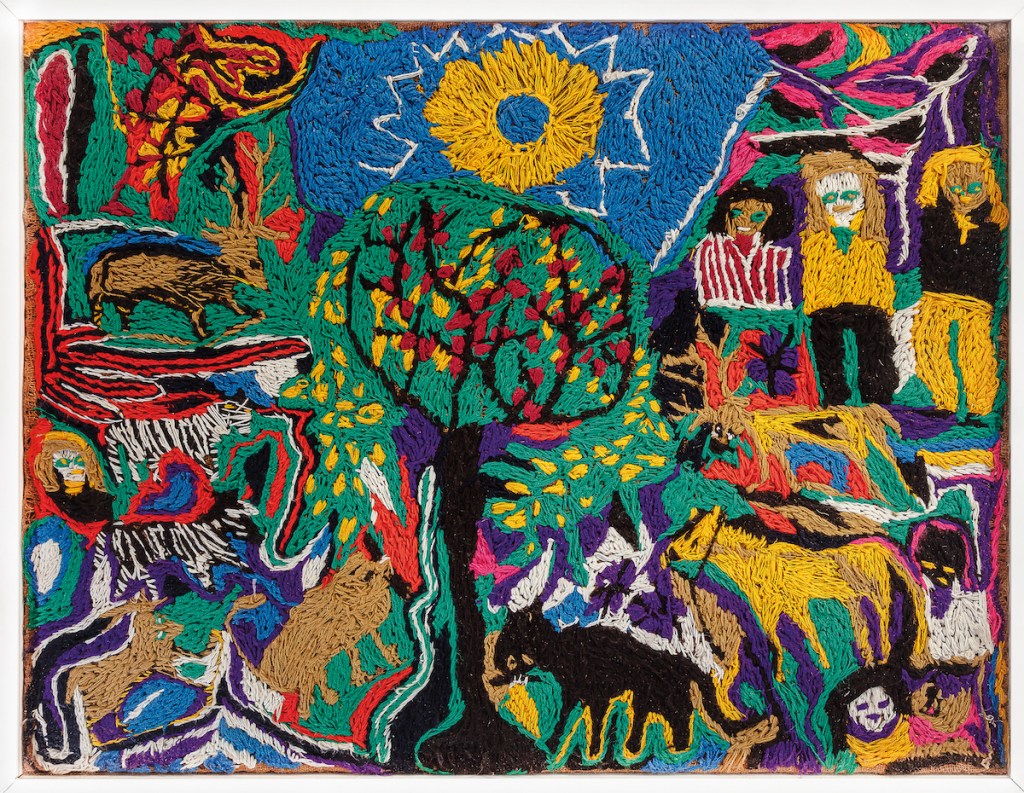
Image Credit: Olya Vysotskaya Fiber fever officially arrived in New York this year, with great shows by Claudia Alarcón and Silät at James Cohan Gallery, Hana Miletić at Magenta Plains, and Teresa Lanceta at Sikkema Jenkins Malloy. But one exhibition stood above all the rest. Making its US debut after appearing at the Museu de Arte de São Paulo in 2022, this survey shone a light on Madalena Santos Reinbolt, who worked as a live-in cook and utilized scraps of wool for her art during the 1960s and ’70s. The resulting works, known as her “wool pictures,” are as dense with people as they are with insight into her life as an Afro-Brazilian woman. Little biographical material has been published about Santos Reinbolt, who gave just one interview during her lifetime. That means the existence of this show and its accompanying catalog is nothing short of a miracle. (Read our review.)
-
P. Staff at David Zwirner
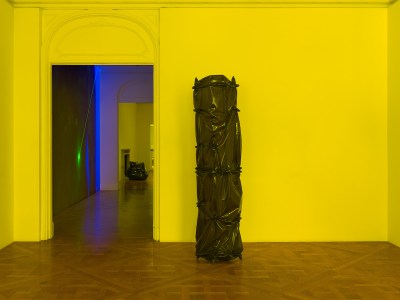
Image Credit: Courtesy David Zwirner During the run of P. Staff’s show this fall, the windows of David Zwirner’s Upper East Side gallery were tinted piss yellow, an appropriate preview of the bodily perturbations held within. Inside were sculptures composed of wood spikes draped with latex and a towering video projected in pieces across all three of the townhouse’s floors. Titled Penetration (2025), that video featured androgynous person with a laser beam pointed at their abdomen and offered a disturbing image that lingered with me long afterward. That I still carry the memory of the bass-heavy soundtrack it in my mind is a sign that Staff is onto something. (Read our review.)
-
Ben Shahn at the Jewish Museum
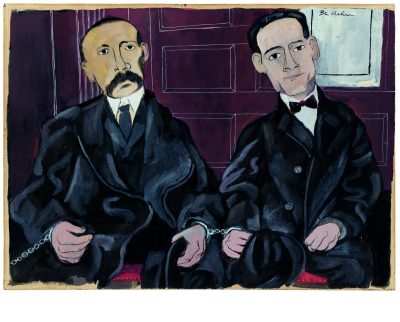
Image Credit: ©2025 Estate of Ben Shahn/Licensed by VAGA at Artists Rights Society (ARS), New York Just one artwork made me cry this year, and that artwork was Ben Shahn’s We Fight for a Free World (ca. 1942), a painting of five posters pasted to a brick wall that variously denounce murder, slavery, and other forms of injustice. Designed by artists such as Käthe Kollwitz and Yasuo Kuniyoshi, those posters combine to create a cross-national coalition, suggesting solidarity across borders as the only path forward in the fight against fascism—as timely a topic as any. In stark paintings that directly addressed racism, xenophobia, class oppression, and antisemitism, Shahn refused to wallow in nihilism or submit to complacency. In an otherwise depressing year, this rousing retrospective for the Lithuanian-born artist, first staged at the Museo Reina Sofía in 2023, left me optimistic.
-
Laura Owens at Matthew Marks Gallery
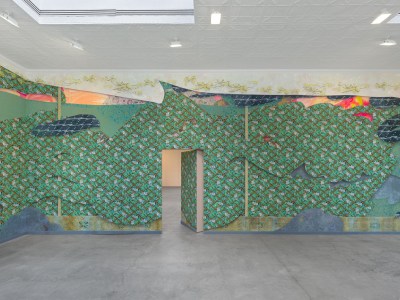
Image Credit: Courtesy Matthew Marks Maybe it’s obvious to even say it at a time when so much is viewed through screens, but it merits repeating: art really does deserve to be seen in person. Indeed, if you only looked at installation shots of Laura Owens’s effervescent Matthew Marks show, you only got a quarter of their total impact. Her latest works—if they can even be called discrete works—spanned entire rooms and featured hidden doors, a video about crows seeking Starbucks(!), nearly inaudible sounds, and sculptural elements. Owens’s show was maximalism of the highest order. In its own strange way, it was also a big statement about all that gets overlooked or forgotten in our culture of excess. Nearly eight months after this rapturous show’s closure, I’m still learning of wonderful details I missed. (Read our review.)
-
Jack Whitten at the Museum of Modern Art
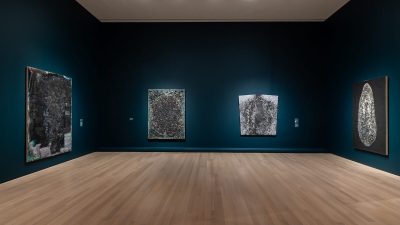
Image Credit: Jonathan Dorado Jack Whitten’s glorious abstractions also require in-person viewing to achieve their full potential. In this retrospective, his canvases glimmered, sparkled, and shone. Whitten was no ordinary painter—he made a career out of applying outré methods to acrylic, dragging his materials with a giant tool called the Developer for his exuberantly colored canvases of the 1970s—and his paintings were no ordinary paintings, either. As the MoMA show underscored, they prove to their viewer that art is not just viewed but experienced, taken in by both the eye and the mind. And what a pleasure it was to do just that in one of the greatest retrospectives held at MoMA—or anywhere—in recent memory. (Read our review.)