



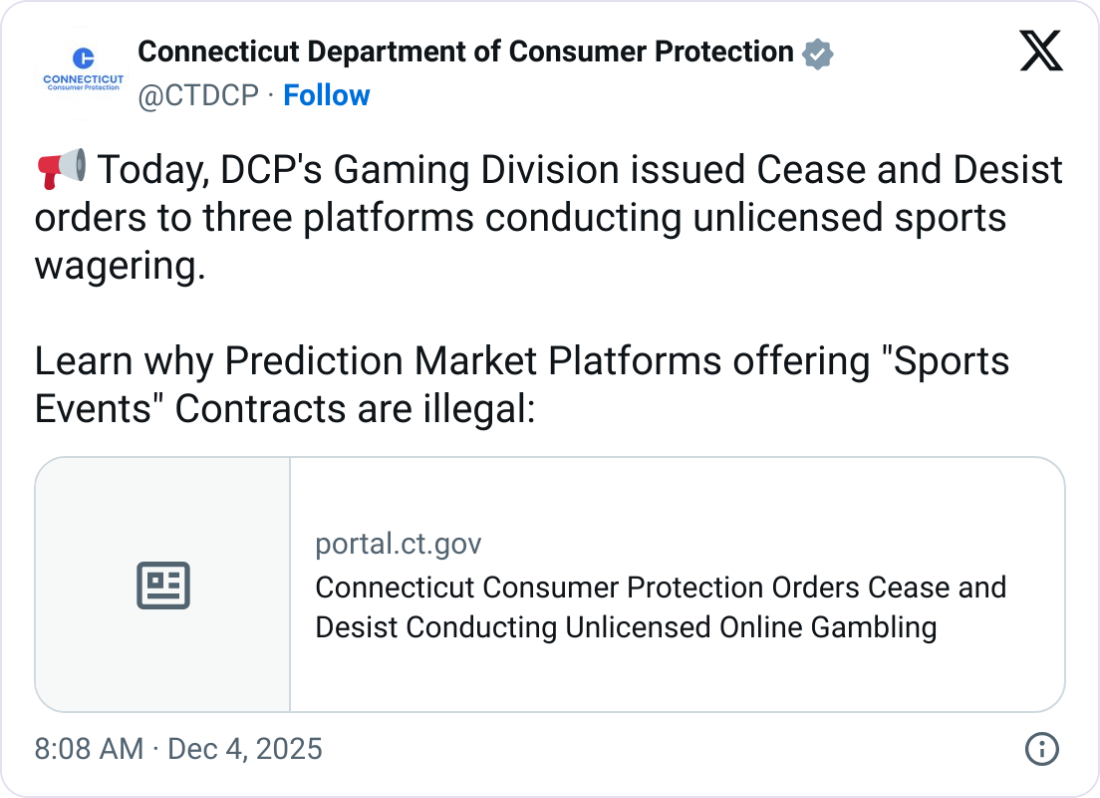
The US state of Connecticut has hit Robinhood, Kalshi and Crypto.com with cease and desist orders, accusing the platforms of offering unlicensed sports betting through event contracts.
The Connecticut Department of Consumer Protection (DCP) sent letters to the three platforms on Wednesday, claiming they were “conducting unlicensed online gambling, more specifically sports wagering,” with event contracts available online.
“None of these entities possess a license to offer wagering in our state, and even if they did, their contracts violate numerous other state laws and policies, including offering wagers to individuals under the age of 21,” said DCP Commissioner Bryan Cafferelli.
DCP Gaming Director Kris Gilman accused the platforms of “deceptively advertising that their services are legal,” adding that they operate outside of the state’s regulatory environment, “posing a serious risk to consumers who may not realize that wagers placed on these illegal platforms offer no protections for their money or information.”
Prediction markets have come under legal scrutiny in several US states, as the use of the platforms has skyrocketed this year and attracted billions of dollars in investment for allowing users to bet on the outcome of a variety of events.
Kalshi fires back in court
A Kalshi spokesperson told Cointelegraph that it is “a regulated, nationwide exchange for real-world events, and it is subject to exclusive federal jurisdiction.” “It’s very different from what state-regulated sportsbooks and casinos offer their customers. We are confident in our legal arguments and have filed suit in federal court,” Kalshi added.
In a complaint filed on Wednesday against the DCP, Kalshi claimed that “Connecticut’s attempt to regulate Kalshi intrudes upon the federal regulatory framework that Congress established for regulating derivatives on designated exchanges.”
It added that its platform was subject to the Commodity Futures Trading Commission’s “exclusive jurisdiction” and its sports event contracts “are lawful under federal law.”
Crypto.com and Robinhood did not immediately respond to requests for comment.
In its statement, Connecticut’s DCP said that prediction market platforms pose serious risks to consumers because they lack the required technical standards and security protections for financial and personal data.
The agency claimed such platforms also have no integrity controls to prevent insider betting or manipulation, operate without regulatory oversight of their payout rules, advertise to self-excluded gamblers and on college campuses, and allow betting on events with known outcomes, giving insiders unfair advantages.
Related: Polymarket opens US app to waitlisted users after CFTC green light
Only three platforms are legally licensed for sports wagering in Connecticut: DraftKings, FanDuel, and Fanatics, all of which require users to be at least 21 years old.
Kalshi under fire in at least ten US states
Connecticut is not the only state to take a hard stance on prediction platforms, as regulators in two neighboring states previously took action.
New York sent a cease and desist to Kalshi in late October, and the company responded on Oct. 27 by suing the state. Meanwhile, the Massachusetts state attorney general sued Kalshi in the state court in September.
Kalshi also previously received cease and desist orders from Arizona, Illinois, Montana, and Ohio this year, and it remains embroiled in ongoing litigation in New Jersey, Maryland, and Nevada, reported Bookies.
Kalshi announced this week that it has closed a $1 billion funding round at a valuation of $11 billion, after seeing its best-ever monthly volume in November.
Magazine: Crypto gaming’s mainstream moment hinges on CLARITY Act: Web3 Gamer

