



Major US banks are running early pilots involving stablecoins, crypto custody and digital-asset trading in partnership with Coinbase, CEO Brian Armstrong said onstage at The New York Times DealBook Summit.
According to Bloomberg, Armstrong didn’t name specific institutions but warned that banks slow to adopt crypto “are going to get left behind.” His remarks were made during a joint appearance with BlackRock CEO Larry Fink on a panel at the event. Although Armstrong and Fink haven’t always aligned on crypto, the two struck a notably similar tone on Bitcoin.
Armstrong dismissed the idea that Bitcoin could ever fall to zero, while Fink said he now sees a significant “use case” for the asset, though he did caution that Bitcoin is “still heavily influenced by leveraged players.”
BlackRock’s iShares Bitcoin Trust (IBIT), launched in January 2024, is now the largest spot Bitcoin ETF with a market cap of over $72 billion, according to CoinMarketCap data.
BlackRock also issues the largest tokenized US Treasury product by market cap, currently managing around $2.3 billion in assets, according to data from RWA.xyz.
Related: Identity checks to power AI stablecoin payments added to Coinbase-incubated x402
The battle between banks and Coinbase
Despite Brian Armstrong’s comments that Coinbase and some major banks are collaborating, the relationship has become more adversarial in recent months.
In August, the Banking Policy Institute, a lobbying group chaired by JPMorgan’s Jamie Dimon, warned Congress that stablecoins could undermine the banking sector’s credit model. The group urged lawmakers to tighten the GENIUS Act, arguing that a capital shift from fiat deposits into stablecoins could increase lending costs and reduce credit available to businesses.
Traditional banks are primarily concerned about what they perceive as a “loophole” in the US GENIUS Act, which bans stablecoin issuers from offering yield, but allows third parties, such as Coinbase, to do so.
In September, Armstrong told Fox Business that Coinbase aims to replace traditional banks by becoming a “super app,” offering everything from credit cards to payments and rewards. He also called the traditional banking system outdated, pointing to the “three percent” fees charged every time people use a credit card.
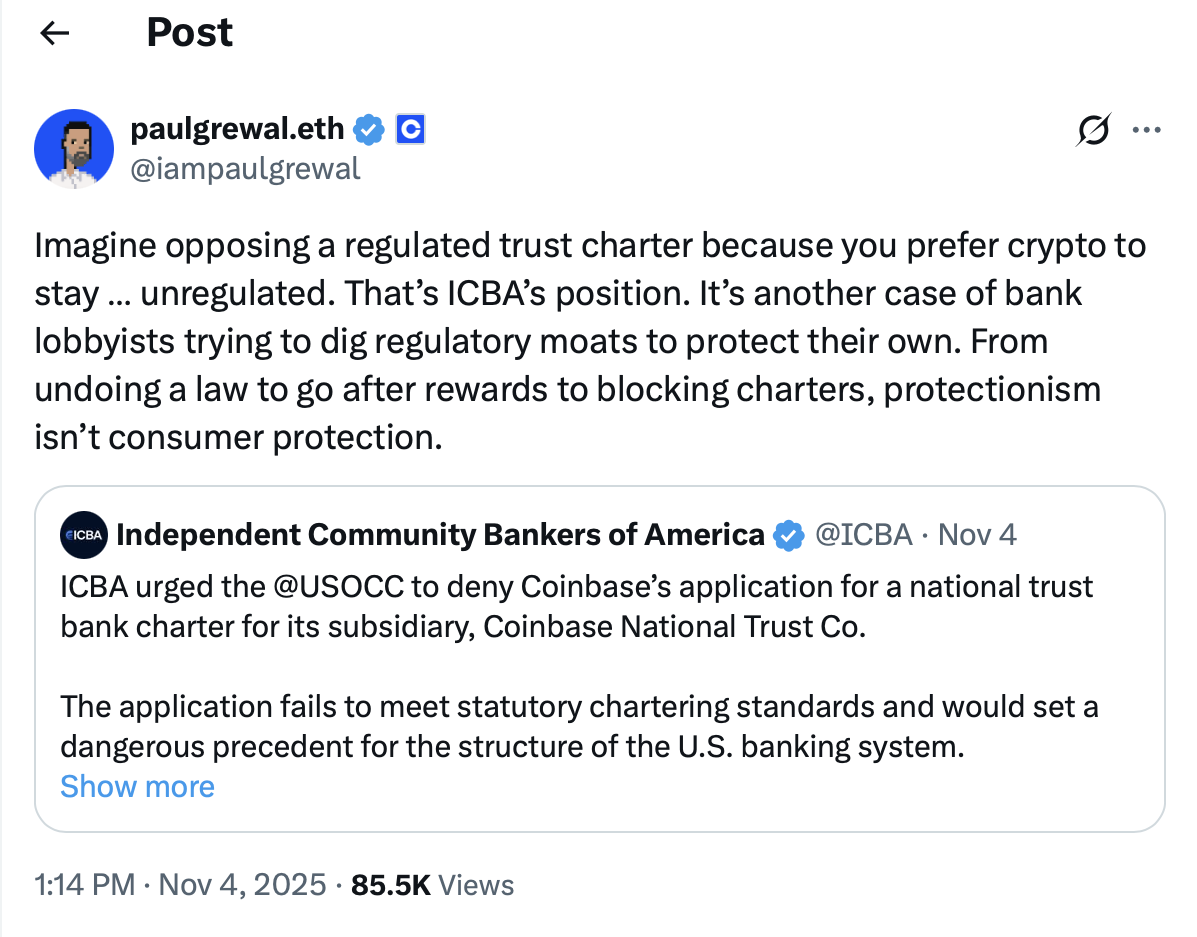
Banks have also pushed back directly against Coinbase. In November, the Independent Community Bankers of America urged the Office of the Comptroller of the Currency to reject the exchange’s application for a national trust charter, arguing that Coinbase’s crypto-custody model is untested.
Paul Grewal, the chief legal officer at Coinbase, responded on X:
“It’s another case of bank lobbyists trying to dig regulatory moats to protect their own. From undoing a law to go after rewards to blocking charters, protectionism isn’t consumer protection.”
Magazine: How Neal Stephenson ‘invented’ Bitcoin in the ‘90s: Author interview