


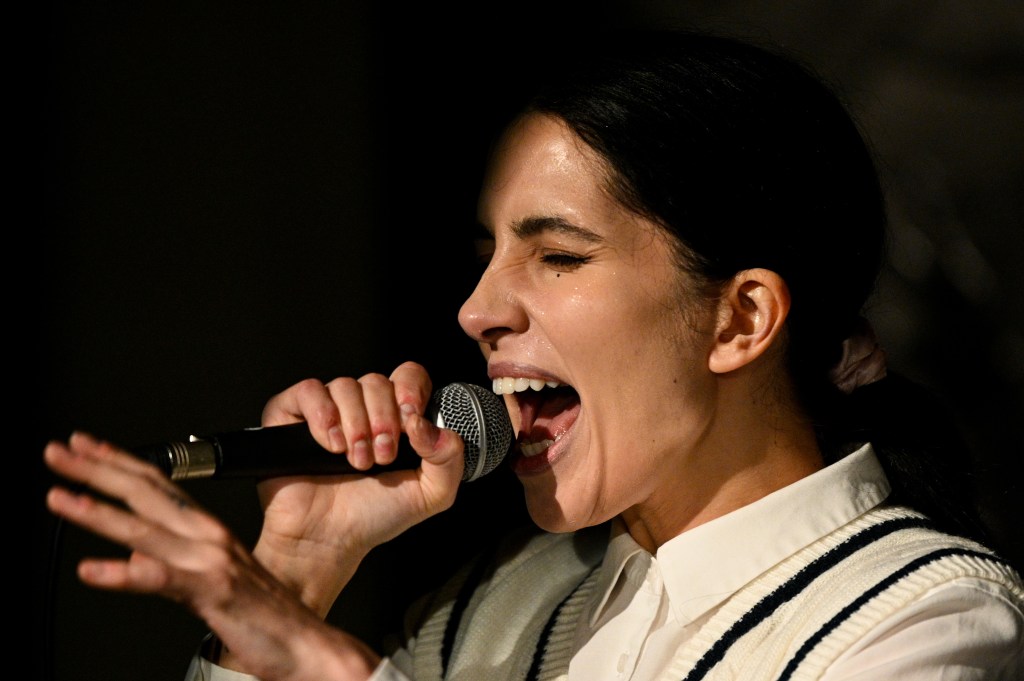
Russia’s justice ministry is trying to get Pussy Riot, the feminist punk rock art collective, designated as an extremist organization. A hearing is set for December 15 at Moscow’s Tverskoy Court after prosecutor general Alexander Gutsan filed a lawsuit with the intention of banning the group’s activities in Russia. The move came during the durational performance of Pussy Riot’s creator, Nadya Tolokonnikova, called Police State at MCA Chicago.
Members of the Russian art group have previously been labeled as foreign agents, criminals, and terrorists, and even added to an international wanted list, but the lawsuit is the first time Pussy Riot is facing official allegations of extremism.
“In other countries, you might even get supported by your government or get a booth at the Venice Biennale [for doing performances like ours],” US-based Tolokonnikova told ARTnews. “But in Russia, you get criminal cases or labeled as extremists. Well, we will take it as a badge of honor and our own version of a Venice booth… a trophy to bring about the fall of [Russia’s] regime with truth and laughter.”
She added that “Russians, with their proud memories of World War II and defeating Nazis, may need to be reminded of the folly of calling art movements ‘extremist’ or ‘degenerate.’”
Police State, which ran from November 25 to 30, saw Tolokonnikova—who was imprisoned by the Russian government on charges of “hooliganism motivated by religious hatred” from 2012 to 2013—transform MCA Chicago’s Edlis Neeson Theater into a replica Russian prison cell. She did not leave the installation for the entire five-day performance, “sewing garments as she did in prison, while creating a new, live immersive soundscape that ranges from eerie lullabies to harsh bursts of noise,” MCA Chicago’s exhibition notes read. “Lining the interior walls of her cell are reproductions of artworks originally sent to Tolokonnikova by current and formerly incarcerated Russian, Belarusian, and American political prisoners—implicating the concerns of the project far beyond Russia.”
Tolokonnikova’s previous performance of Police State was shut down at the Museum of Contemporary Art (MOCA) in Los Angeles in June after three days when President Donald Trump sent National Guard troops to quell protests against immigration raids, overriding California governor Gavin Newsom’s objections. She told the Guardian at the time that the situation “felt like I had entered a wormhole,” adding that she wanted to be out on the streets but decided to finish her performance while live-streaming audio of the protests outside into her prison cell.
In September, a Moscow court sentenced five members of Pussy Riot to prison sentences ranging from eight to 13 years, on charges of spreading “fakes” about the Russian military via their videos and performances. In 2023, Tolokonnikova was placed on Russia’s wanted list after the Kremlin launched a criminal case against her for offending religious beliefs. The move came after her performance titled Putin’s Ashes in which she filmed herself and 11 other women wearing balaclavas torching a ten-foot portrait of Putin in the desert.
“[Putin] probably didn’t like that… I guess we got enough attention to scare him as we rallied allies in the West who were willing to stand up to Putin and also to aid Ukraine,” Tolokonnikova said at the time.

