


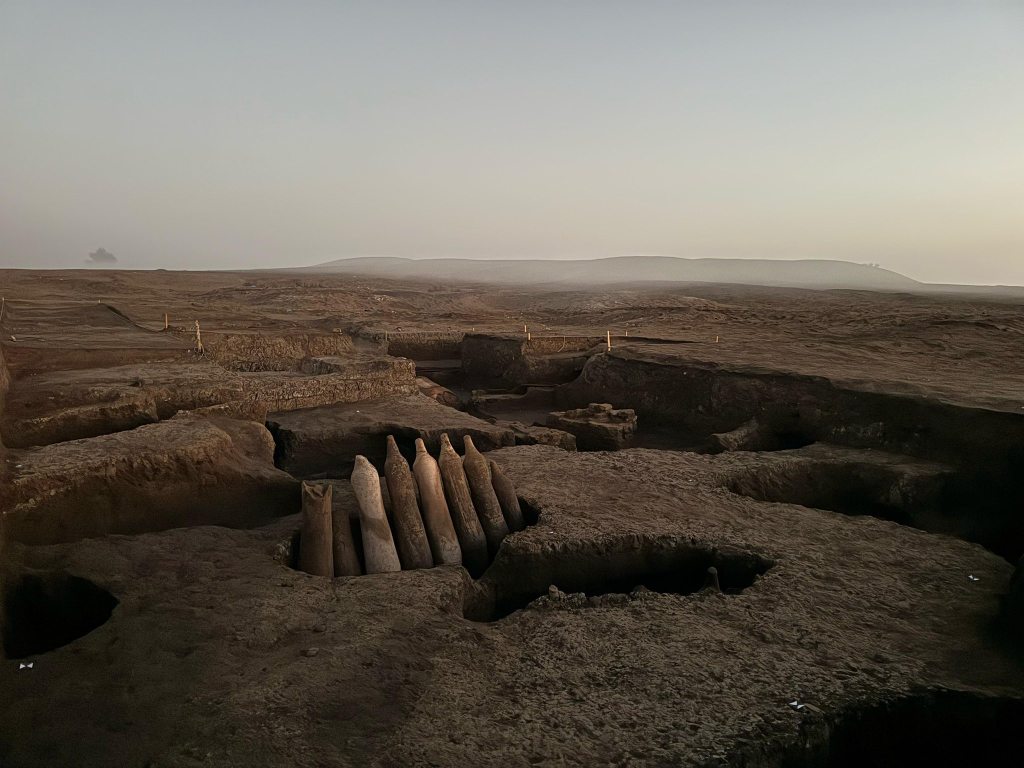
An international team of archaeologists from Egypt’s Supreme Council of Antiquities and Italy’s University of Padua has uncovered several industrial workshops and a burial complex in Egypt’s western Nile Delta region. The discovery took place across two interconnected archaeological sites in the Beheira Governorate: Kom Al-Ahmar and Kom Wasit.
The Egyptian daily newspaper Al-Ahram reported the news on December 30. The industrial complex is from the early Ptolemaic Period, around 300 BCE, and the nearby necropolis is from the subsequent Roman Period. The discovery includes remains of a large building subdivided into six rooms.
Archaeologists found nearly 10,000 fish bones in two of the rooms, indicating that the facility was used for salted fish production, an important manufacturing activity during this time period. Based on other artifacts—pottery fragments, imported jars, amulets, and tools—the other rooms were used for other types of manufacturing.
The Roman era burial site includes remains of 23 men, women, children, and adolescents, interred in a variety of ways: in-ground burials, individuals buried in coffins made of pottery, and children buried in large clay jars called amorpha.
Mohamed Ismail Khaled, secretary general of the Supreme Council of Antiquities, observed that “the discoveries enrich research into settlement patterns, funerary traditions, and industrial production, while offering new perspectives on regional interactions from the Late Period through the Roman and early Islamic eras.”
The group from the University of Padua plans to further analyze the human remains to learn more about the individuals’ age, diet, and health. Meanwhile, many of the non-human artifacts (tools, pottery, jewelry) are being moved to the recently opened Grand Egyptian Museum near Giza.